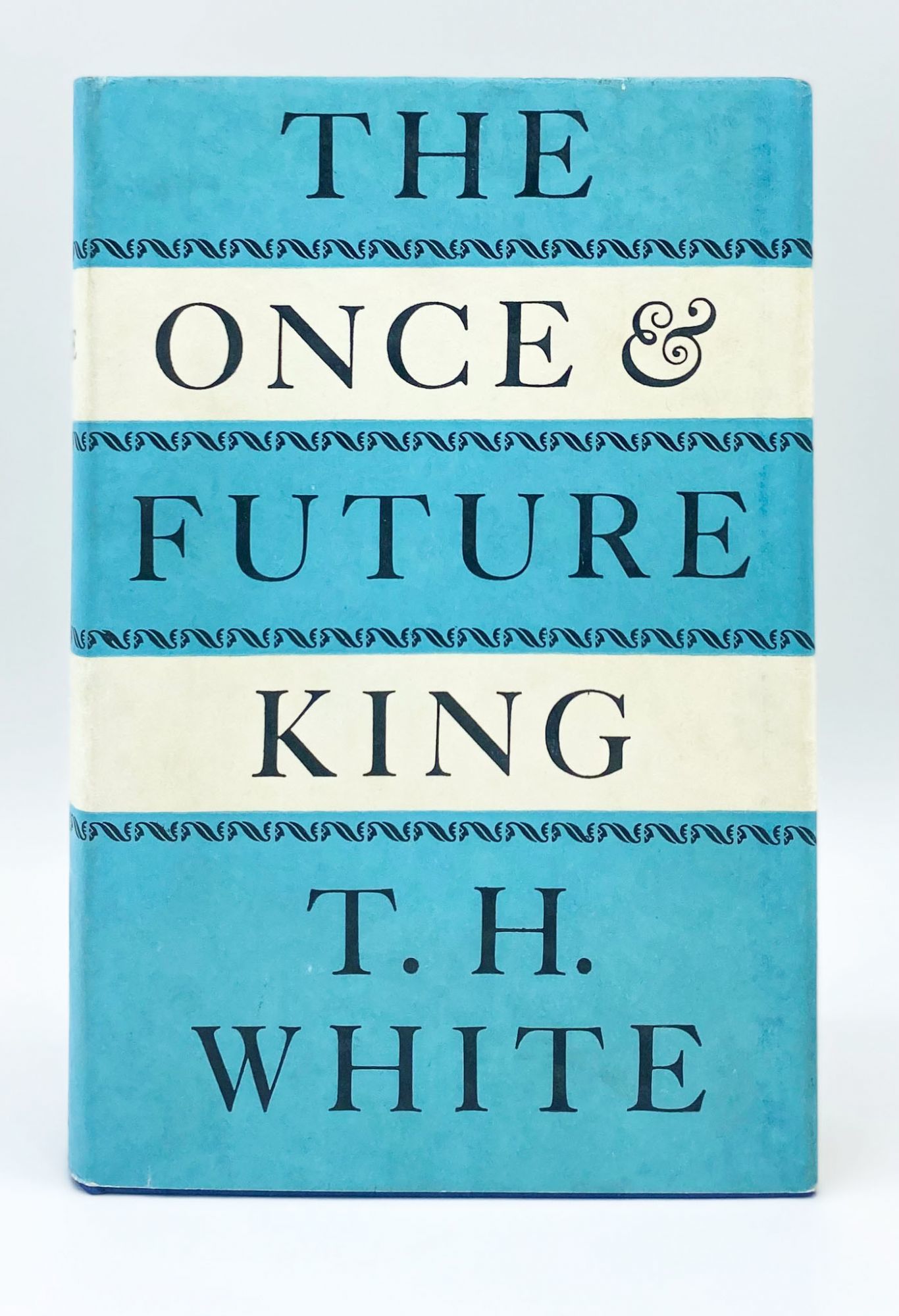
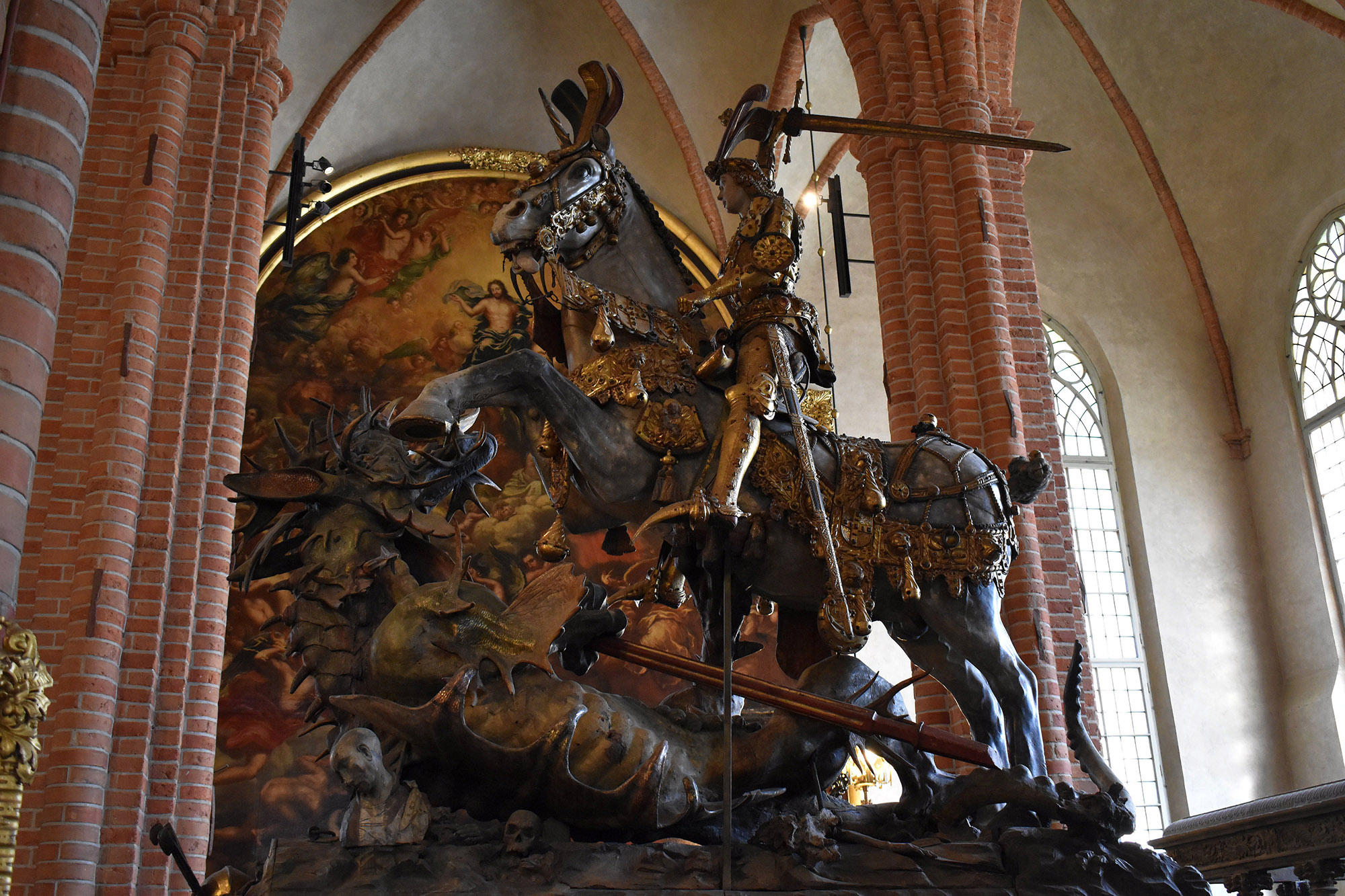
➕ T.H. White, The Once and Future King, 1958

“What were you thinking?”
“Oh, it was not anything. I was thinking about Kay learning to be a knight.”
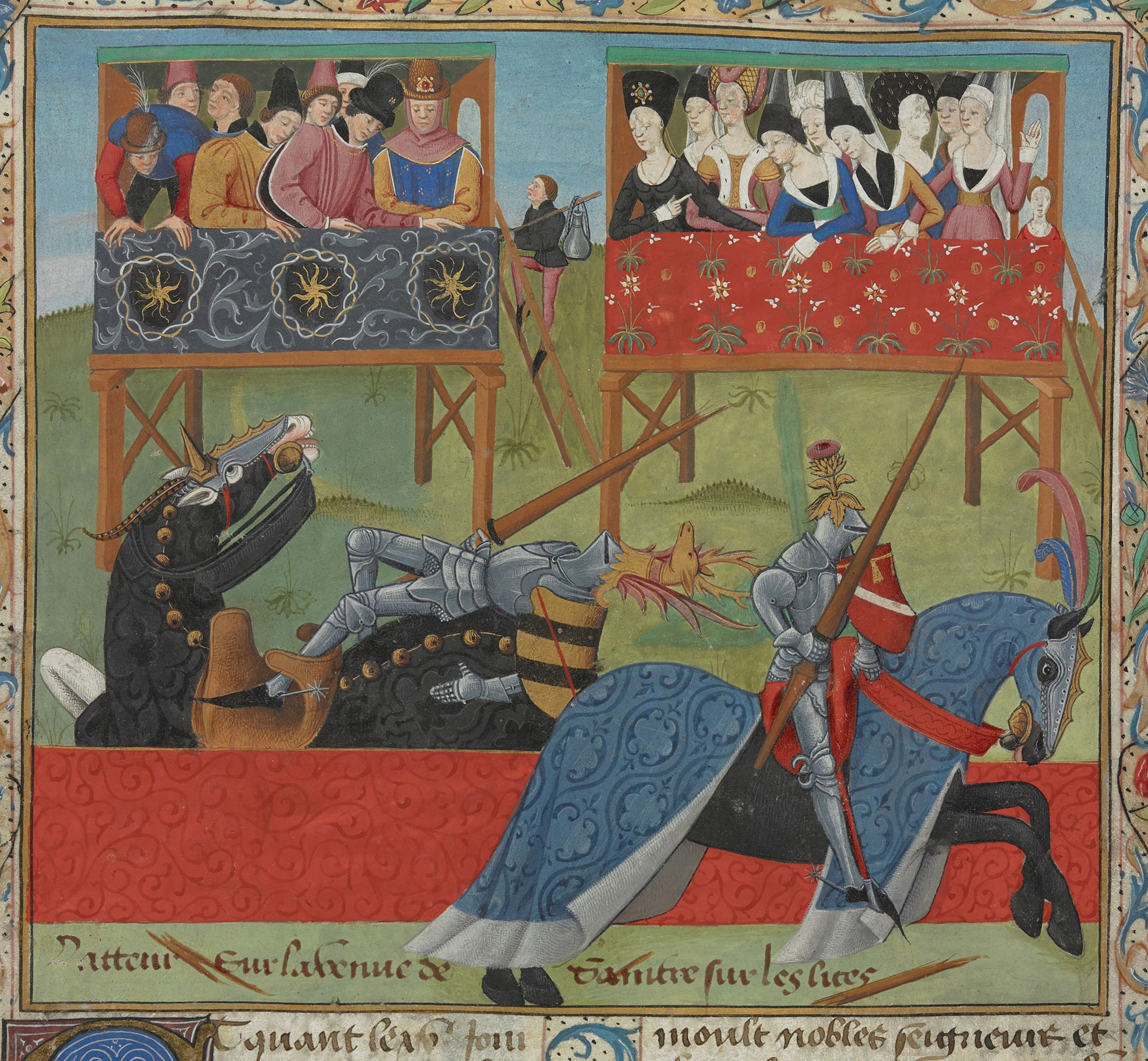
“And well you may grieve,” exclaimed Merlyn hotly. “A lot of brainless unicorns swaggering about and calling themselves educated just because they can push each other off a horse with a bit of stick! It makes me tired. Why, I believe Sir Ector would have been gladder to get a by-our-lady tilting blue for your tutor, that swings himself along on his knuckles like an anthropoid ape, rather than a magician of known probity and international reputation with first-class honours from every European university. The trouble with the Norman Aristocracy is that they are games-mad, that is what it is, games-mad.”
He broke off indignantly and deliberately made the sergeant’s ears flap slowly twice, in unison.
“I was not thinking quite about that,” said the Wart. “As a matter of fact, I was thinking how nice it would be to be a knight, like Kay.”
“Well, you will be one soon enough, won’t you?” asked the old man, impatiently.
Wart did not answer.
“Won’t you?”
Merlyn turned round and looked closely at the boy through his spectacles.
“What is the matter now?” he enquired nastily. His inspection had shown him that his pupil was trying not to cry, and if he spoke in a kind voice he would break down and do it.
“I shall not be a knight,” replied the Wart coldly. Merlyn’s trick had worked and he no longer wanted to weep: he wanted to kick Merlyn. “I shall not be a knight because I am not a proper son of Sir Ector’s. They will knight Kay, and I shall be his squire.”
Merlyn’s back was turned again, but his eyes were bright behind his spectacles. “Too bad,” he said, without commiseration.


Another thing was the riot. It was all very well for the crack hunts in practically artificial forests like those at Windsor, where the King hunted, but it was a different thing in the Forest Sauvage. Suppose His Majesty’s famous hounds were to go runnin’ riot after a unicorn or something? Everybody knew that you could never catch a unicorn without a young virgin for bait (in which case the unicorn meekly laid its white head and mother-of-pearl horn in her lap) and so the puppies would go chargin’ off into the forest for leagues and leagues, and never catch it, and get lost, and then what would Sir Ector say to his sovereign? It was not only unicorns. There was the Beast Glatisant that everybody had heard so much about. If you had the head of a serpent, the body of a leopard, the haunches of a lion, and were footed like a hart, and especially if you made a noise like thirty couple of hounds questin’, it stood to reason that you would account for an excessive number of royal puppies before they pulled you down. Serve them right too. And what would King Pellinore say if Master William Twyti did succeed in killing his beast? Then there were the small dragons which lived under stones and hissed like kettles—dangerous varmints, very. Or suppose they were to come across one of the really big dragons? Suppose they was to run into a griffin?
Sir Ector considered the prospect moodily for some time, then began to feel better. It would be a jolly good thing, he concluded, if Master Twyti and his beastly dogs did meet the Questing Beast, yes, and get eaten up by it too, every one.


It was Christmas night, the eve of the Boxing Day Meet. You must remember that this was in the old Merry England of Gramarye, when the rosy barons ate with their fingers, and had peacocks served before them with all their tail feathers streaming, or boars’ heads with the tusks stuck in again—when there was no unemployment because there were too few people to be unemployed—when the forests rang with knights walloping each other on the helm, and the unicorns in the wintry moonlight stamped with their silver feet and snorted their noble breaths of blue upon the frozen air. Such marvels were great and comfortable ones. But in the Old England there was a greater marvel still. The weather behaved itself.


On top of this, there was a trouble which distressed the children in particular. Queen Morgause had set her cap at the visitors.
“What was our mother at doing,” asked Gawaine, as they made their way toward St. Toirdealbhach’s cell one morning, “with the knights on the mountain?”
Gaheris answered with some difficulty, after a long pause: “They were at hunting a unicorn.”
“How do you do that?”
“There must be a virgin to attract it.”
“Our mother,” said Agravaine, who also knew the details, “went on a unicorn hunt, and she was the virgin for them.”
His voice sounded strange as he made this announcement.
Gareth protested: “I did not know she was wanting a unicorn. She has never said so.”
Agravaine looked at him sideways, cleared his throat and quoted: “Half a word is sufficient to the wise man.”
“How do you know this?” asked Gawaine.
“We listened.”
They had a way of listening on the spiral stairs, during the times when they were excluded from their mother’s interest.
Gaheris explained, with unusual freedom since he was a taciturn boy:
“She told Sir Grummore that this King’s lovesick melancholy could be dispelled by interesting him in his old pursuits. They were at saying that this King is in the habit of hunting a Beast which has become lost. So she said that they were to hunt a unicorn instead, and she would be the virgin for them. They were surprised, I think.”


The boys sat round the door without surprise, waiting for something else to happen. They considered in their minds the questions of wells, witches, unicorns and the practices of mothers.
“I make this proposition,” said Gareth unexpectedly, “my heroes, that we have a unicorn hunt of our own!”
They looked at him.
“It would be better than not having anything. We have not seen our Mammy for one week.”
“She has forgotten us,” said Agravaine bitterly.
“She has not so. You are not to speak in that way of our mother.”
“It is true. We have not been to serve at dinner even.”
“It is because she has a necessity to be hospitable to these knights.”
“No, it is not.”
“What is it, then?”
“I will not say.”
“If we could do a unicorn hunt,” said Gareth, “and bring this unicorn which she requires, perhaps we would be allowed to serve?”
They considered the idea with a beginning of hope.

“St. Toirdealbhach,” they shouted, “come out again! We want to catch a unicorn.”
The saint put his head out of the hole and examined them suspiciously.
“What is a unicorn? What are they like? How do you catch them?”
He nodded the head solemnly and vanished for the second time, to return on all fours in a few moments with a learned volume, the only secular work in his possession. Like most saints, he made his living by copying manuscripts and drawing pictures for them.
“You need a maid for bait,” they told him.
“We have goleor of maids,” said Gareth. “We could take any of the maids, or cook.”
“They would not come.”
“We could take the kitchenmaid. We could make her to come.”
“And then, when we have caught the unicorn which is wanted, we will bring it home in triumph and give it to our mother! We will serve at supper every night!”
“She will be pleased.”
“Perhaps after supper, whatever the event.”
“And Sir Grummore will knight us. He will say, ‘Never has such a doughty deed been done, by my halidome!'”
St. Toirdealbhach laid the precious book on the grass outside his hole. The grass was sandy and had empty snail shells scattered over it, small yellowish shells with a purple spiral. He opened the book, which was a Bestiary called Liber de Natura Quorundam Animalium, and showed that it had pictures on every page.
They made him turn the vellum quickly, with its lovely Gothic manuscript, skipping the enchanting Griffins, Bonnacons, Cocodrills, Manticores, Chaladrii, Cinomulgi, Sirens, Peridexions, Dragons, and Aspidochelones. In vain for their eager glances did the Antalop rub its complicated horns against the tamarisk tree—thus, entangled, becoming a prey to its hunters—in vain did the Bonnacon emit its flatulence in order to baffle the pursuers. The Peridexions, sitting on trees which made them immune to dragons, sat unnoticed. The Panther blew out his fragrant breath, which attracted his prey, without interest for them. The Tigris, who could be deceived by throwing down a glass ball at its feet, in which, seeing itself reflected, it thought to see its own cubs—the Lion, who spared prostrate men or captives, was afraid of white cocks, and brushed out his own tracks with a foliated tail—the Ibex, who could bound down from mountains unharmed because he bounced upon his curly horns—the Yale, who could move his horns like ears—the She-Bear who was accustomed to bear her young as lumps of matter and lick them into whatever shape she fancied afterwards—the Chaladrius bird who, if facing you when it sat on your bedrail, showed that you were going to die—the Hedgehogs who collected grapes for their progeny by rolling on them, and brought them back on the end of their prickles—even the Aspidochelone, who was a large whale-like creature with seven fins and a sheepish expression, to whom you were liable to moor your boat in mistake for an island if you were not careful: even the Aspidochelone scarcely detained them. At last he found them the place at the Unicorn, called by the Greeks, Rhinoceros.
It seemed that the Unicorn was as swift and timid as the Antalop, and could only be captured in one way. You had to have a maid for bait, and, when the Unicorn perceived her alone, he would immediately come to lay his horn in her lap. There was a picture of an unreliable-looking virgin, holding the poor creature’s horn in one hand, while she beckoned to some spearmen with the other. Her expression of duplicity was balanced by the fatuous confidence with which the Unicorn regarded her.


Gawaine hurried off, as soon as the instructions had been read and the picture digested, to fetch the kitchenmaid without delay.
“Now then,” he said, “you have to come with us on the mountain, to catch a unicorn.”
“Oh, Master Gawaine,” cried the maid he had caught hold of, whose name was Meg.
“Yes, you have. You are to be the bait whatever. It will come and put its head in your lap.”
Meg began to weep.
“Now then, do not be silly.”
“Oh, Master Gawaine, I do not want a unicorn. I have been a decent girl, I have, and there is all the washing up to do, and if Mistress Truelove do catch me playing at truant I shall get stick, Master Gawaine, that I will.”
He took her firmly by the plaits and led her out.
In the clean bog-wind of the high tops, they discussed the hunt. Meg, who cried incessantly, was held by the hair to prevent her from running away, and occasionally passed from one boy to the other, if the one who was holding her happened to want both hands for gestures.
“Now then,” said Gawaine. “I am the captain. I am the oldest, so I am the captain.”
“I thought of it,” said Gareth.
“The question is, it says in the book that the bait must be left alone.”
“She will run away.”
“Will you run away, Meg?”
“Yes, please, Master Gawaine.”
“There.”
“Then she must be tied.”
“Oh, Master Gaheris, if it is your will, need I be tied?”
“Close your mouth. You are only a girl.”
“There is nothing to tie her with.”
“I am the captain, my heroes, and I command that Gareth runs back home to fetch some rope.”
“That I will not.”
“But you will destroy everything, if you do not do so.”
“I do not see why I should have to go. I thought of it.”
“Then I command our Agravaine to go.”
“Not I.”
“Let Gaheris go.”
“I will not.”
“Meg, you wicked girl, you are not to run away, do you hear?”
“Yes, Master Gawaine. But, oh, Master Gawaine…”
“If we could find a strong heather root,” said Agravaine, “we could tie her pigtails together, round the other side of it.”
“We will do that.”
“Oh, oh!”
After they had secured the virgin, the four boys stood round her, discussing the next stage. They had abstracted real boar-spears from the armoury, so they were properly armed.
“This girl,” said Agravaine, “is my mother. This is what our Mammy was at doing yesterday. And I am going to be Sir Grummore.”
“I will be Pellinore.”
“Agravaine can be Grummore if he wants to be, but the bait has got to be left alone. It says so in the book.”
“Oh, Master Gawaine, oh, Master Agravaine!”
“Stop howling. You will frighten the unicorn.”
“And then we must go away and hide. That is why our mother did not catch it, because the knights stayed with her.”
“I am going to be Finn MacCoul.”
“I shall be Sir Palomides.”
“Oh, Master Gawaine, pray do not leave me alone.”
“Hold in your noise,” said Gawaine. “You are silly. You ought to be proud to be the bait. Our mother was, yesterday.”
Gareth said, “Never mind, Meg, do not cry. We will not let it hurt you.”
“After all, it can only kill you,” said Agravaine brutally.
At this the unfortunate girl began to weep more than ever.
“Why did you say that?” asked Gawaine angrily. “You always try to frighten people. Now she is at howling more than before.”
“Look,” said Gareth. “Look, Meg. Poor Meg, do not cry. It will be with me to let you have some shots with my catapult, when we go home.”
“Oh, Master Gareth!”
“Ach, come your ways. We cannot bother with her.”
“There, there!”
“Oh, oh!”
“Meg,” said Gawaine, making a frightful face, “if you do not stop squealing, I will look at you like this.”
She dried her tears at once.
“Now,” he said, “when the unicorn comes, we must all rush out and stick it. Do you understand?”
“Must it be killed?”
“Yes, it must be killed dead.”
“I see.”
“I hope it will not hurt it,” said Gareth.
“That is the sort of foolish hope you would have,” said Agravaine.
“But I do not see why it should be killed.”
“So that we may take it home to our mother, you amadan.”
“Could we catch it,” asked Gareth, “and lead it to our mother, do you think? I mean, we could get Meg to lead it, if it was tame.”
Gawaine and Gaheris agreed to this.
“If it is tame,” they said, “it would be better to bring it back alive. That is the best kind of Big Game Hunting.”
“We could drive it,” said Agravaine. “We could hit it along with sticks.”
“We could hit Meg, too,” he added, as an afterthought.
Then they hid themselves in their ambush, and decided to keep silence. There was nothing to be heard except the gentle wind, the heather bees, the skylarks very high, and a few distant snuffles from Meg.


When the unicorn came, things were different from what had been expected. He was such a noble animal, to begin with, that he carried a beauty with him. It held all spellbound who were within sight.
The unicorn was white, with hoofs of silver and a graceful horn of pearl. He stepped daintily over the heather, scarcely seeming to press it with his airy trot, and the wind made waves in his long mane, which had been freshly combed. The glorious thing about him was his eye. There was a faint bluish furrow down each side of his nose, and this led up to the eye-sockets, and surrounded them in a pensive shade. The eyes, circled by this sad and beautiful darkness, were so sorrowful, lonely, gentle and nobly tragic, that they killed all other emotion except love.
The unicorn went up to Meg the kitchenmaid, and bowed his head in front of her. He arched his neck beautifully to do this, and the pearl horn pointed to the ground at her feet, and he scratched in the heather with his silver hoof to make a salute. Meg had forgotten her tears. She made a royal gesture of acknowledgment, and held her hand out to the animal.
“Come, unicorn,” she said. “Lay your head in my lap, if you like.”
The unicorn made a whinny, and pawed again with his hoof. Then, very carefully, he went down first on one knee and then on the other, till he was bowing in front of her. He looked up at her from this position, with his melting eyes, and at last laid his head upon her knee. He stroked his flat, white cheek against the smoothness of her dress, looking at her beseechingly. The whites of his eyes rolled with an upward flash. He settled his hind quarters coyly, and lay still, looking up. His eyes brimmed with trustfulness, and he lifted his near fore in a gesture of pawing. It was a movement in the air only, which said, “Now attend to me. Give me some love. Stroke my mane, will you, please?”
There was a choking noise from Agravaine in the ambush, and at once he was rushing toward the unicorn, with the sharp boar-spear in his hands. The other boys squatted upright on their heels, watching him.
Agravaine came to the unicorn, and began jabbing his spear into its quarters, into its slim belly, into its ribs. He squealed as he jabbed, and the unicorn looked to Meg in anguish. It leaped and moved suddenly, still looking at her reproachfully, and Meg took its horn in one hand. She seemed entranced, unable to help it. The unicorn did not seem able to move from the soft grip of her hand on its horn. The blood, caused by Agravaine’s spear, spurted out upon the blue-white coat of hair.
Gareth began running, with Gawaine close after him. Gaheris came last, stupid and not knowing what to do.
“Don’t!” cried Gareth. “Leave him alone. Don’t! Don’t!”
Gawaine came up, just as Agravaine’s spear went in under the fifth rib. The unicorn shuddered. He trembled in all his body, and stretched his hind legs out behind. They went out almost straight, as if he were doing his greatest leap—and then quivered, trembling in the agony of death. All the time his eyes were fixed on Meg’s eyes, and she still looked down at his.
“What are you doing?” shouted Gawaine. “Leave him alone. No harm at him.”
“Oh, Unicorn,” whispered Meg.
The unicorn’s legs stretched out horizontally behind him, and stopped trembling. His head dropped in Meg’s lap. After a last kick they became rigid, and the blue lids rose half over the eye. The creature lay still.
“What have you done?” cried Gareth. “You have killed him. He was beautiful.”
Agravaine bawled, “This girl is my mother. He put his head in her lap. He had to die.”
“We said we would keep him,” yelled Gawaine. “We said we would take him home, and be allowed to supper.”
“Poor unicorn,” said Meg.
“Look,” said Gaheris, “I am afraid he is dead.”
Gareth stood square in front of Agravaine, who was three years older than he was and could have knocked him down quite easily. “Why did you do it?” he demanded. “You are a murderer. It was a lovely unicorn. Why did you kill it?”
“His head was in our mother’s lap.”
“It did not mean any harm. Its hoofs were silver.”
“It was a unicorn, and it had to be killed. I ought to have killed Meg too.”
“You are a traitor,” said Gawaine. “We could have taken it home, and been allowed to serve at supper.”
“Anyway,” said Gaheris, “now it is dead.”
Meg bowed her head over the unicorn’s forelock of white, and once again began to sob.
Gareth began stroking the head. He had to turn away to hide his tears. By stroking it, he had found out how smooth and soft its coat was. He had seen a near view of its eye, now quickly fading, and this had brought the tragedy home to him.
“Well, it is dead now, whatever,” said Gaheris for the third time. “We had better take it home.”
“We managed to catch one,” said Gawaine, the wonder of their achievement beginning to dawn on him.
“It was a brute,” said Agravaine.
“We caught it! We of ourselves!”
“Sir Grummore did not catch one.”
“But we did.”
Gawaine had forgotten about his sorrow for the unicorn. He began to dance round the body, waving his boar-spear and uttering horrible shrieks.
“We must have a gralloch,” said Gaheris. “We must do the matter properly, and cut its insides out, and sling it over a pony, and take it home to the castle, like proper hunters.”
“And then she will be pleased!”
“She will say, God’s Feet, but my sons are of mickle might!”
“We shall be allowed to be like Sir Grummore and King Pellinore. Everything will go well with us from now.”
“How must we set about the gralloch?”
“We cut out its guts,” said Agravaine.
Gareth got up and began to go away into the heather. He said, “I do not want to help cut him. Do you, Meg?”
Meg, who was feeling ill inside herself, made no answer. Gareth untied her hair—and suddenly she was off, running for all she was worth away from the tragedy, toward the castle. Gareth ran after her.
“Meg, Meg!” he called. “Wait for me. Do not run.”
But Meg continued to run, as swiftly as an antalop, with her bare feet twinkling behind her, and Gareth gave it up. He flung himself down in the heather and began to cry in earnest—he did not know why.


At the gralloch, the three remaining huntsmen were in trouble. They had begun to slit at the skin of the belly, but they did not know how to do it properly and so they had perforated the intestines. Everything had begun to be horrible, and the once beautiful animal was spoiled and repulsive. All three of them loved the unicorn in their various ways, Agravaine in the most twisted one, and, in proportion as they became responsible for spoiling its beauty, so they began to hate it for their guilt. Gawaine particularly began to hate the body. He hated it for being dead, for having been beautiful, for making him feel a beast. He had loved it and helped to trap it, so now there was nothing to be done except to vent his shame and hatred of himself upon the corpse. He hacked and cut and felt like crying too.
“We shall not ever get it done,” they panted. “How can we ever carry it down, even if we manage the gralloch?”
“But we must,” said Gaheris. “We must. If we do not, what will be the good? We must take it home.”
“We cannot carry it.”
“We have not a pony.”
“At a gralloch, they sling the beast over a pony.”
“We must cut his head off,” said Agravaine. “We must cut its head off somehow, and carry that. It would be enough if we took the head. We could carry it between us.”
So they set to work, hating their work, at the horrid business of hacking through its neck.


When the grisly spine was severed, the head was too heavy to carry. They got themselves in a mess, trying to lift it. Then Gawaine suggested that it had better be dragged with rope. There was none.
“We could drag it by the horn,” said Gareth. “At any rate we could drag and push it like that, so long as it was downhill.”
Only one of them at a time could get a good hold of the horn, so they took it in turns to do the hauling, while the others pushed behind when the head got snagged in a heather root or a drain. It was heavy for them, even in this way, so that they had to stop every twenty yards or so, to change over.
“When we get to the castle,” panted Gawaine, “we will prop it up in the seat in the garden. Our mother is bound to walk past there, when she goes for her walk before supper. Then we will stand in front of it until she is ready, and all will suddenly step back at once, and there it will be.”
“She will be surprised,” said Gaheris.
When they had at last got it down from the sloping ground, there was another hitch. They found that it was no longer possible to drag it on the flat land, because the horn did not give enough purchase.
In this emergency, for it was getting near to suppertime, Gareth voluntarily ran ahead to fetch a rope. The rope was tied round what remained of the head, and thus at last, with eyes ruined, flesh bruised and separating from the bones, the muddy, bloody, heather-mangled exhibit was conveyed on its last stage to the herb garden. They heaved it to the seat, and arranged its mane as well as they could. Gareth particularly tried to prop it up so that it would give a little idea of the beauty which he remembered.


The magic queen came punctually on her walk, conversing with Sir Grummore and followed by her lap dogs: Tray, Blanche and Sweetheart. She did not notice her four sons, lined up in front of the seat. They stood respectfully in a row, dirty, excited, their breasts beating with hope.
“Now!” cried Gawaine, and they stood aside.
Queen Morgause did not see the unicorn. Her mind was busy with other things. With Sir Grummore she passed by.
“Mother!” cried Gareth in a strange voice, and he ran after her, plucking at her skirt.
“Yes, my white one? What do you want?”
“Oh, Mother. We have got you a unicorn.”
“How amusing they are, Sir Grummore,” she said. “Well, my doves, you must run along and ask for your milk.”
“But, Mammy….”
“Yes, yes,” she said in a low voice. “Another time.”
And the Queen passed on with the puzzled knight of the Forest Sauvage, electrical and quiet. She had not noticed that her children’s clothes were ruined: had not even scolded them about that. When she found out about the unicorn later in the evening she had them whipped for it, for she had spent an unsuccessful day with the English knights.


All the saints came out of their beehives to see them off. All the Fomorians, Fir Bolg, Tuatha de Danaan, Old People and others waved to them without the least suspicion from cliffs, currachs, mountains, bogs and shell-mounds. All the red deer and unicorns lined the high tops to bid good-bye. The terns came with their forked tails from the estuary, squeaking away as if intent upon imitating an embarkation scene on the wireless—the white-bottomed wheatears and pipits flitted along beside them from whin to whin—the eagles, peregrines, ravens and chuffs made circles over them in the air—the peat smoke followed them as if anxious to make one last curl in the tips of their nostrils—the ogham stones and souterrains and promontory forts exhibited their prehistoric masonry in a blaze of sunlight—the sea-trout and salmon put their gleaming heads out of the water—the glens, mountains and heather-shoulders of the most beautiful country in the world joined the general chorus—and the soul of the Gaelic world said to the boys in the loudest of fairy voices: Remember Us!


“Gareth,” said the King.
The young man knelt down and took the King’s hand. He held it as if it were a banister or a life-line. He looked at Arthur with dull eyes, and did not cry.
“My mother is dead,” said Gareth.
“Who killed her?” asked the King, as if it were the natural question.
“My brother Agravaine.”
“What!”
The exclamation was from Lancelot.
“My brother has killed our mother, because he found her sleeping with a man.”
“Keep quiet, Lancelot, please,” said the King. Then to Gareth: “What did they do to Sir Lamorak?”
But Gareth had not finished the first part of his story.
“Agravaine cut off her head,” he said. “Like the unicorn.”
“The unicorn?”
“Please, Lancelot.”
“He killed our mother in her blood.”
“I am sorry.”
“I always knew he would,” said Gareth.
“Are you sure the news is true?”
“It is true. It is true. It was Agravaine who killed the unicorn.”
“Was Lamorak the unicorn?” asked the King gently. He did not know what his nephew was talking about, but he was anxious to help. “Is Lamorak dead?”
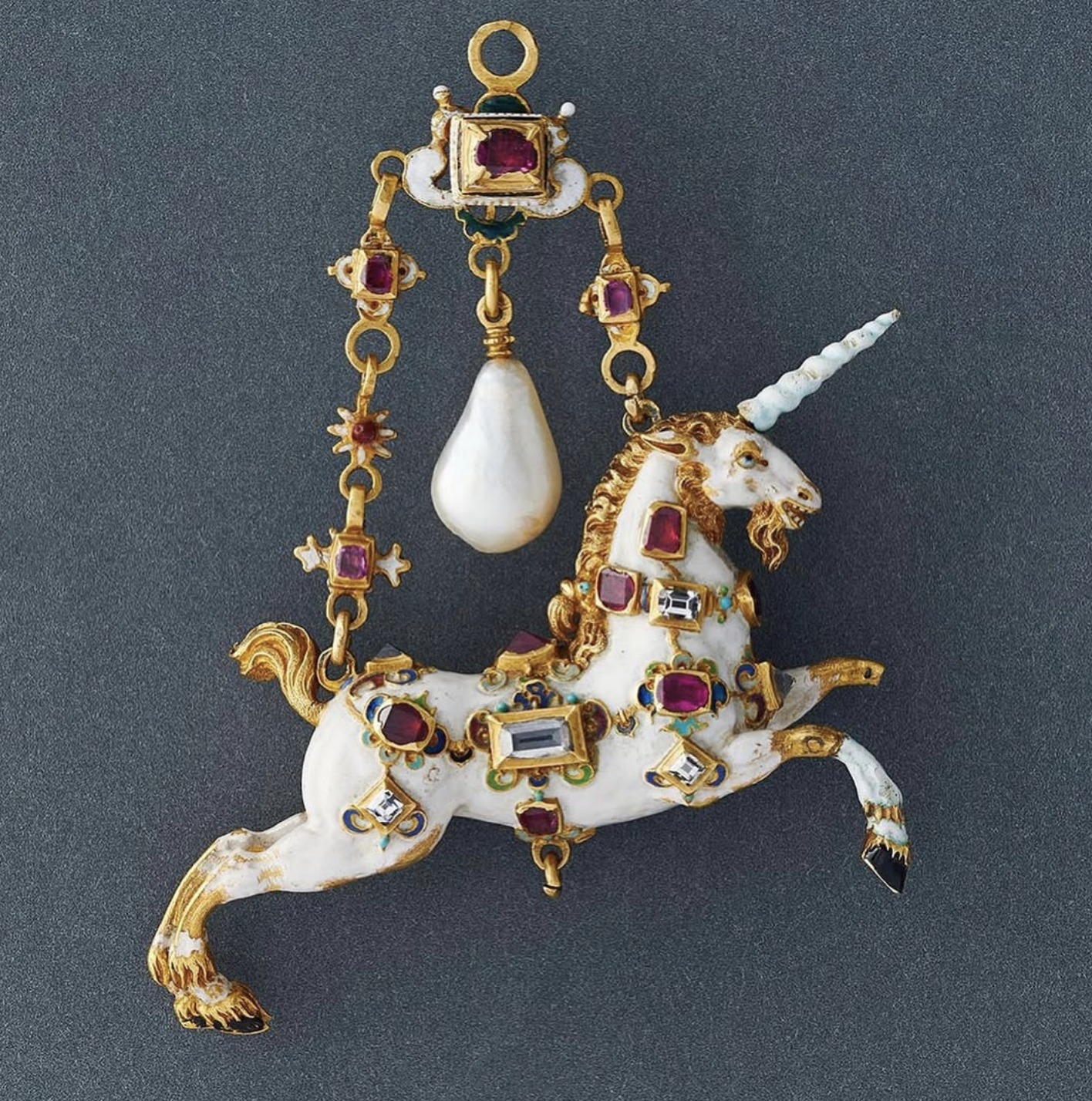
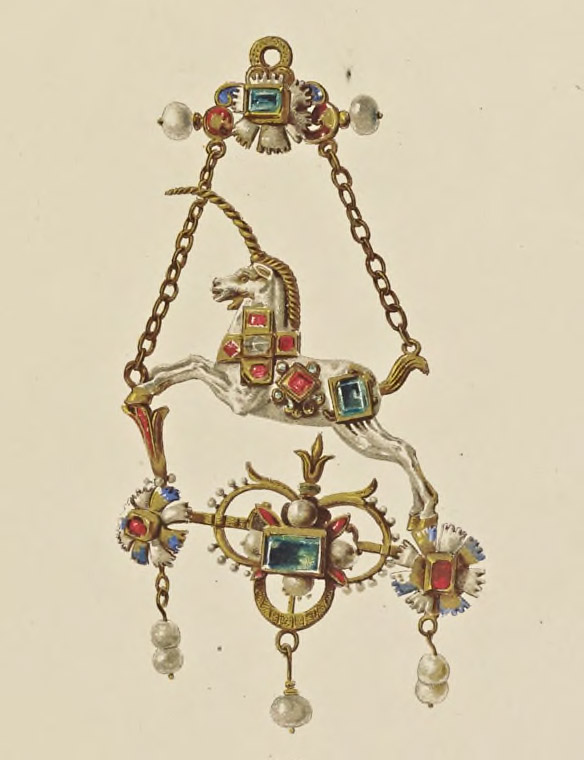
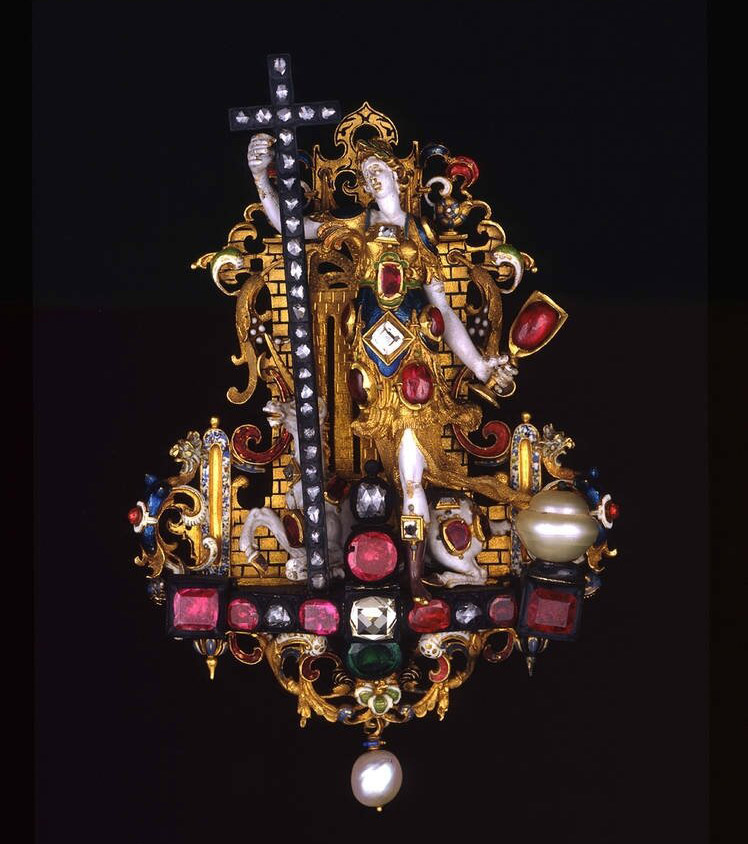
➕ Travaux d’orfèvre

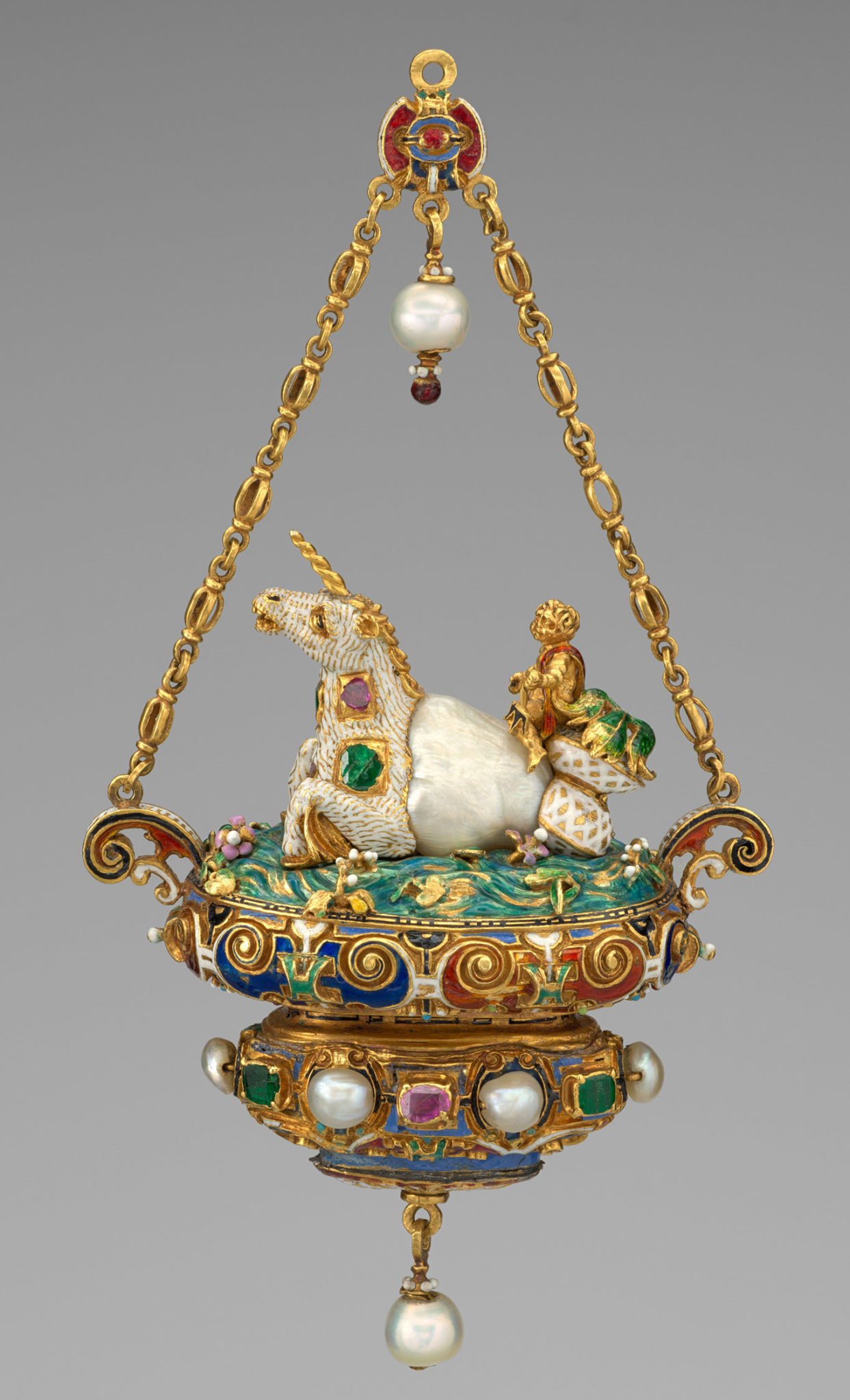
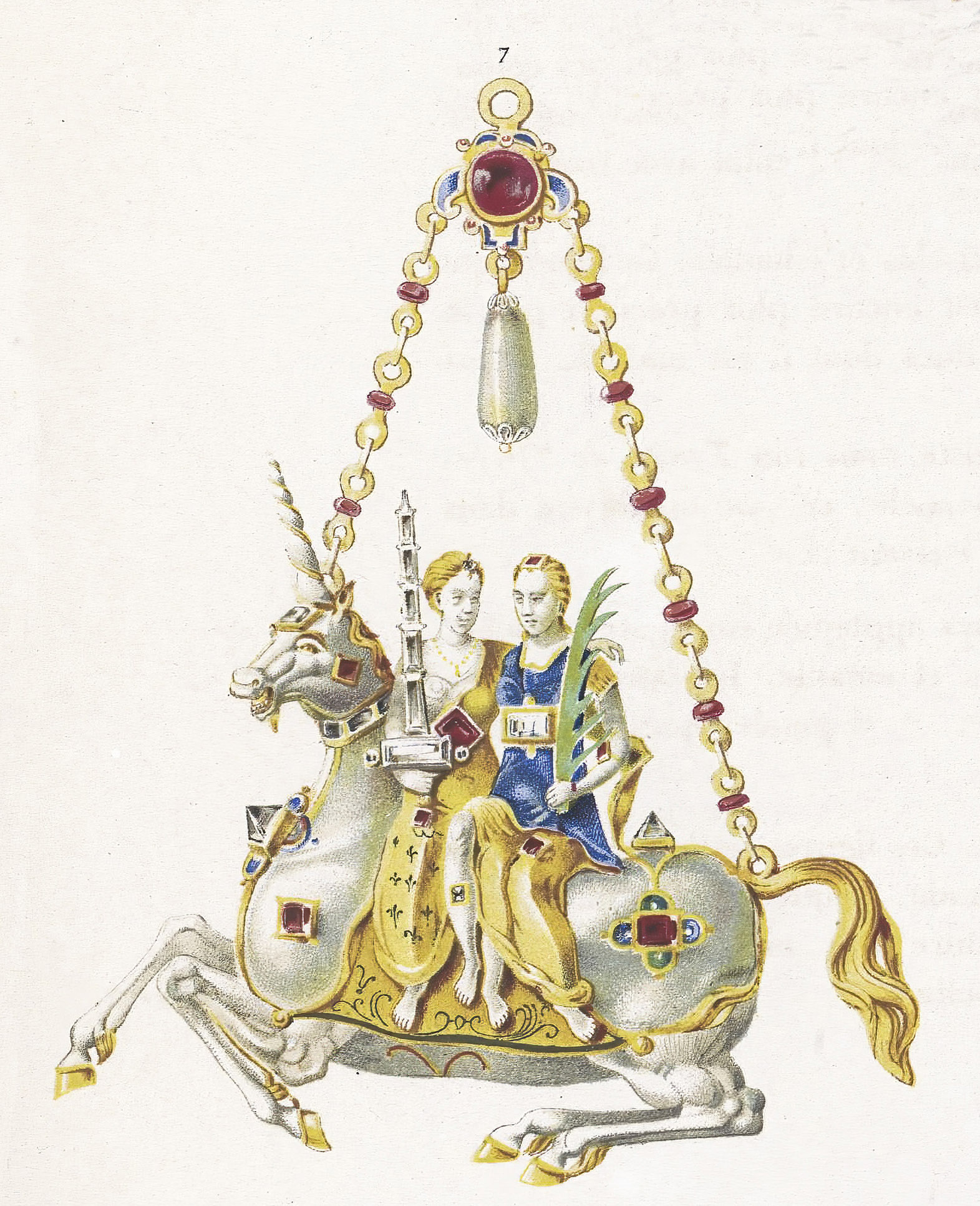
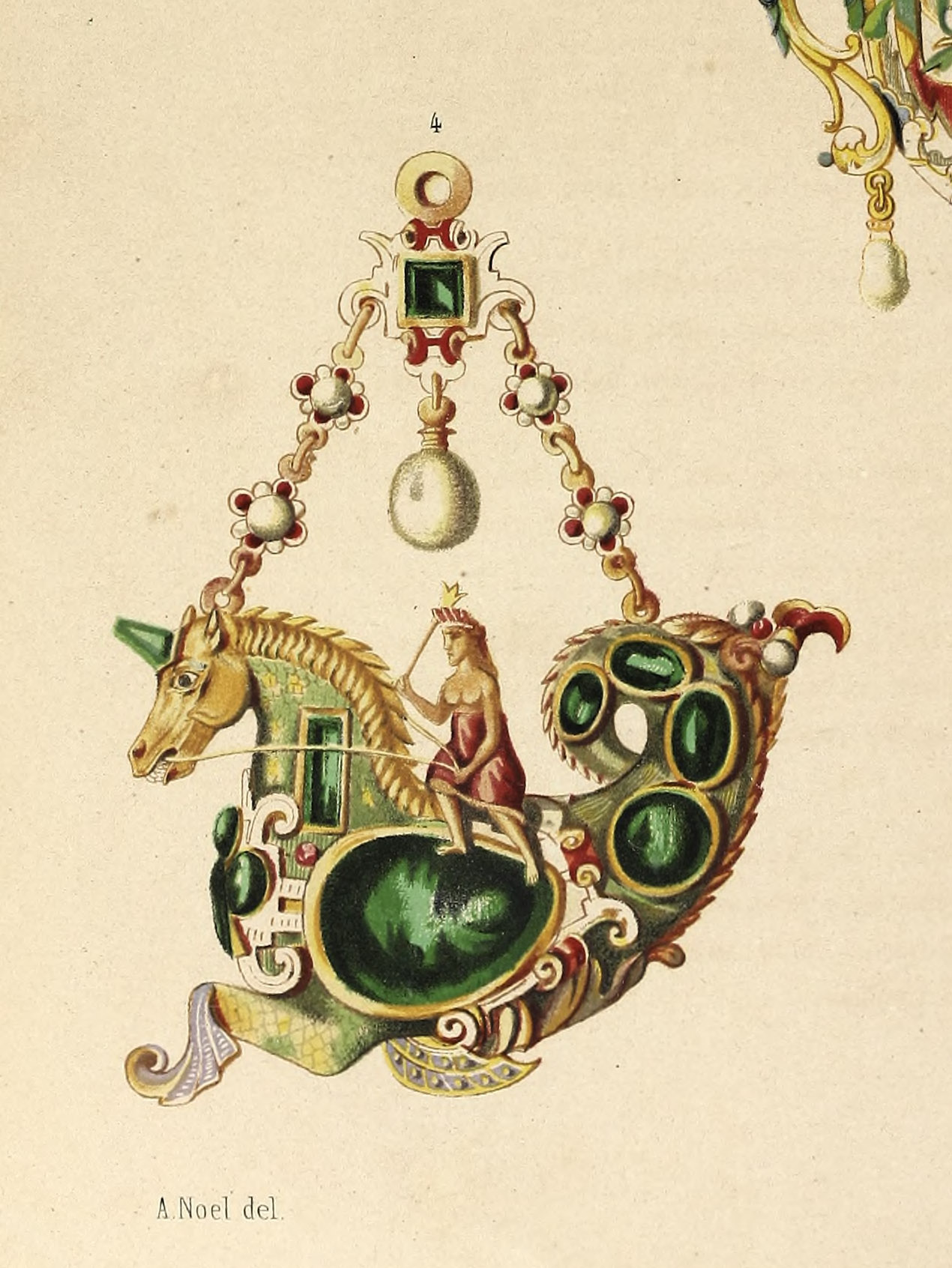
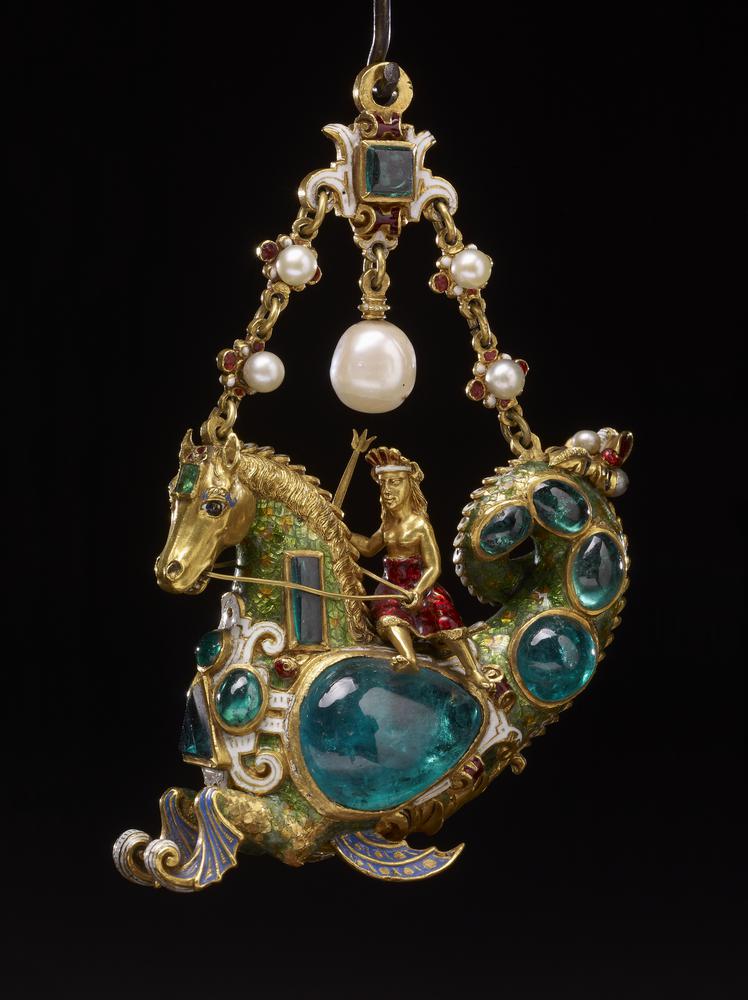
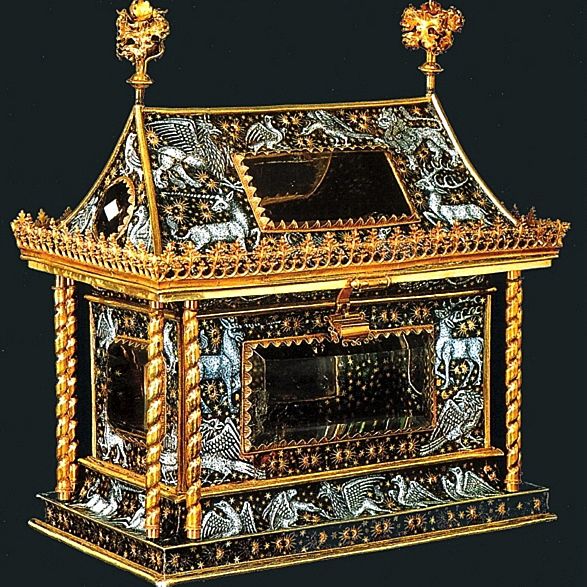
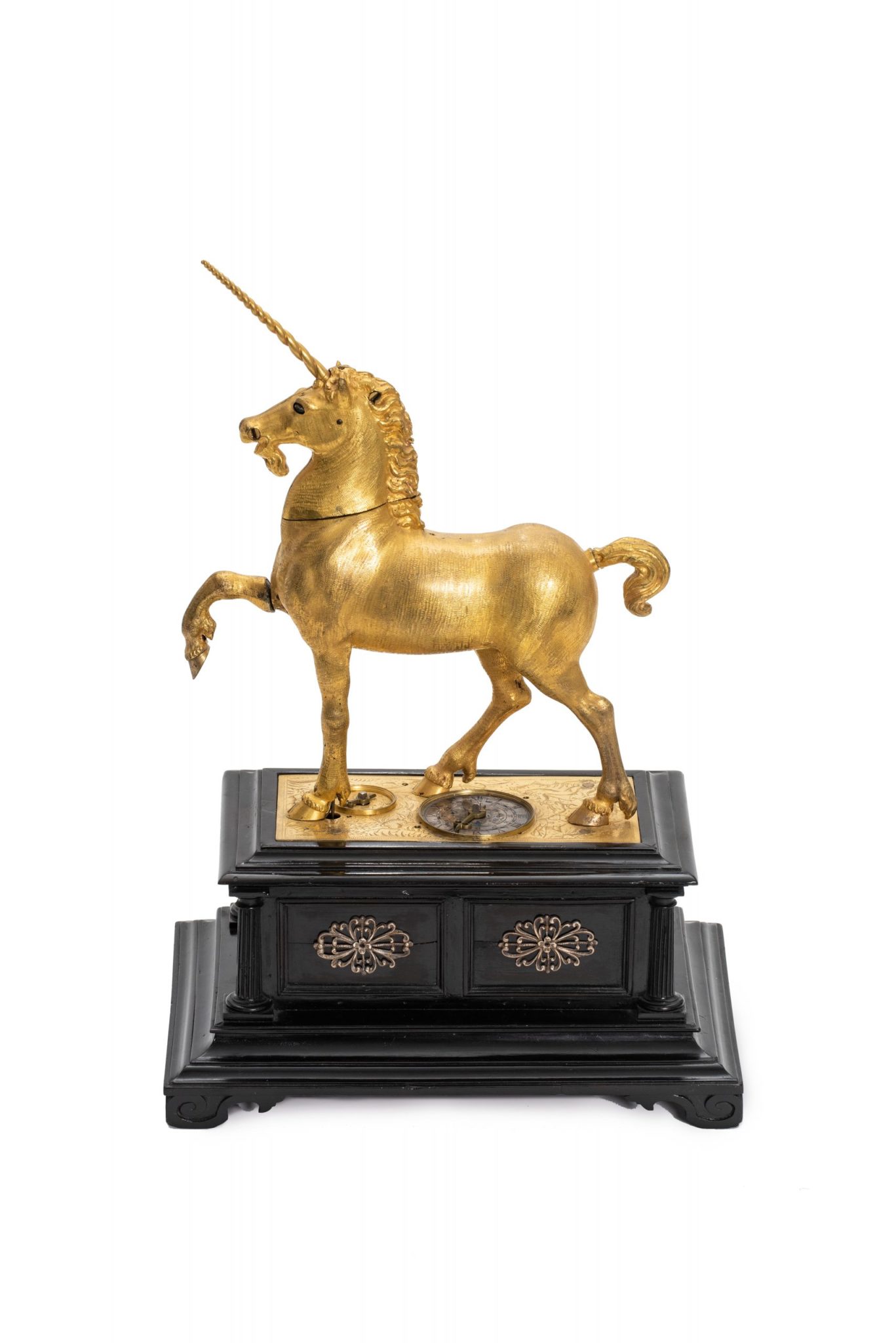
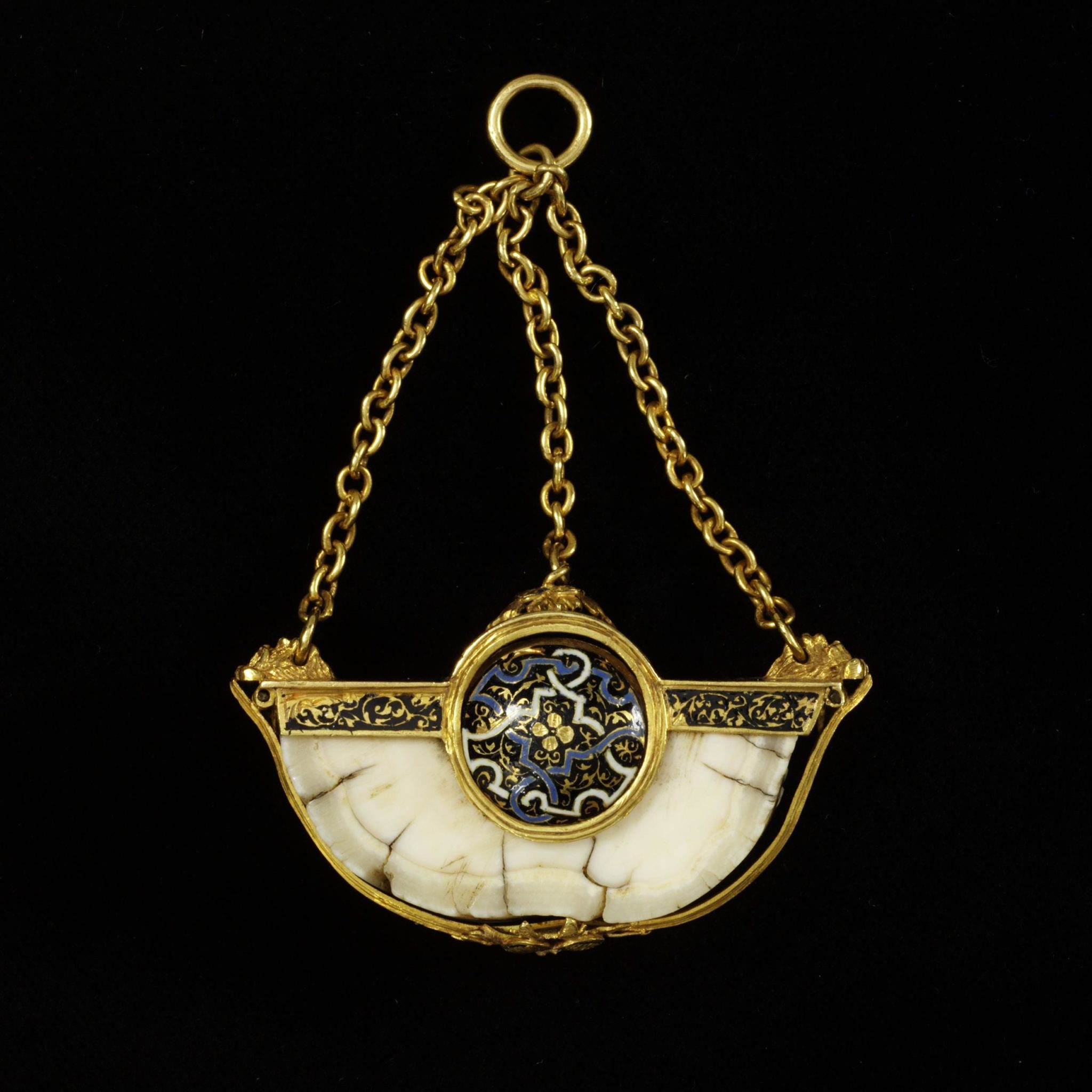
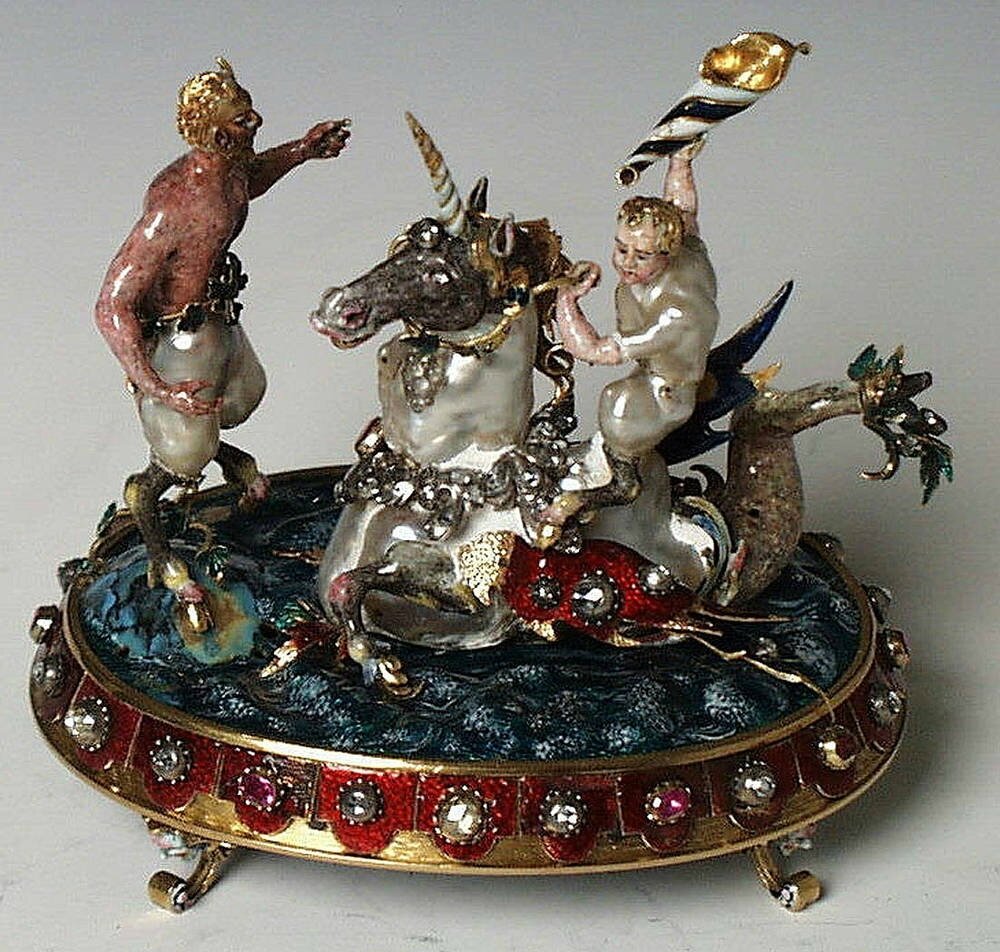
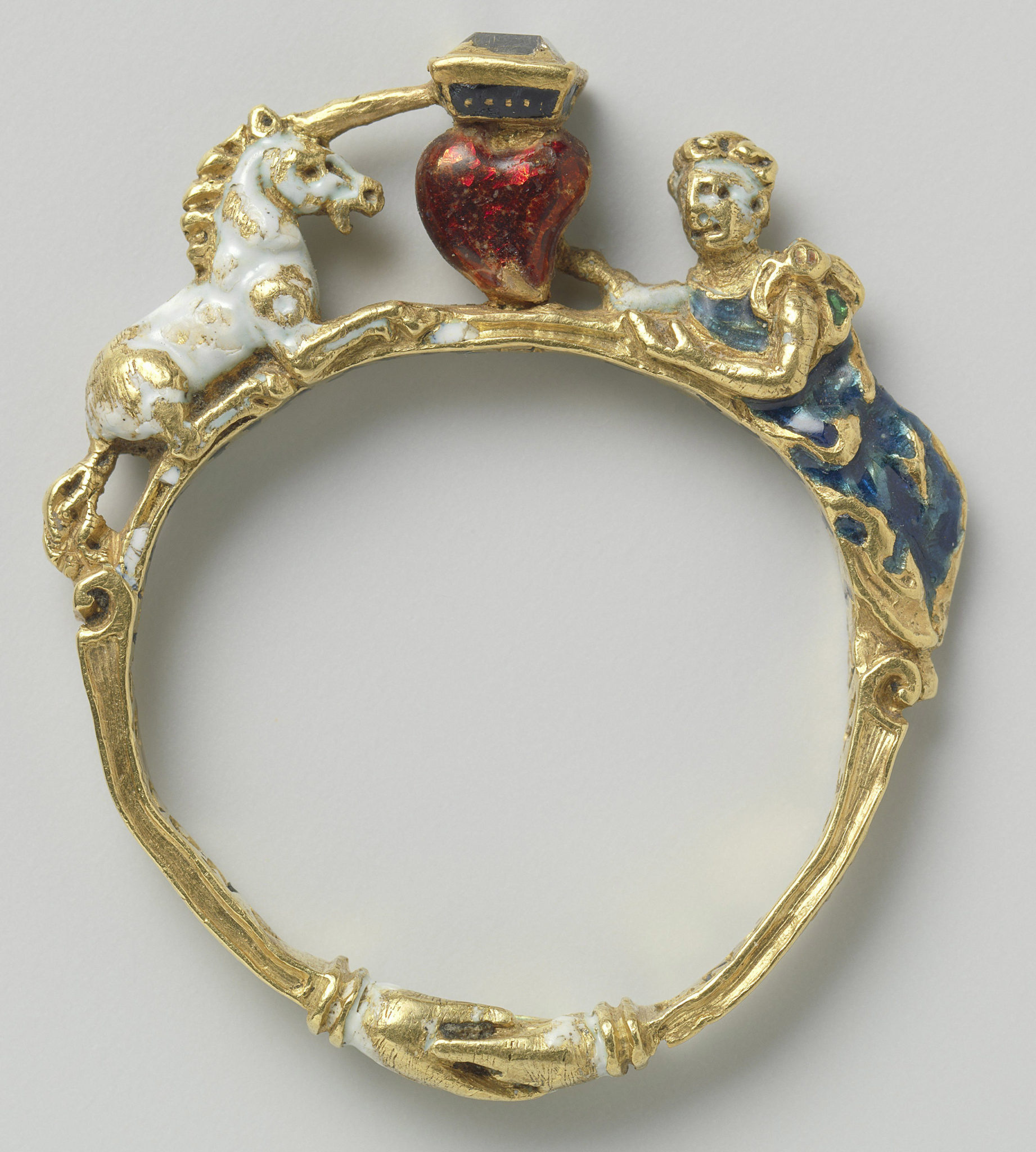
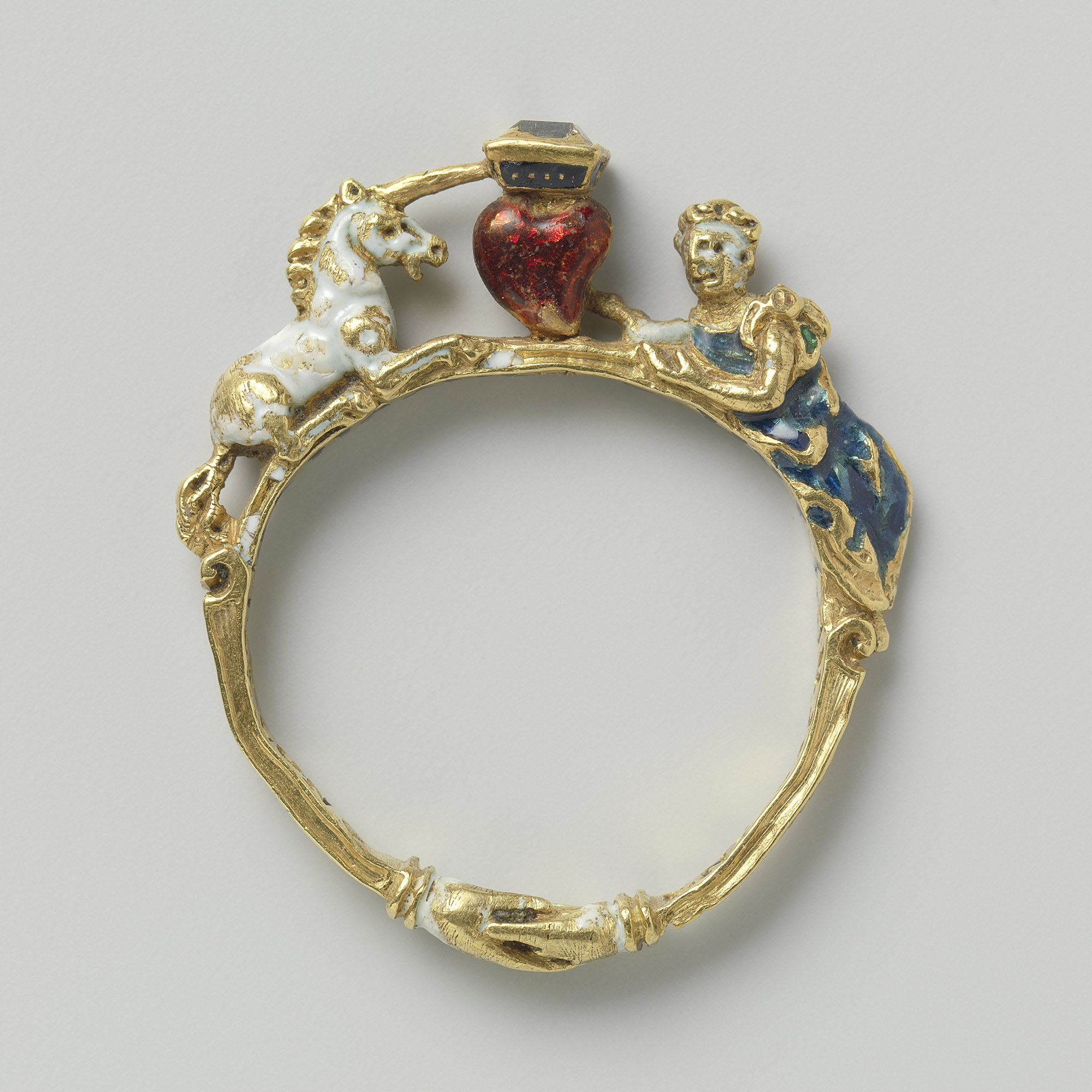
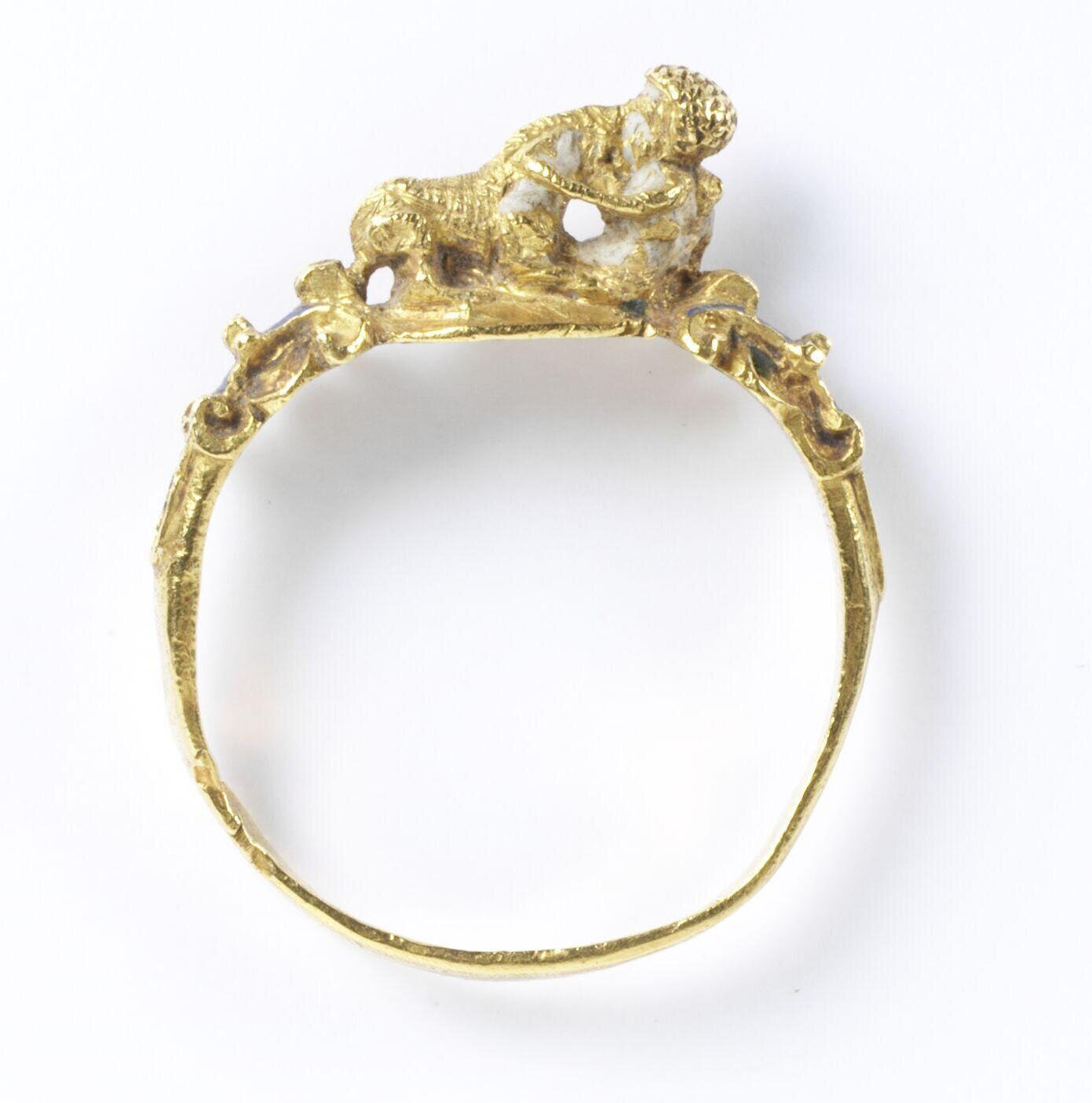
Les orfèvres de la Renaissance ont à l’occasion dessiné, sculpté, taillé des licornes. Les plus petites sont sur des bagues, comme sur une belle bague en or émaillé ou une licorne blanche et une dame en robe bleue encadrent un cœur rouge et un petit coffret. D’autres, en ivoire ou en émail ornent des colliers et pendentifs – mais il faut être prudent, les plus beaux de ces bijoux sont souvent des faux ou des copies du XIXe siècle. C’est par exemple le cas de celui qui se trouve à New York, au Metropolitan Museum, et qui représente un triton chevauchant une licorne matrine.

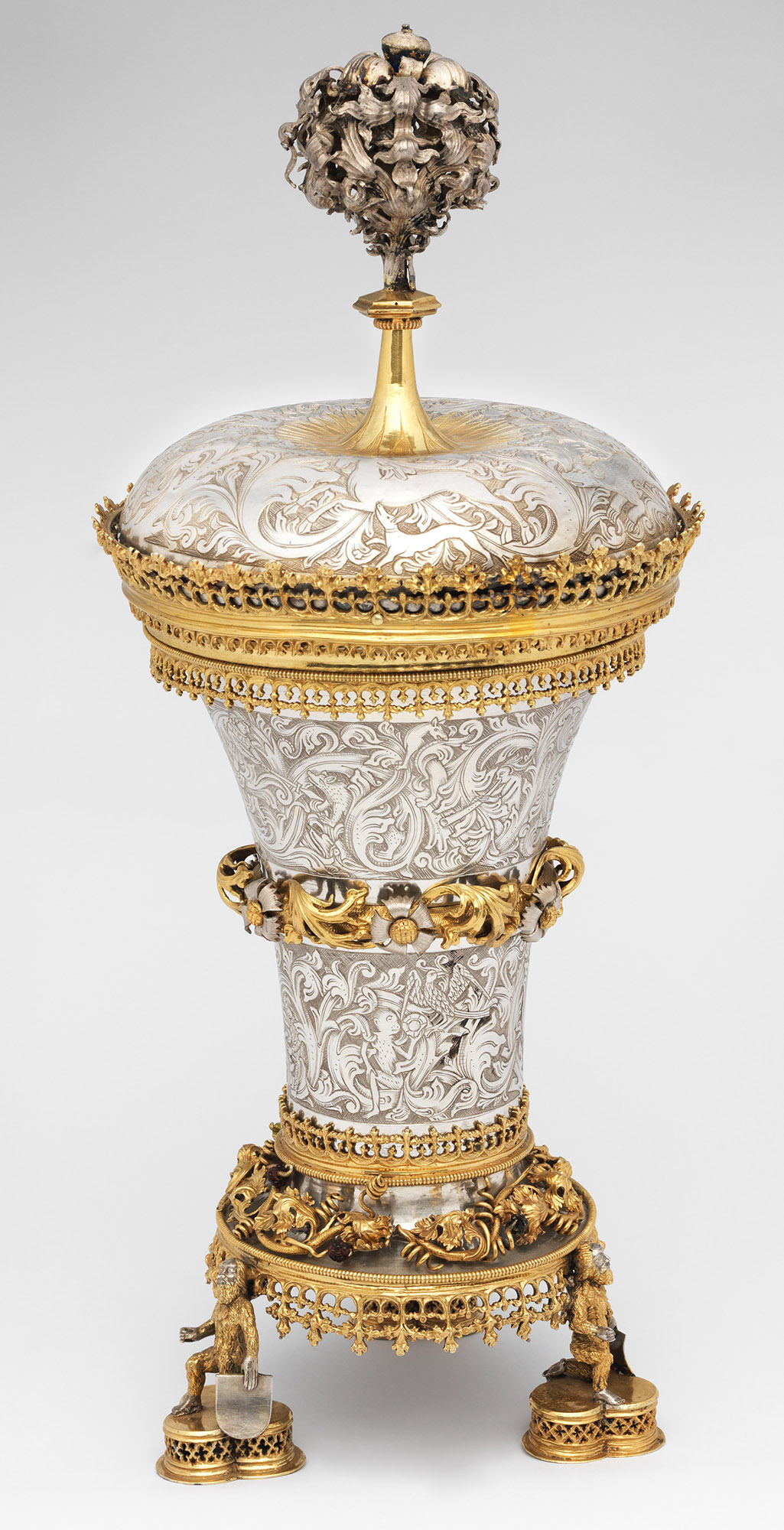
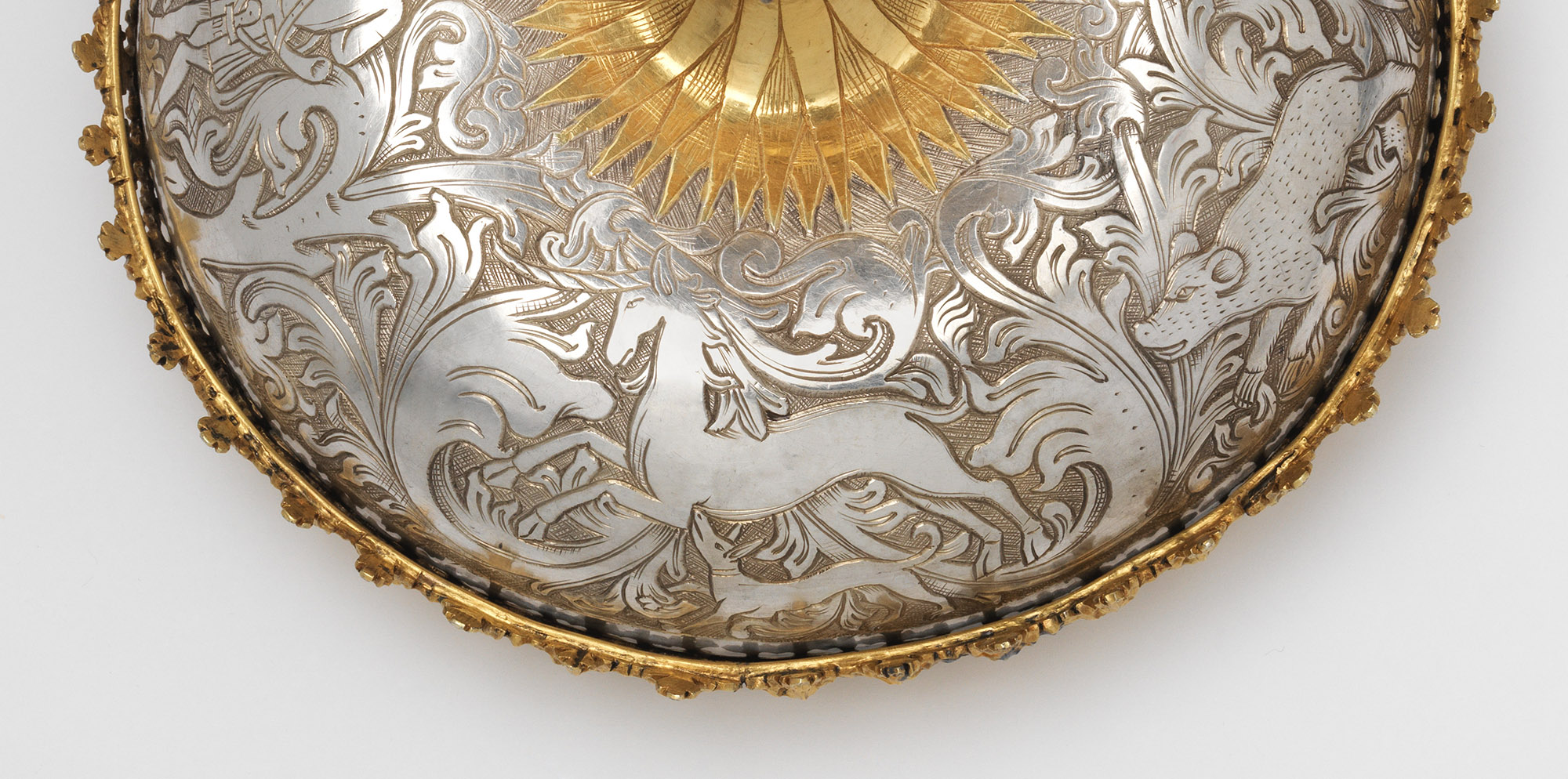
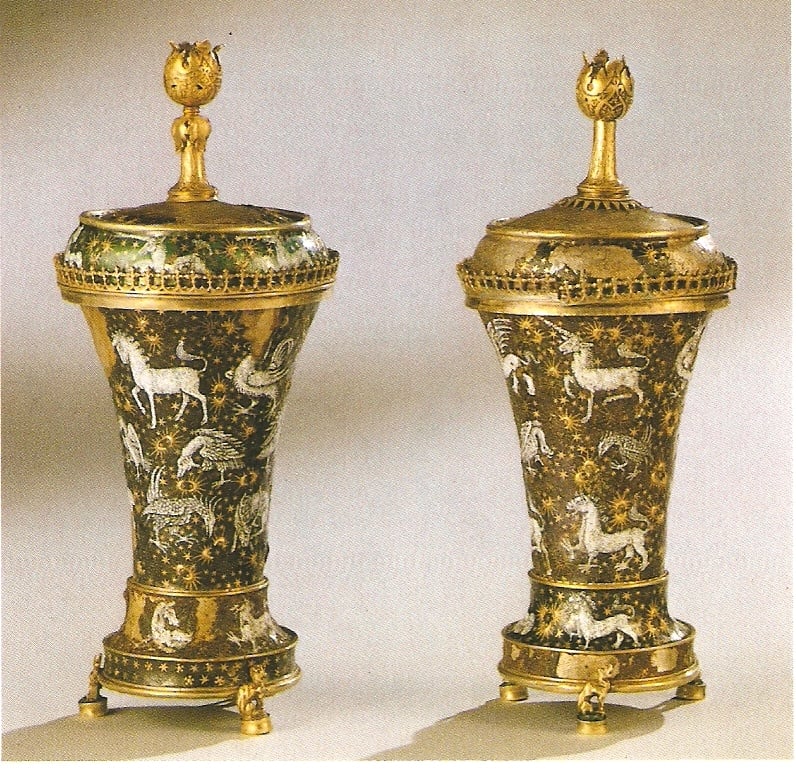
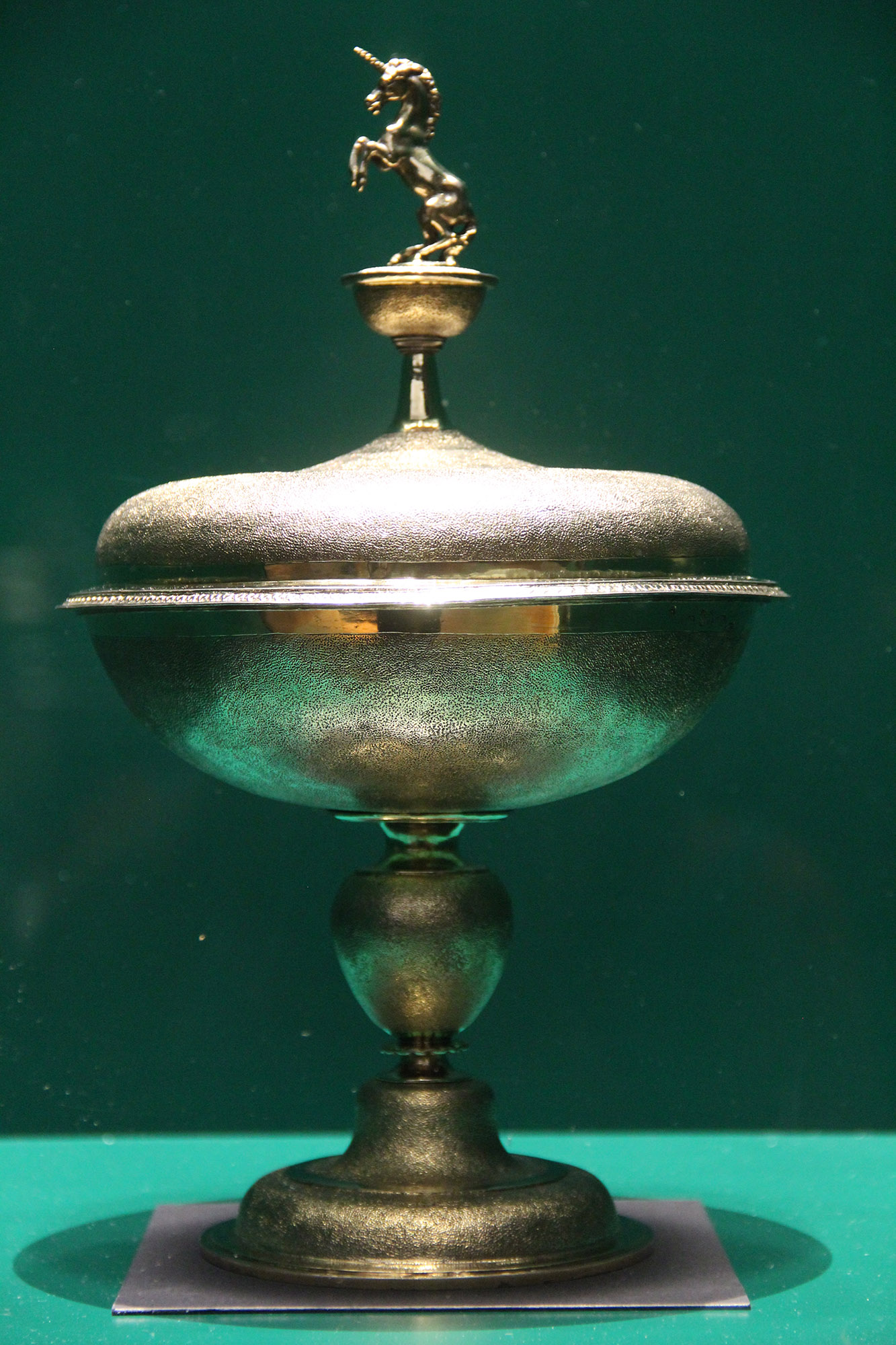
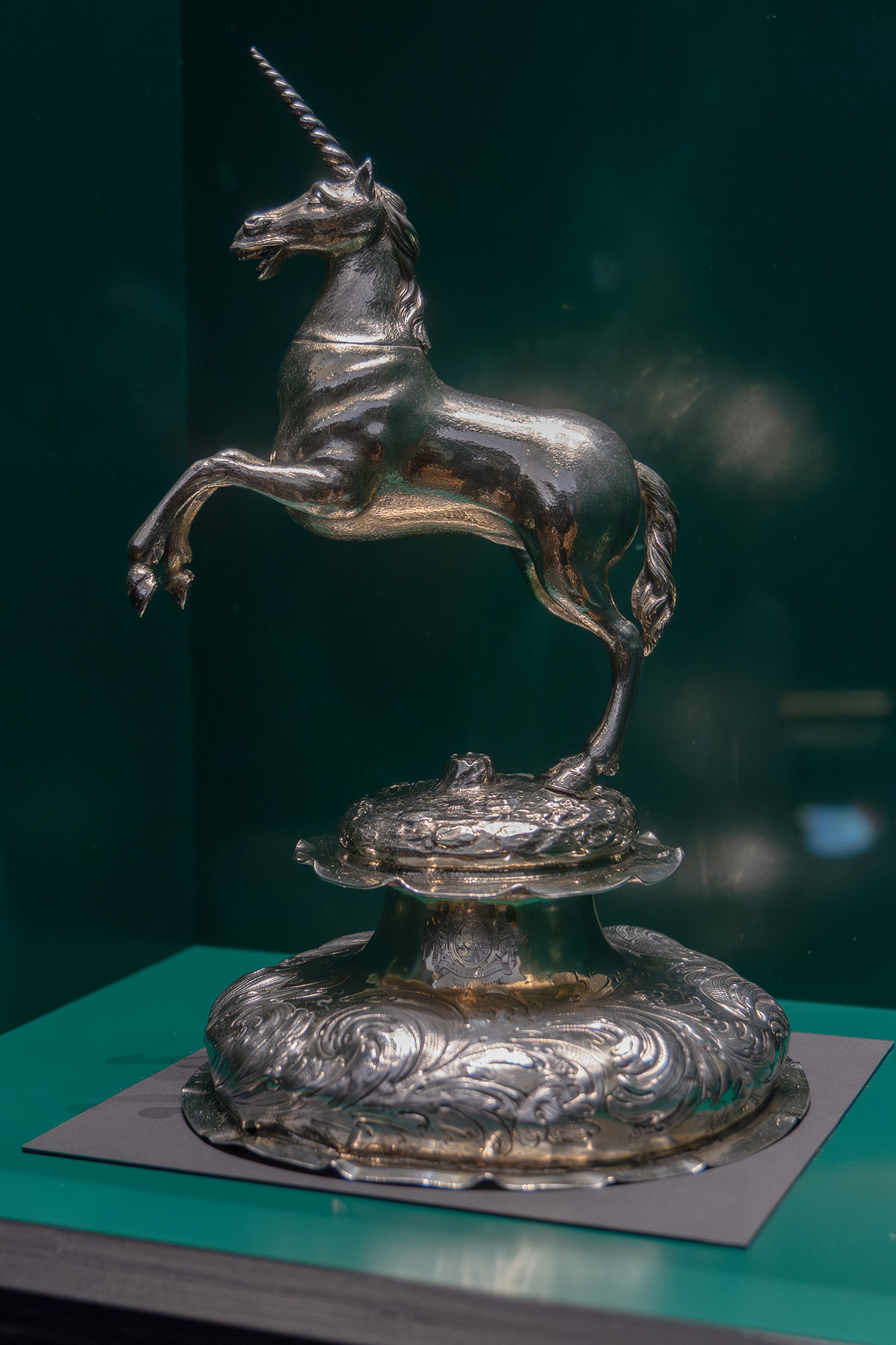
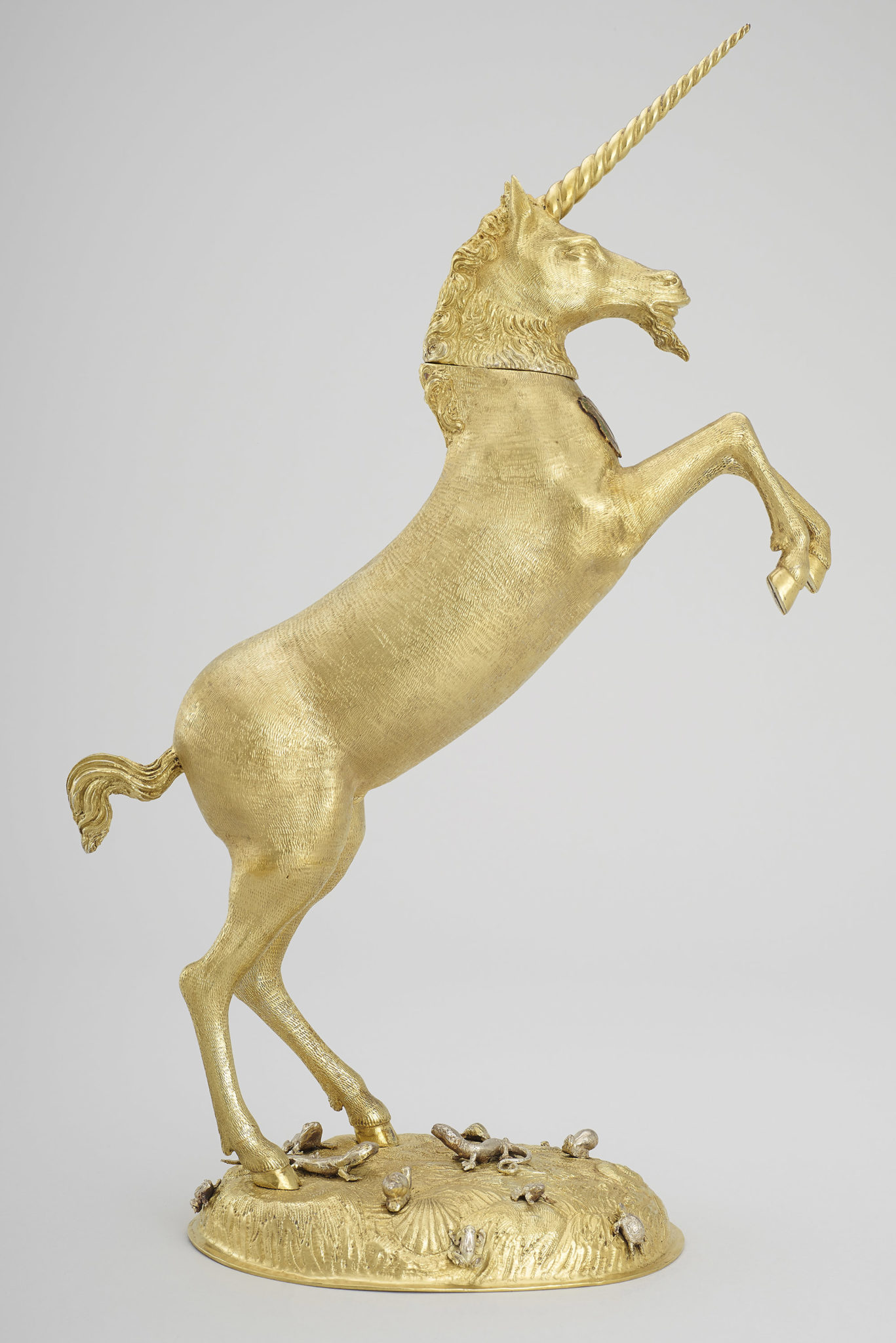
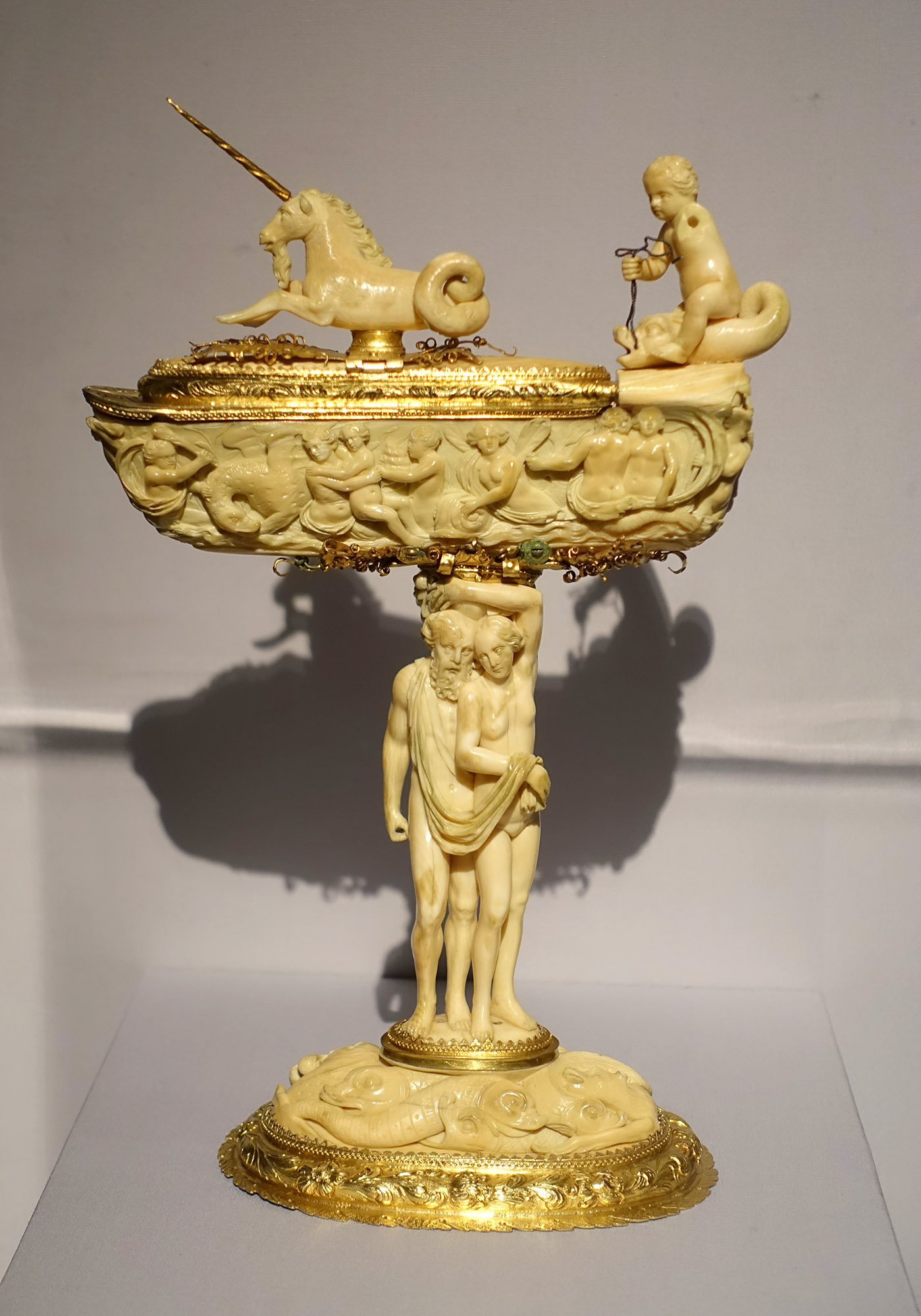
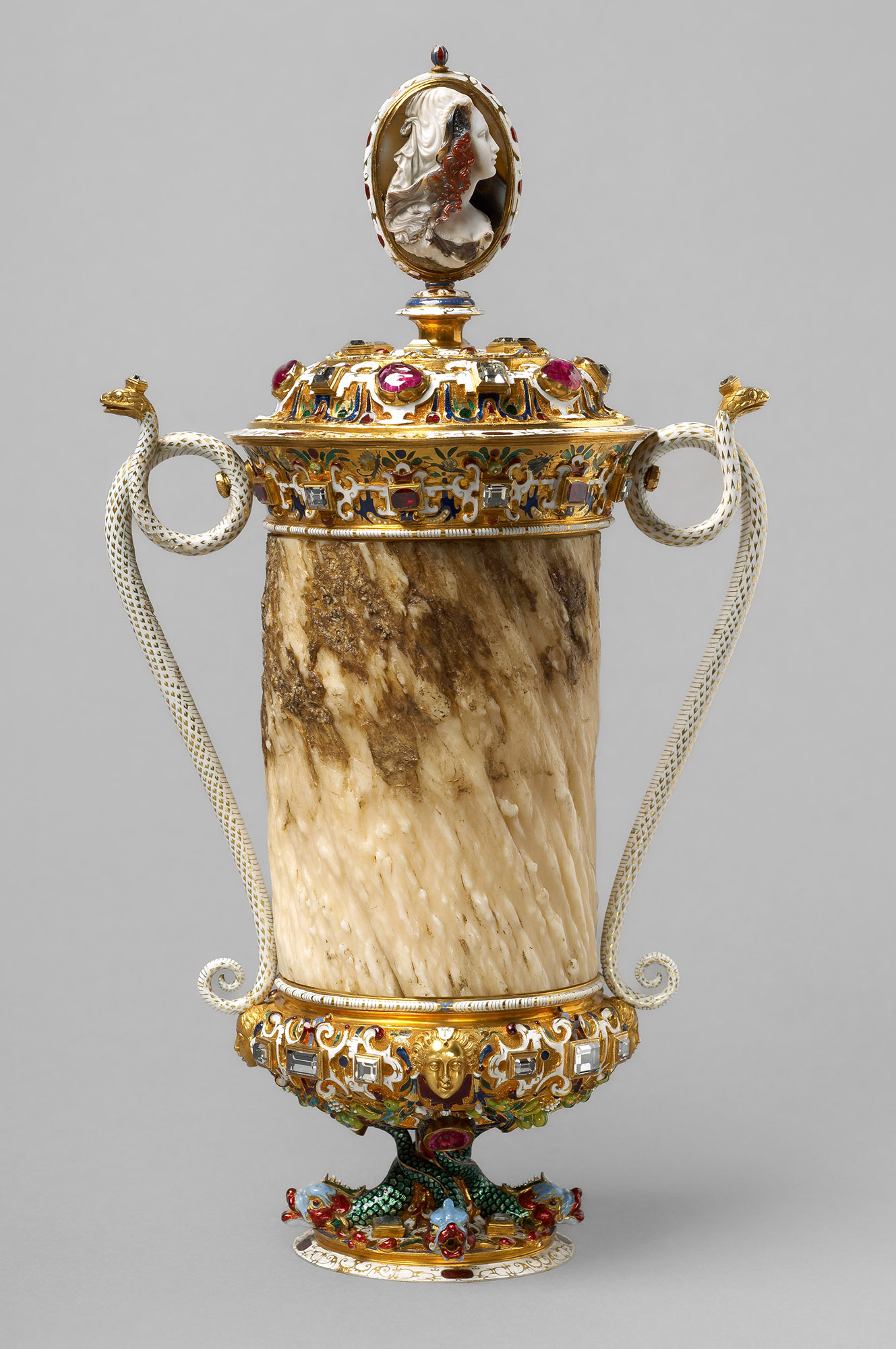
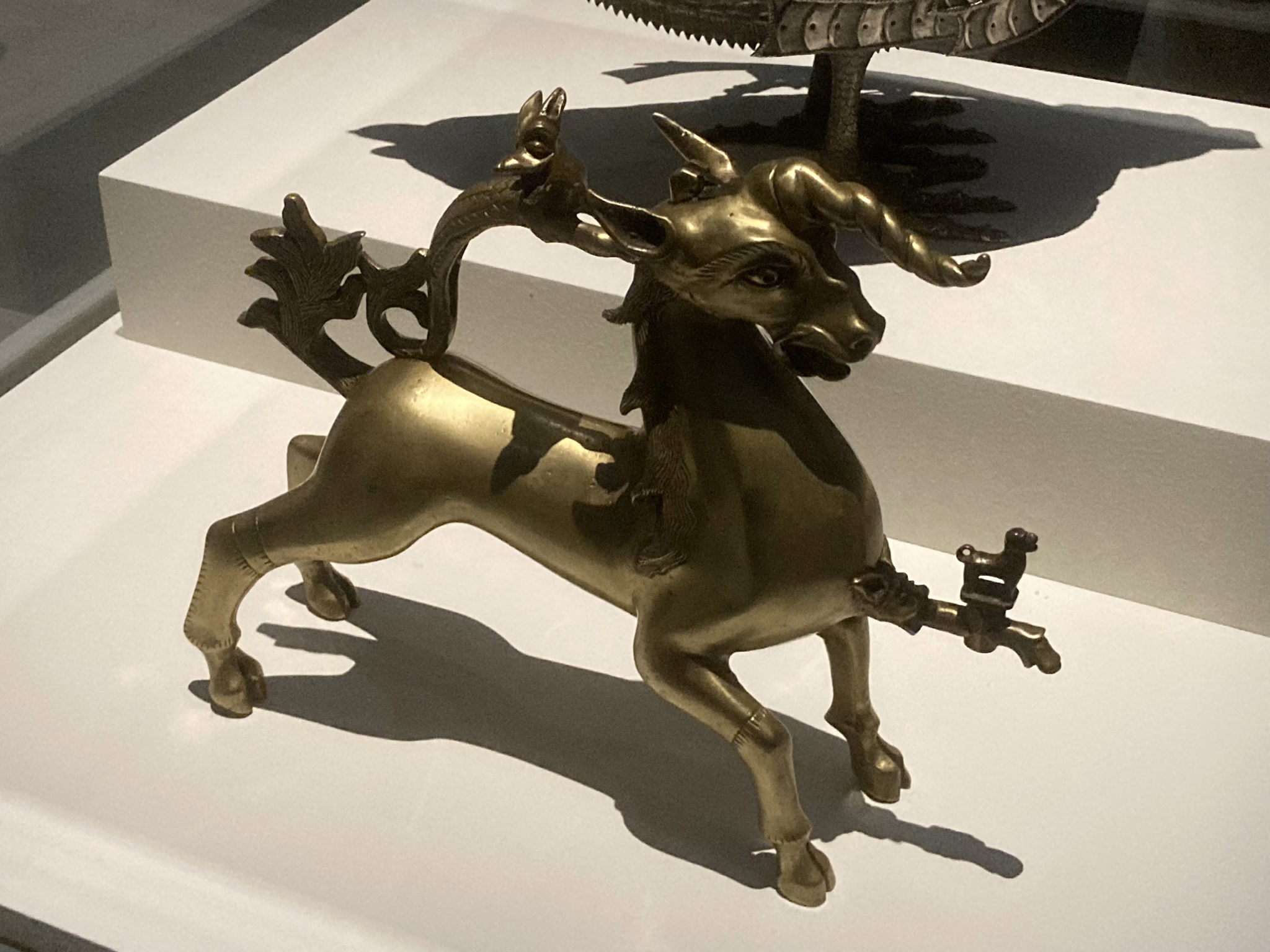
Des plats, des vases ou des pokals, gobelets dotés d’un couvercle utilisés pour porter des toasts, pouvaient avoir forme de licorne, ou être décorés d’une ou plusieurs licornes gravées ou sculptées.

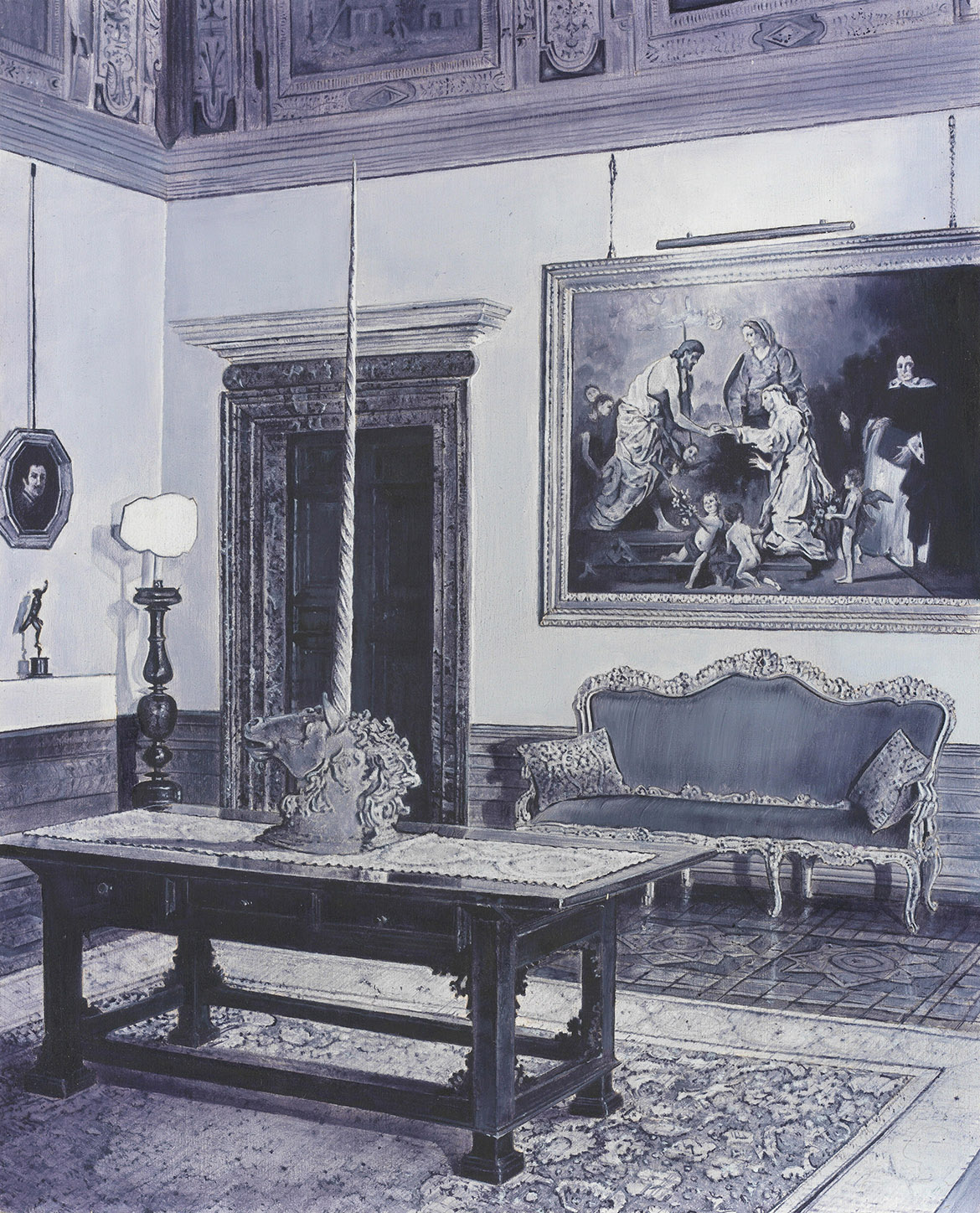
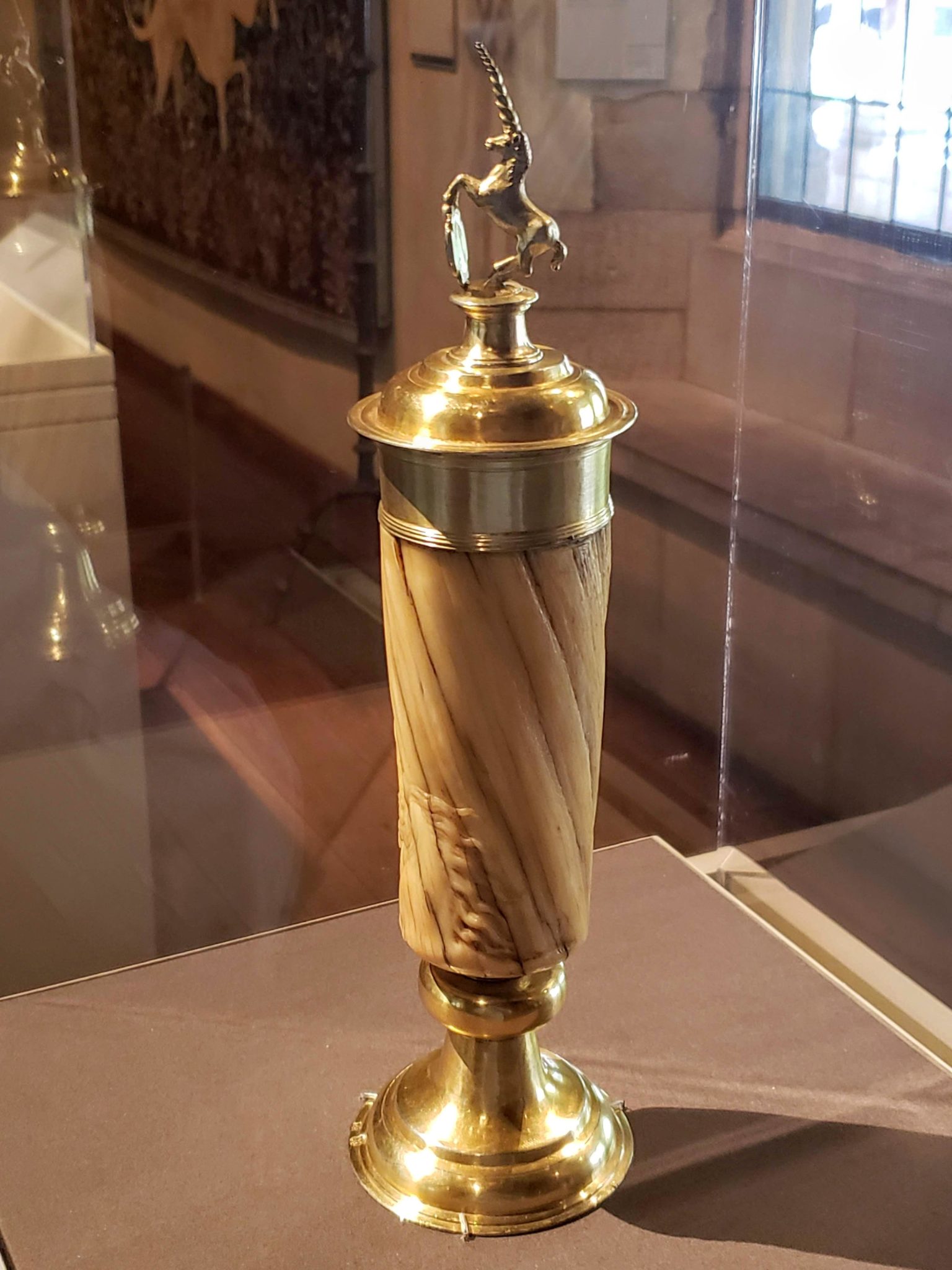
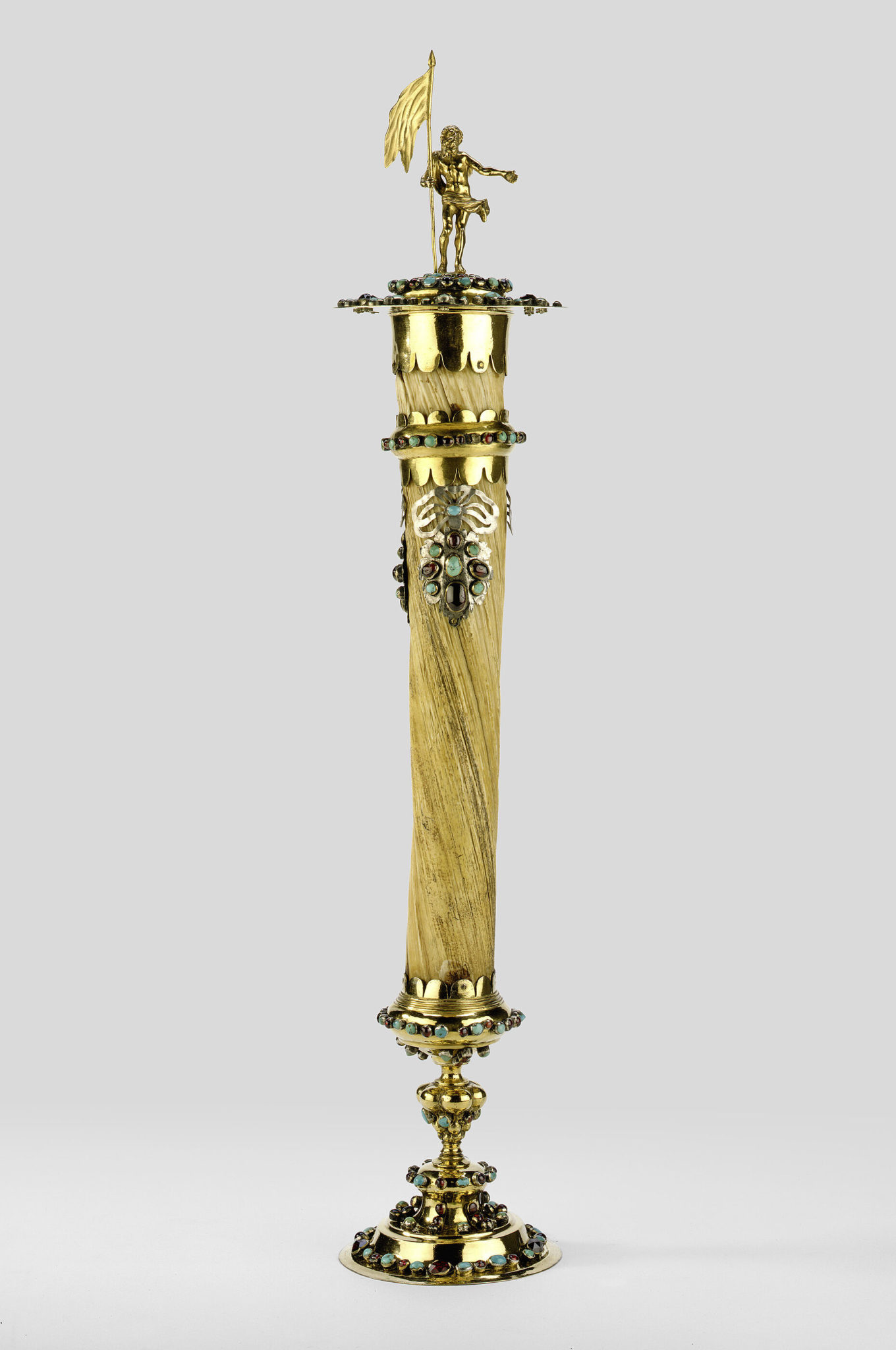
Bien sûr, les plus impressionantes de ces sculptures étaient des chefs de licorne destinés à mettre en scène une « vraie » corne de licorne, comme le raconte dans ses mémoires Benvenuto Cellini.

« Le cardinal Salviati, qui me détestait si cordialement, comme on l’a vu, avait été nommé légat de Parme. Dans  cette ville on arrêta un orfèvre milanais, appelé Tobbia, que l’on condamna à la corde et au feu, pour crime de fausse monnaie. Le légat, ayant entendu parler de ce Tobbia comme d’un artiste du plus grand talent, ordonna de suspendre l’exécution et écrivit ensuite au pape qu’il avait entre les mains le plus grand orfèvre du monde. Il ajouta que cet homme avait été condamné à être pendu et brûlé, mais que c’était un pauvre diable d’une telle simplicité, qu’il assurait avoir consulté son confesseur, qui, à l’en croire, lui aurait donné permission de fabriquer de la fausse monnaie. “ Si vous faites venir ce grand artiste à Rome, continuait le légat, vous rabattrez l’orgueil de votre Benvenuto, et je suis très certain que les ouvrages de ce Tobbia vous plairont infiniment plus ”. Le pape répondit donc qu’on eût à l’envoyer de suite à Rome.
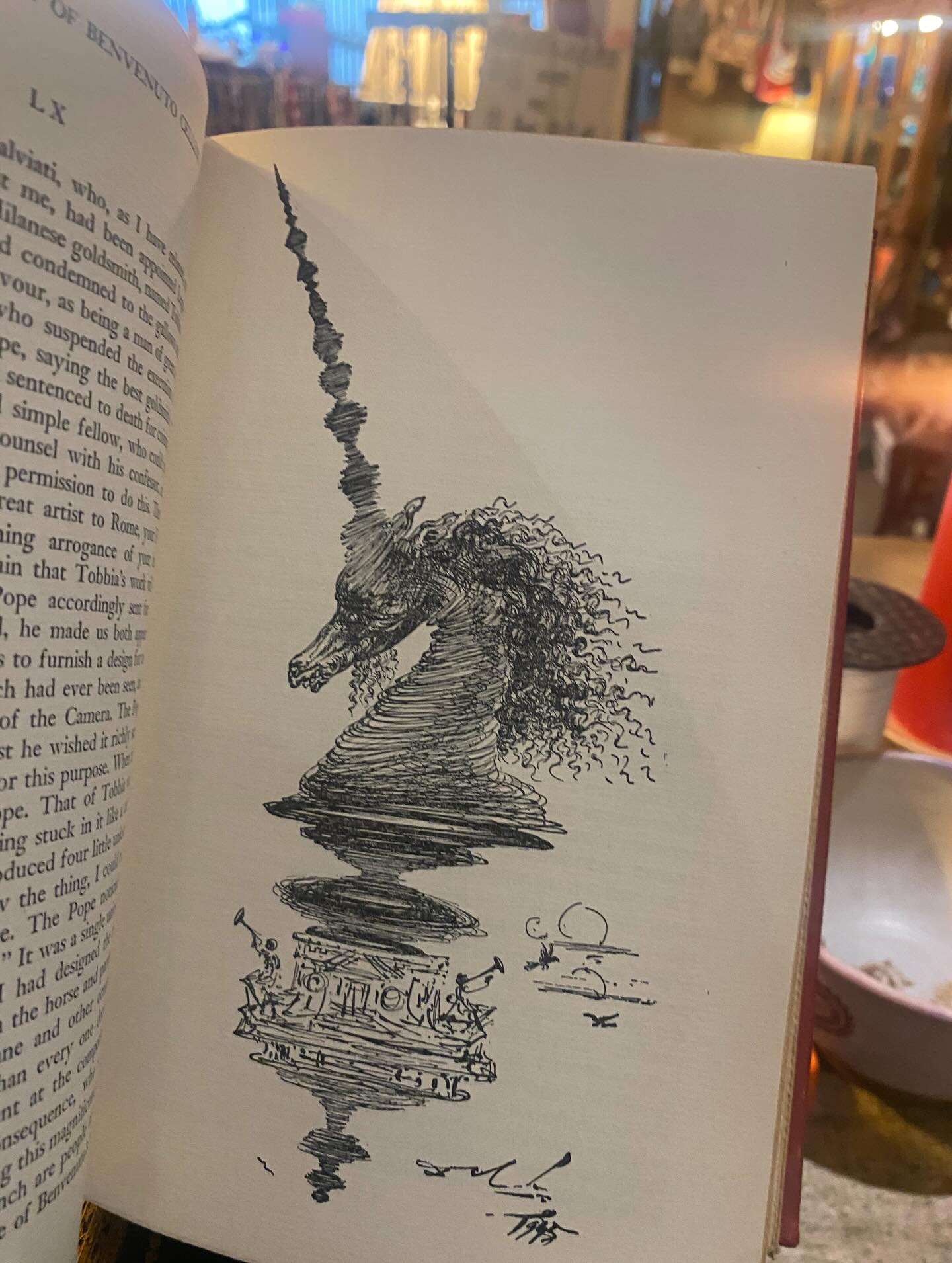
Quand ce Tobbia fut arrivé, Sa Sainteté nous appela tous les deux et nous commanda un dessin pour une corne de licorne, la plus belle qu’on eût jamais vue : on l’avait payée dix-sept mille ducats di Camera. Le pape, qui la destinait au roi François Ier, voulut d’abord qu’on la montât richement en or, d’après l’un des dessins qu’il nous avait demandés. Dès qu’ils furent achevés, chacun de nous apporta le sien au pape. Celui de Tobbia représentait un candélabre, auquel cette belle corne se serait adaptée comme une bougie. Le pied du candélabre était formé de quatre petites têtes de licorne de la composition la plus simple, de sorte que je ne pus m’empêcher de rire sous cape. Le pape s’en aperçut, et me dit : “ Montre-moi ton dessin ”. C’était une seule tête de licorne d’une beauté sans égale, car elle tenait à la fois de la tête du cheval et de celle du cerf, et je l’avais enrichie d’ornements d’une telle élégance, qu’à la première vue tout le monde m’adjugea la palme. Malheureusement, ce concours avait lieu devant des Milanais de haute importance, lesquels dirent au pape : “ Très saint Père, vous envoyez en France un splendide présent : sachez que les Français sont des hommes grossiers, incapables de comprendre le mérite du travail de Benvenuto. Ils aimeront bien mieux cette espèce de fiole, qui sera exécutée plus promptement. Benvenuto achèvera votre calice; vous aurez ainsi deux morceaux terminés en même temps, et ce pauvre diable, que vous avez fait venir, ne restera pas sans ouvrage”.
Le pape, qui désirait avoir son calice, suivit volontiers le conseil de ces Milanais. Le lendemain, il commanda donc à Tobbia la garniture de la corne, et il m’envoya dire par le maître de sa garde-robe que je devais m’occuper de terminer le calice. Je répondis : “ C’est mon plus vif désir, et j’aurais déjà facilement fini ce bel ouvrage, s’il n’eût point été en or ; mais, puisqu’il est en or, il faut que Sa Sainteté me donne de ce métal, si elle veut que je puisse le mener à fin. — Ah çà, me répliqua ce rustre de courtisan, ne va pas demander de l’or au pape, sinon tu le mettras dans une telle colère, que malheur ! malheur à toi ! — Messer, lui repartis-je, vous et votre seigneurie, enseignez-moi donc un peu la manière de faire du pain sans farine; cet ouvrage se finira de même sans or[1]”.»

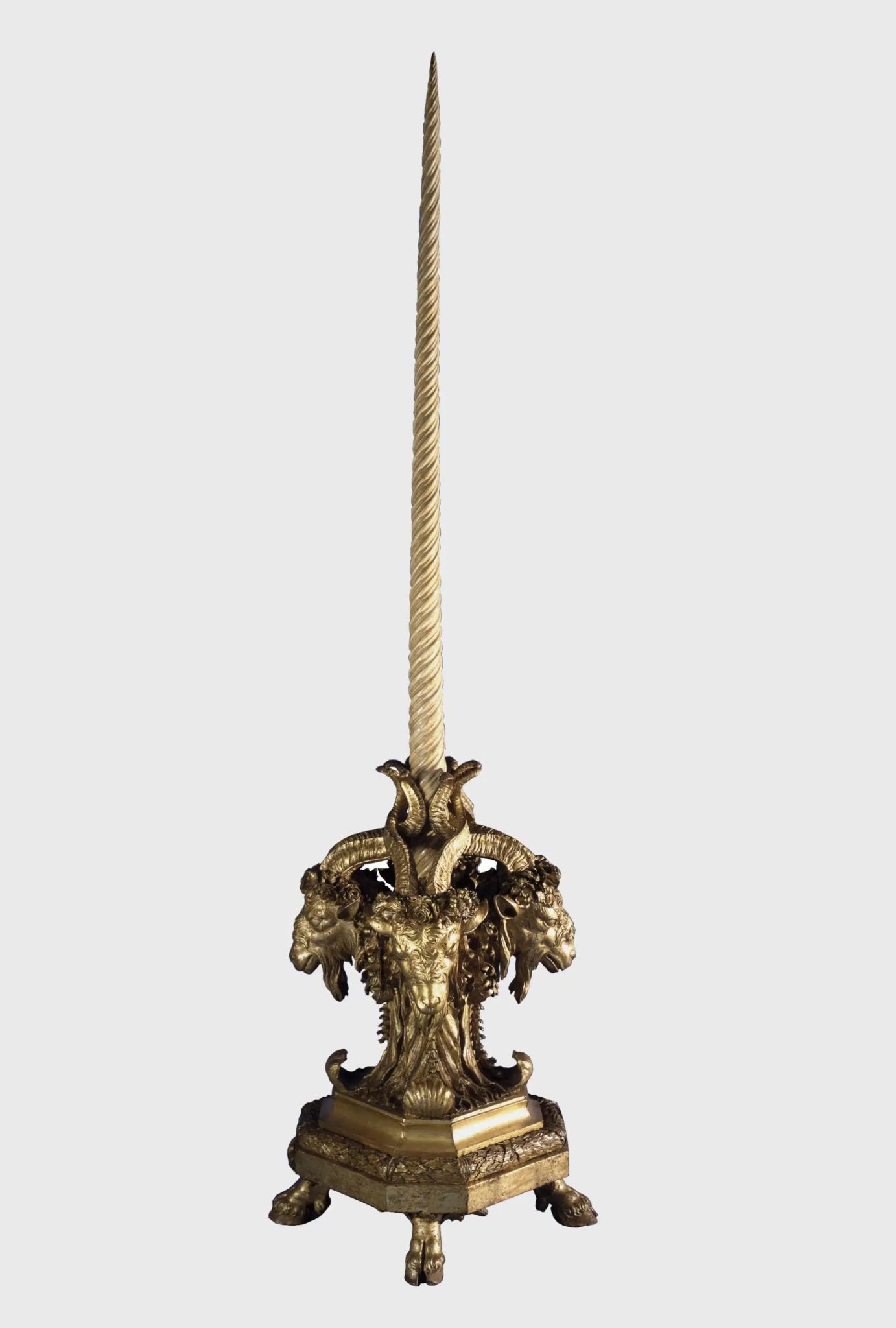
Il y a trente ans, en 1996, je reprenais dans ma thèse un article de 1936 de l’historien Guido Schönberger dans lequel, photo grisâtre à l’appui, il assurait que sinon la corne, du moins son socle se trouvait aujourd’hui au musée de Bologne[2]. On trouve aujourd’hui en ligne de bien meilleures photos, et il apparaît clairement que le socle se trouvant à Bologne, que le site du musée date par ailleurs de la fin du XVIIe siècle représente quatre têtes non de licornes mais de béliers, ce qui est un peu étonnant. Peut-être était-il prévu non pour présenter une corne de licorne mais pour servir de chandelier dans une église ?

Peut-être, et ce bien que le récit de Cellini parle de quatre petites têtes et non de trois, la licorne envoyée en France est-elle celle citée, en 1560, en tête de l’inventaire du cabinet des rois de France : « Une grande licorne émorcée par le bout, garnie d’or et soustenue sur trois testes de licorne d’or par le pied, pesant ladite licorne seullement dix-sept marcs une once et demy et ayant de longueur cinq pieds trois poulces, en ce non comprises une petite garniture qui est au bout laquelle avec l’autre garniture des troys testes de licorne poisent ensemble vingt-troys marcs et demy estimée quinze cens quatre escus[3]. »

Si c’est d’elle qu’il s’agit, j’ignore ce que ce socle est devenu. On n’en sait moins encore sur le sort du socle réalisé par Cellini, pour lequel on a juste…. Un dessin de Salvador Dali illustrant une édition de 1946 de la foisonnante autobiographie du sculpteur et joailler italien.

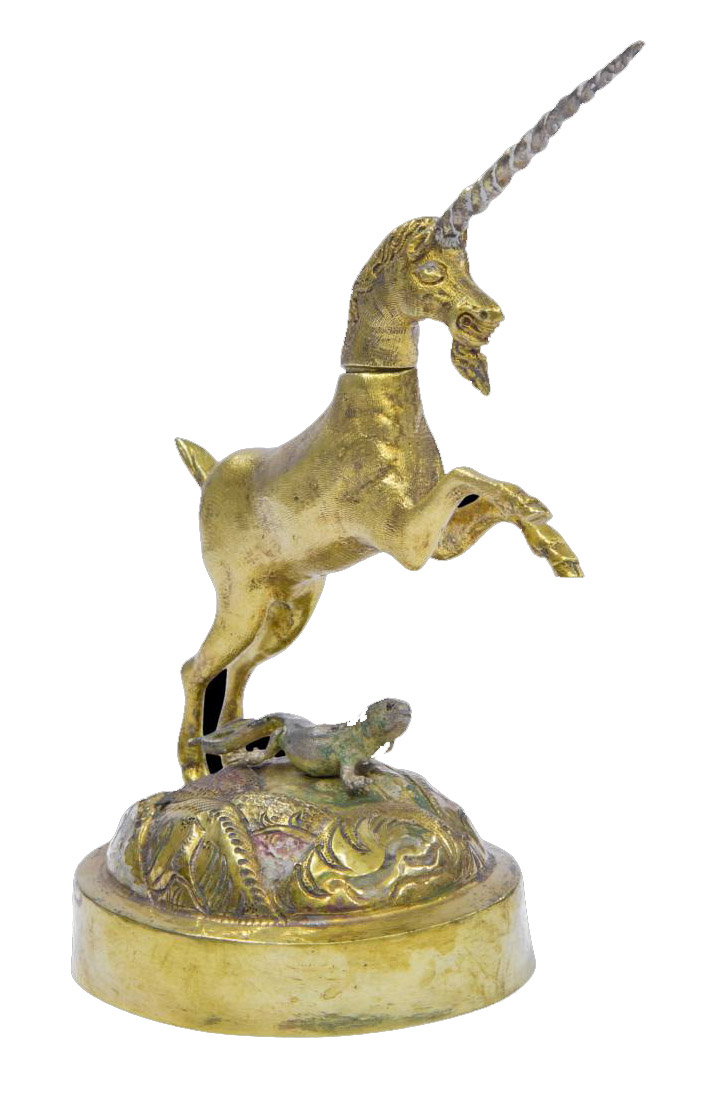
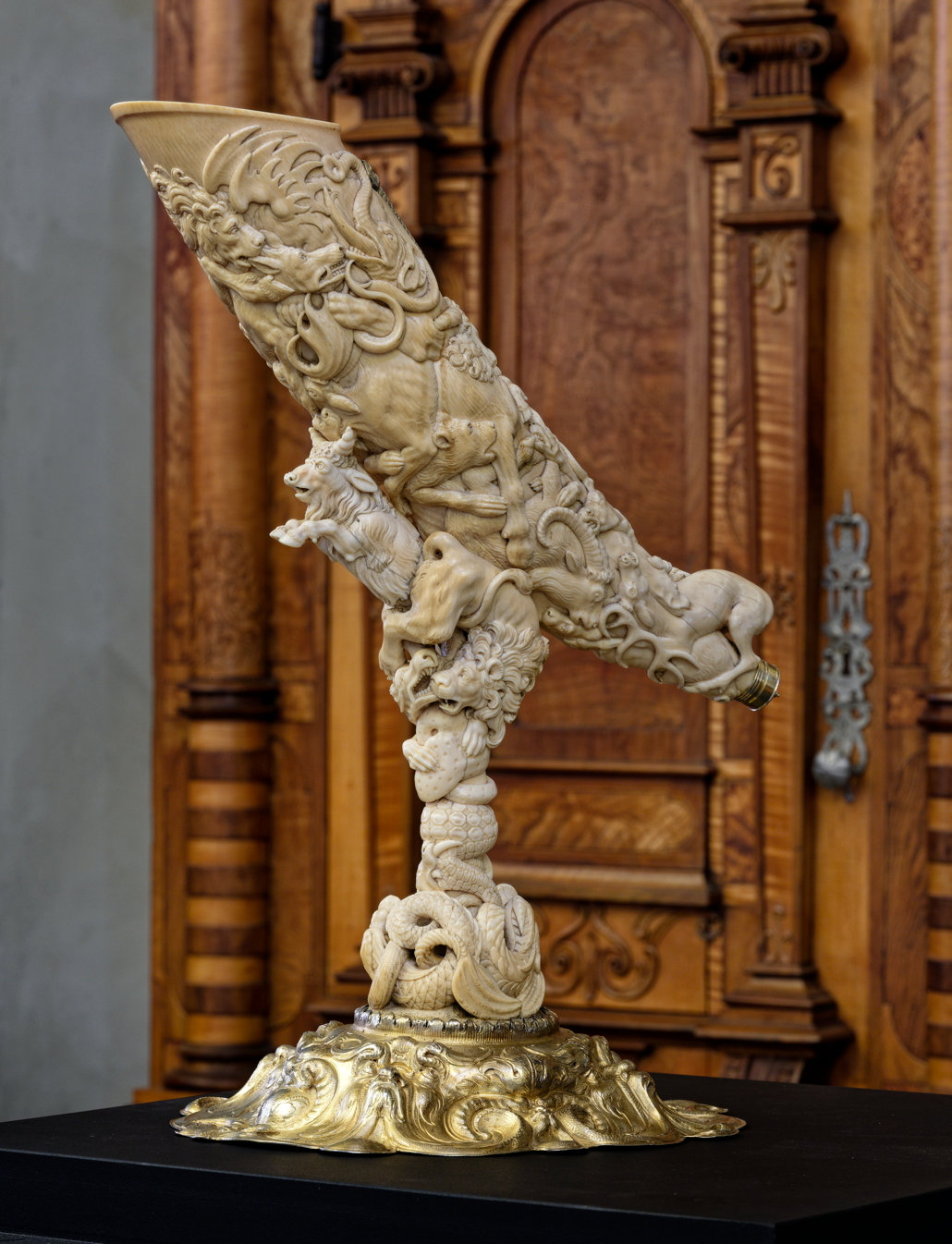
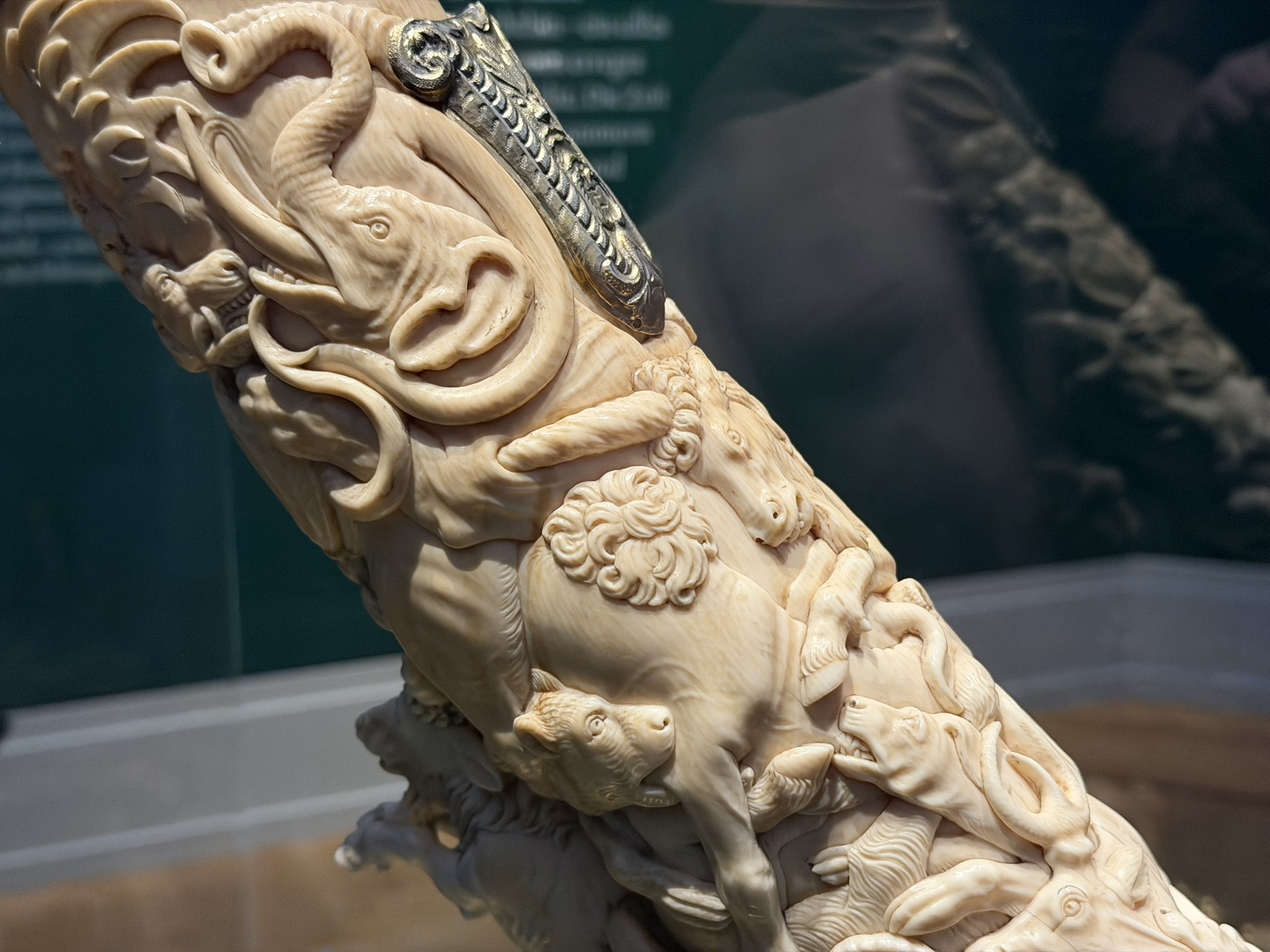
Au XVIIe siècle, les ivoires de narval se font moins rares, et leur origine nordique et maritime devient peu à peu connue de tous. Si beaucoup restent exposées dans les trésors des princes et des cathédrales, d’autres sont désormais découpées, taillées, sculptées pour réaliser des pièces d’orfèvrerie de plus petite taille. Clin d’œil, peut-être un peu ironique lorsque l’artiste sait qu’il travaille une défense de narval, il n’est pas rare que des licornes soient ainsi sculptées dans la licorne, tout comme des éléphants sont représentés sur l’ivoire d’éléphant. On s’étonnera donc de voir, en 1634, une licorne mais pas d’éléphant sur l’Olifant de Rothschild, une superbe défense d’éléphant sculptée pour imiter un cor médiéval. La licorne barbichue, à la courte corne spiralée, n’est cependant ici qu’un animal parmi d’autres dans un entrelacs de créatures réelles et mythologiques.


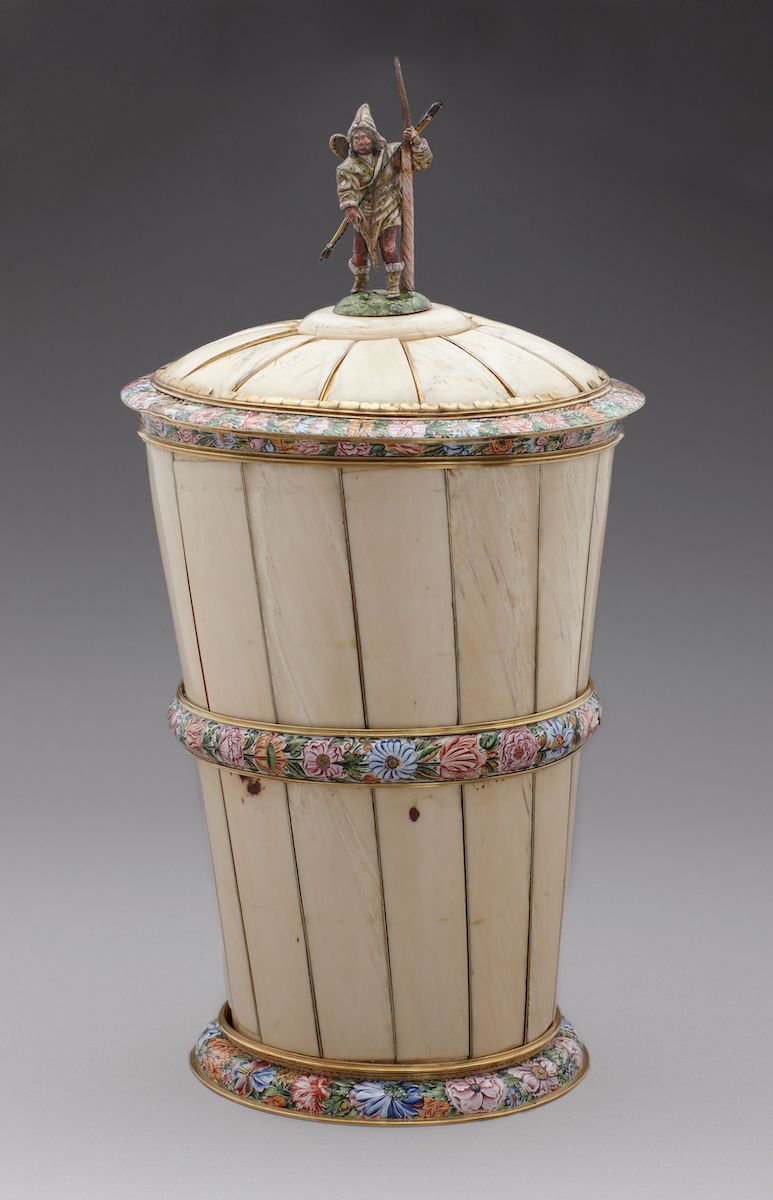
Plus intéressantes sont une chope à bière et un pokal, grand gobelet muni d’un couvercle, réalisés dans les années 1660 par l’artiste danois Jacob Jensen Nordmand. Cet ancien marin norvégien, qui avait appris à sculpter l’ivoire lors de ses voyages à bord de navires hollandais avant de s’établir à Copenhague et de travailler pour le roi de Danemark ne pouvait avoir le moindre doute sur l’origine des pièces d’ivoire ayant servi à confectionner ces deux récipients. Sur le couvercle du pokal, l’artiste a d’ailleurs représenté, avec un certain souci de réalisme, un inuit du Groenland tenant fièrement une défense de narval.  La chope à bière n’en repose pas moins sur trois petites licornes en argent, preuve que cette défense de narval restait aussi, peut-être un peu ironiquement, une corne de licorne.

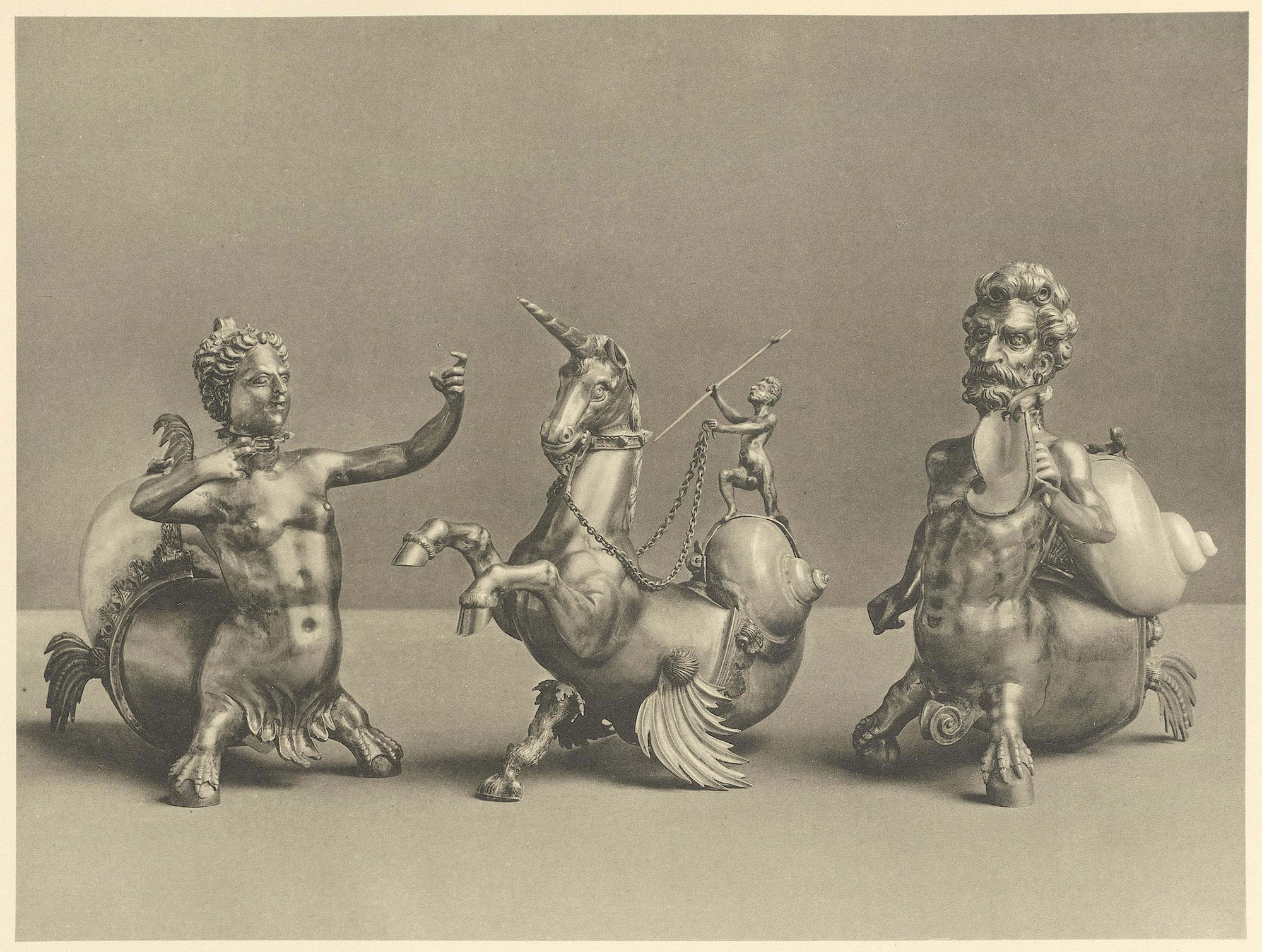
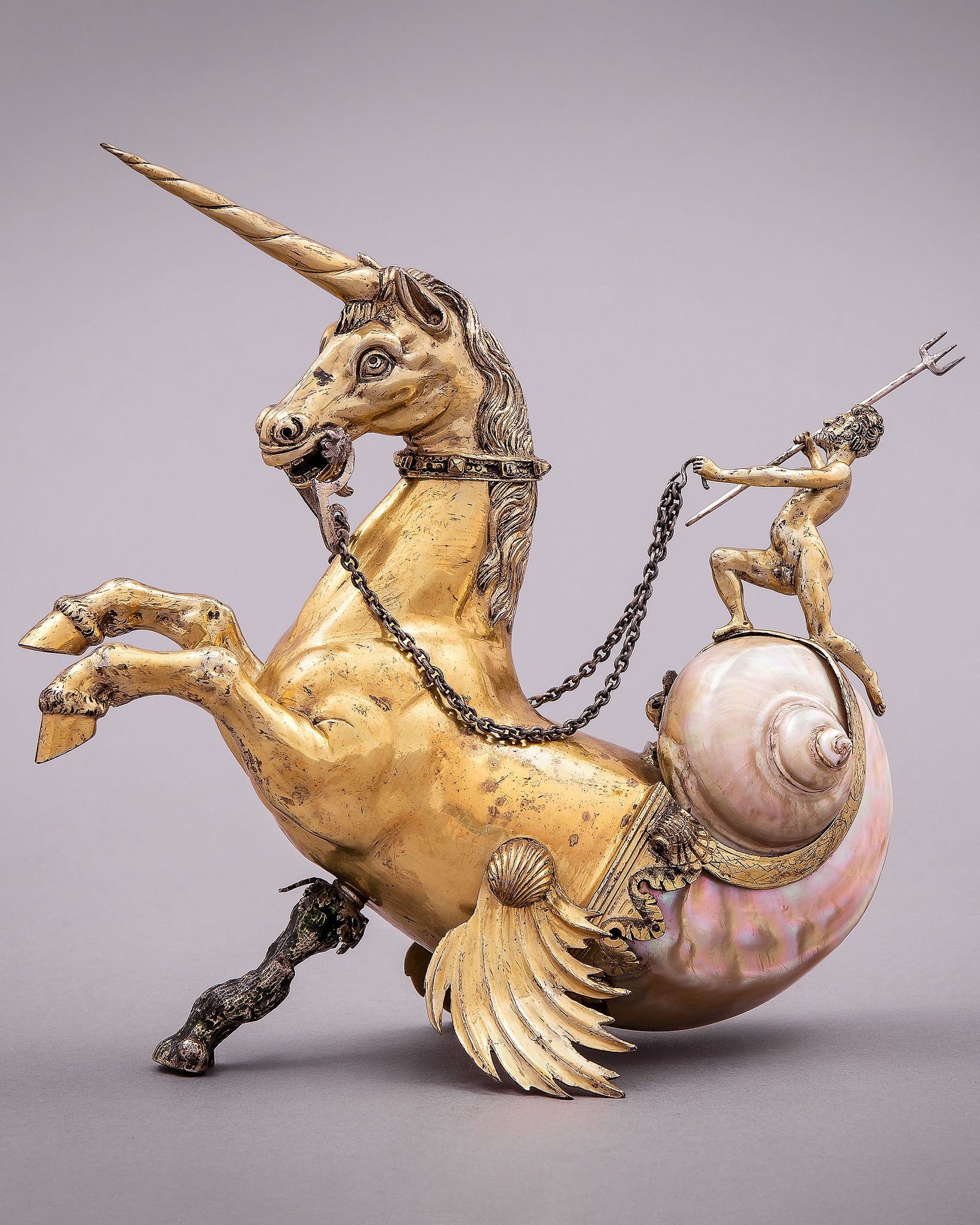
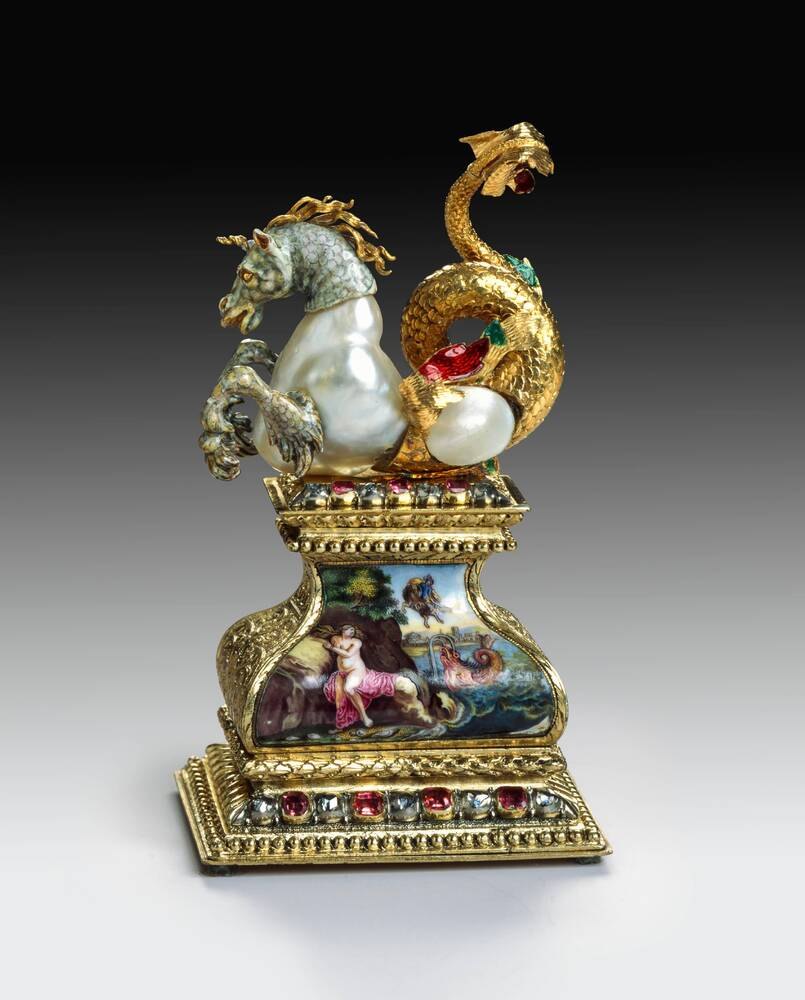
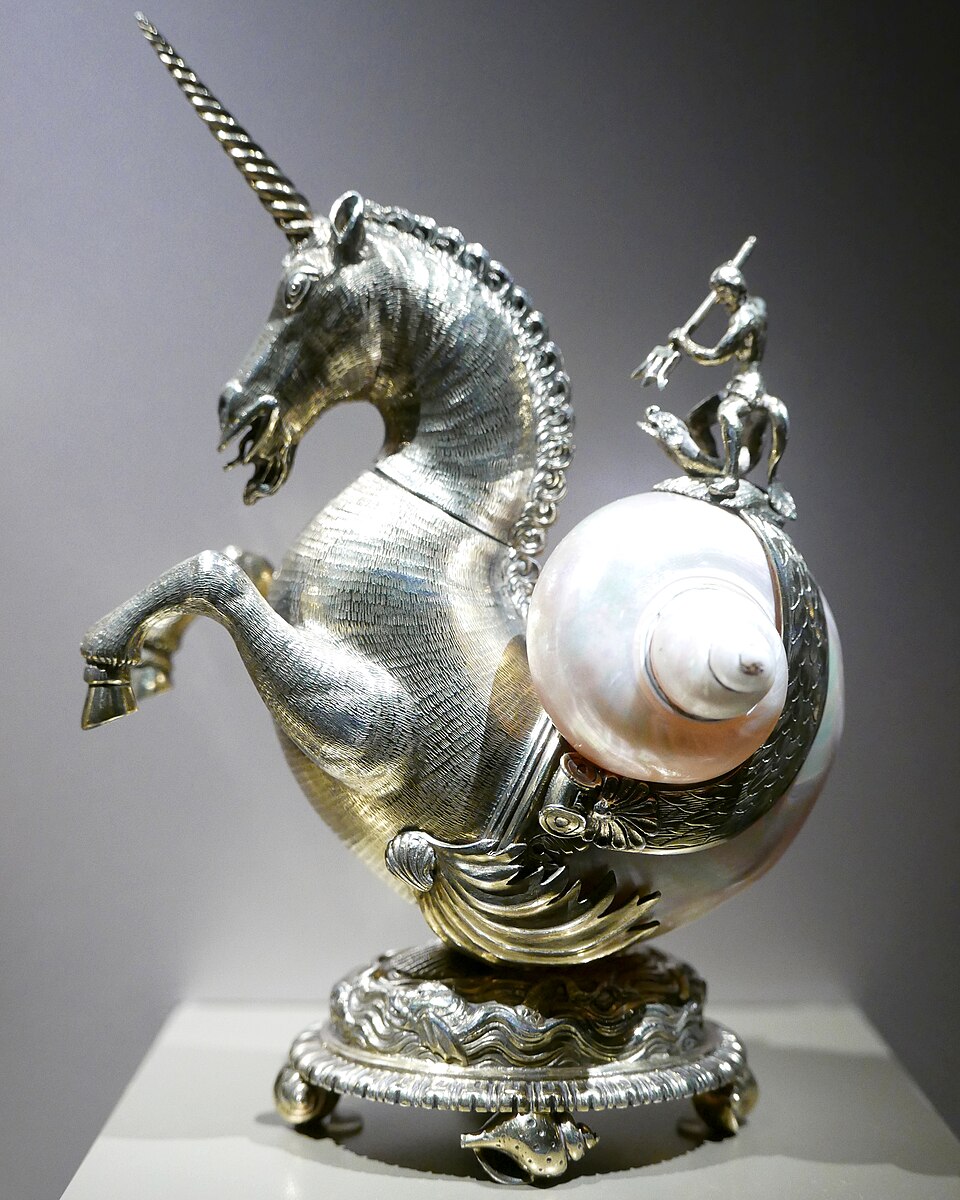
La Voûte Verte, à Dresde, est un musée abritant la plus grande collection au monde de trésors baroques, bijoux, sculptures, figurines et pièces d’orfèvrerie où le travail de l’artiste vient mettre en valeur des merveilles de la nature. L’or, l’argent et l’émail y côtoient le jaspe, l’émeraude, les perles, le corail et les coquillages. Même si l’on y croise un étonnant Actaeon changé par Diane en cerf unicorne, ou plutôt unibois, c’est moins dans les scènes de chasse en forêt  que dans les représentations marines qu’il faut chercher la licorne. On doit par exemple à l’orfèvre allemand Elias Geyer (1560-1634) plusieurs sculptures de créatures semblant sortir de coquilles de nautiles, parmi lesquelles quelques licornes. Ce ne sont pas des narvals, encore mal connus à cette époque, ce ne sont pas non plus des licornes. Ce sont les hippocampes de la mythologie grecque qui, parce qu’elle leur donne plus fière allure, gagnent alors une corne et deviennent des sortes de licornes de mer, ce qu’ils n’avaient jamais été dans les représentations antiques.


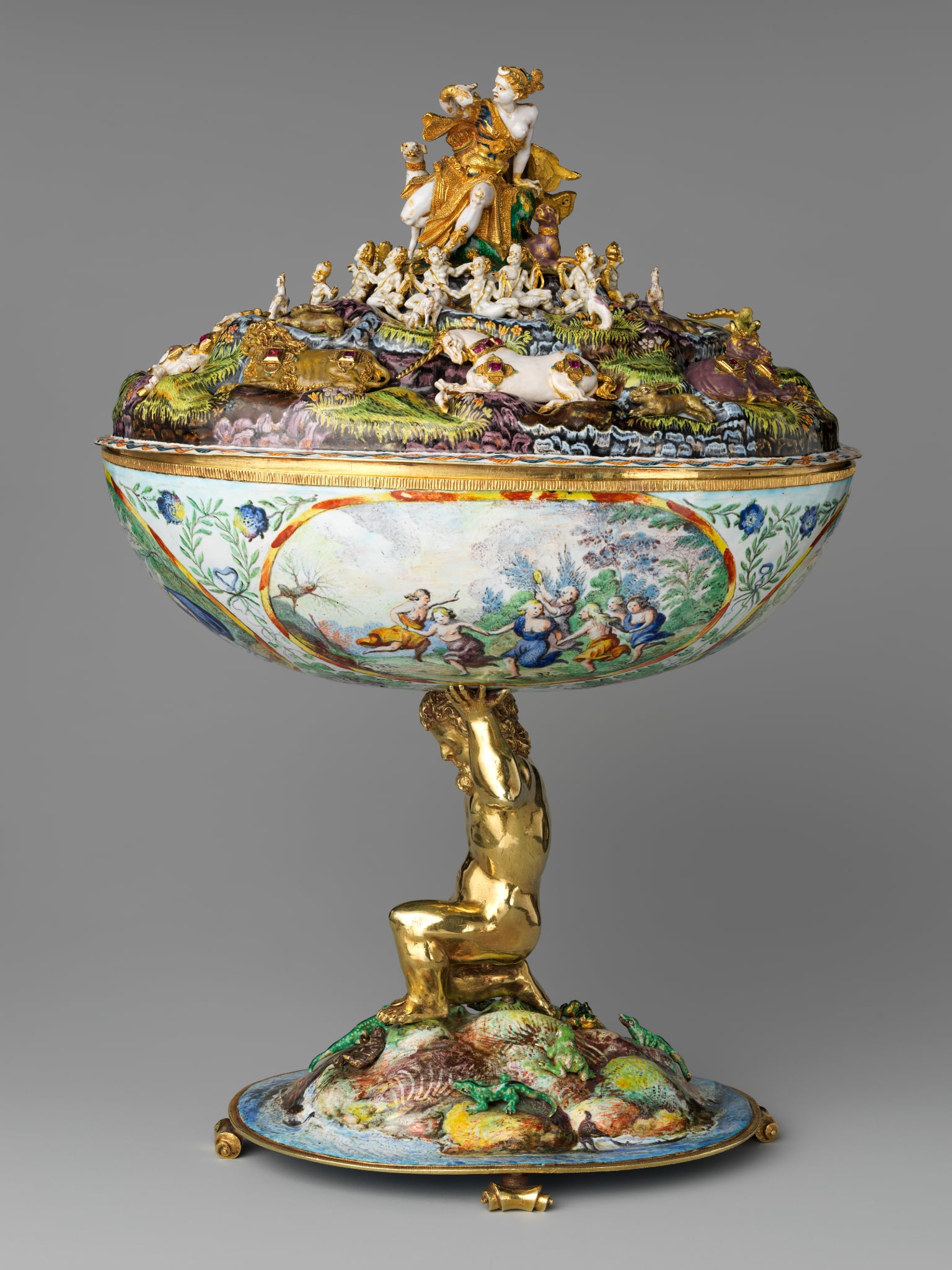
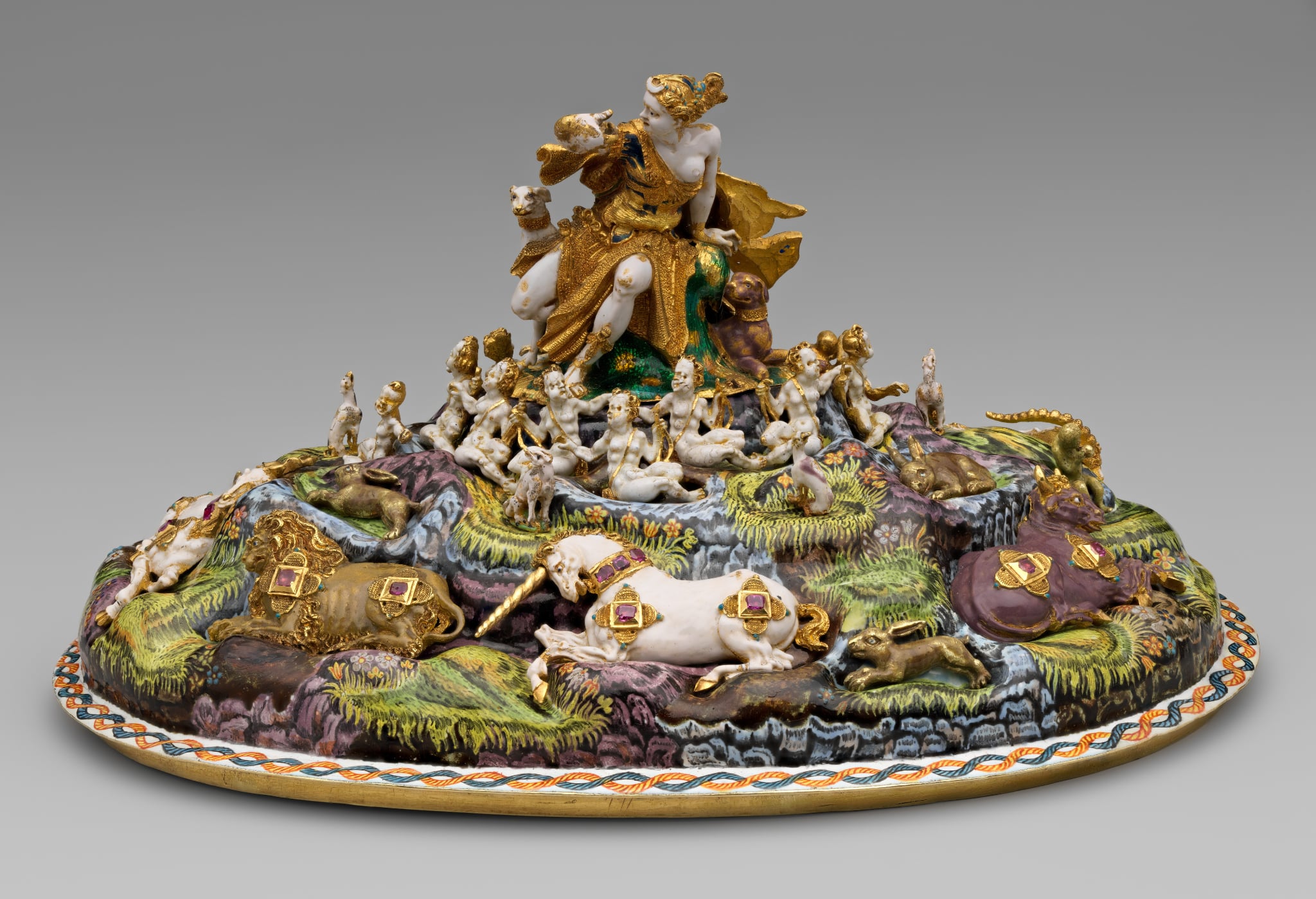
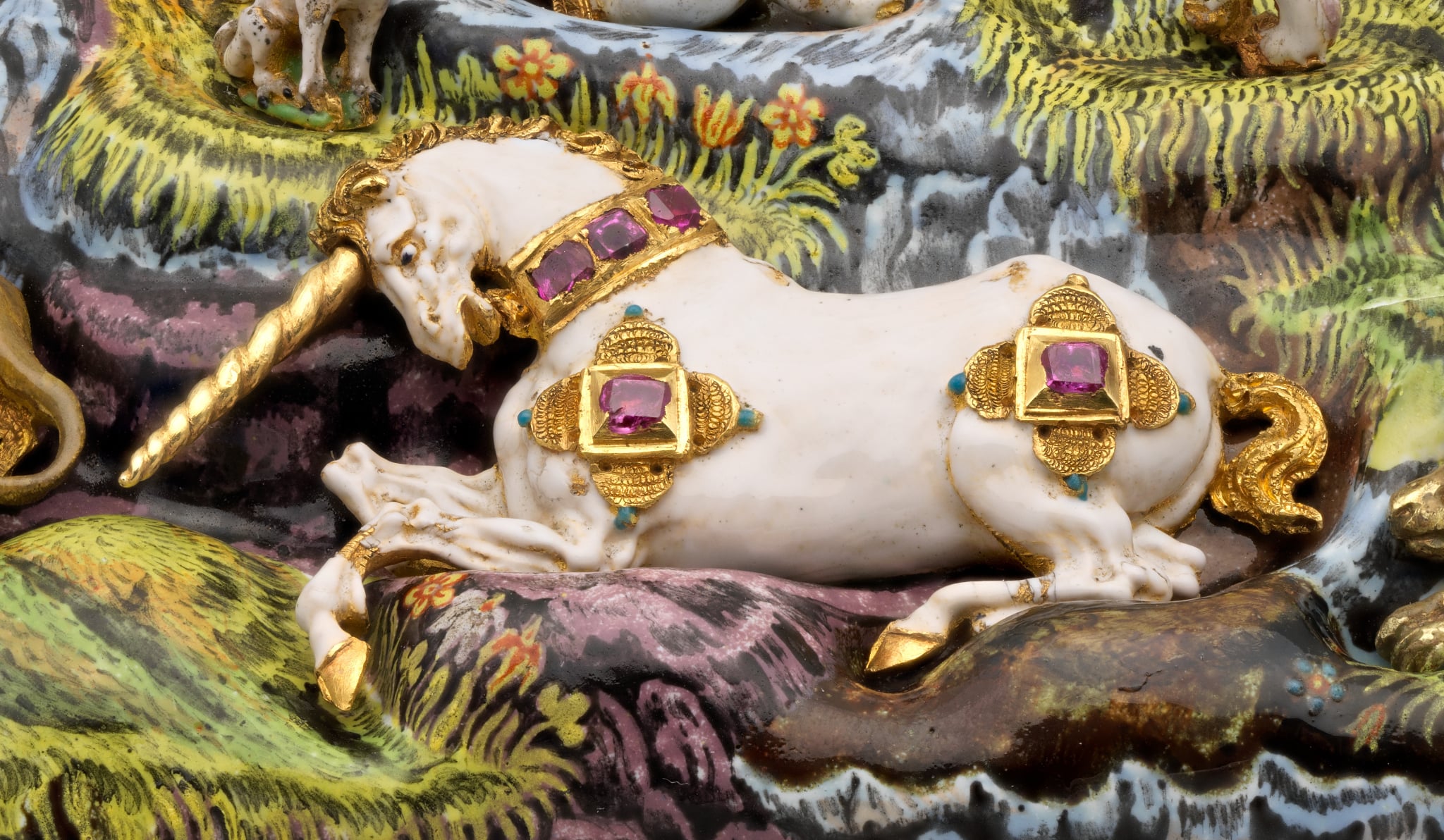
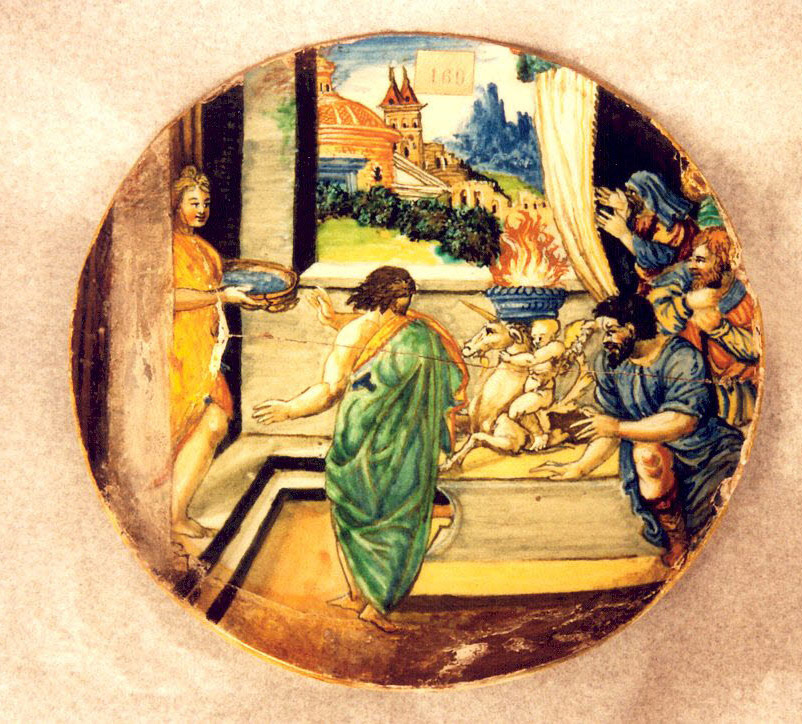
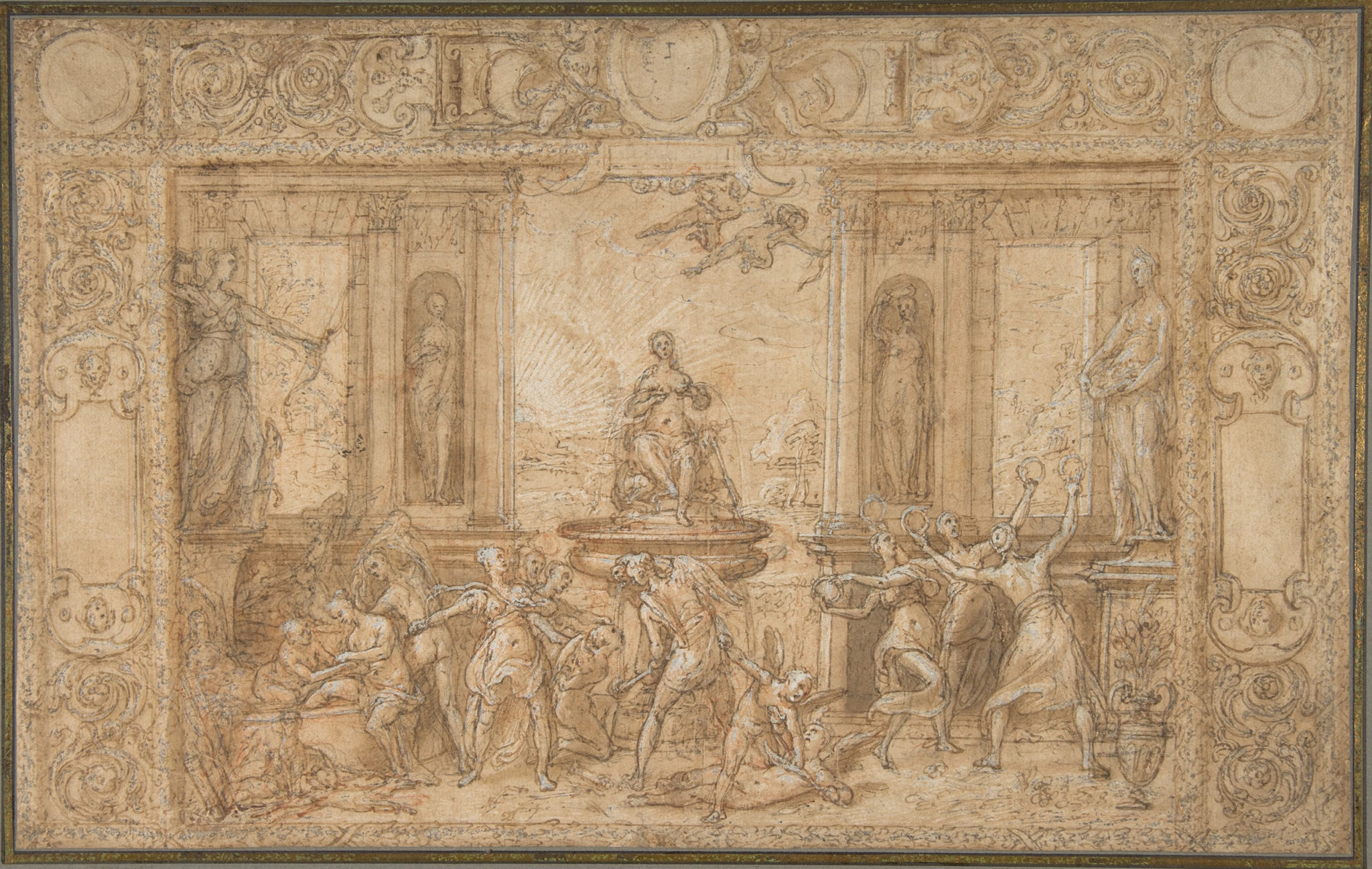
Pour représenter des licornes dans des scènes mythologiques, il fallait soit ajouter une corne à des créatures qui n’en avaient pas dans les récits classiques, comme les hippocampes représentés plus haut, soit faire de la licorne un animal parmi d’autres. Diane et Orphée appartiennent à des récits bien distincts, mais tous deux fréquentaient les créatures de la forêt, l’un pour les chasser avec son arc, l’autre pour les charmer avec sa lyre. Au Metropolitan Museum de New York se trouve une splendide coupe baroque réalisée à Prague vers 1600, pour l’empereur Frédéric II, sur le couvercle de laquelle Diane chasseresse et Orphée musicien sont représentés dos à dos, entourés d’animaux parmi lesquels une blanche licorne – et tant pis si cela semble donner à Orphée un rôle un peu ambigu.


[1] La vie de Benvenuto Celllini, écrite par lui-même, Paris, 1881, p.163 sq.
[2] Guido Schönberger, “Narwal-Einhorn, Stüdien über einen seltenen Werkstoff”,in Städel Jahrbuch,Francfort,1936, pp.199-200.
[3] BNF, ms fr 4732.

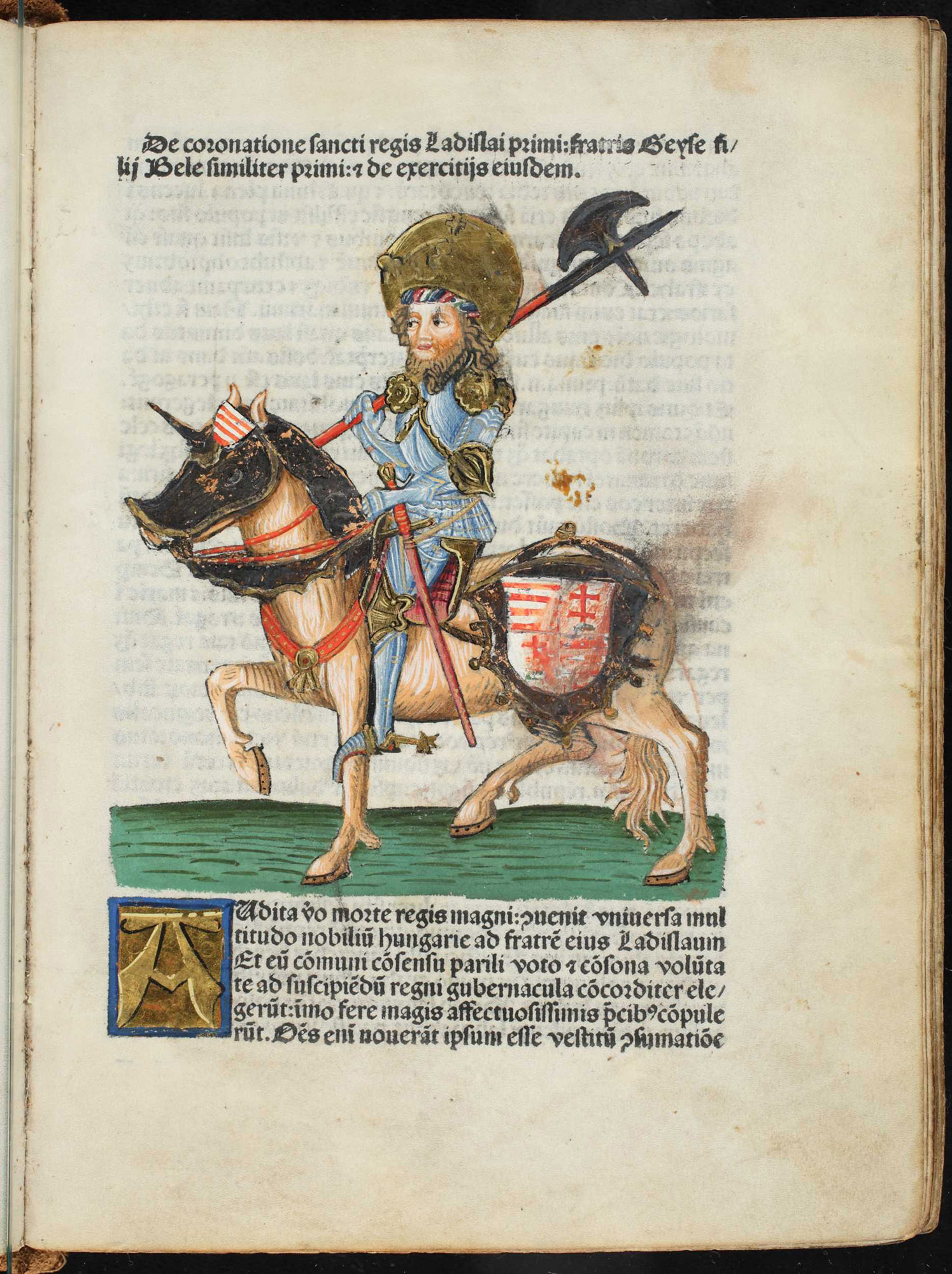
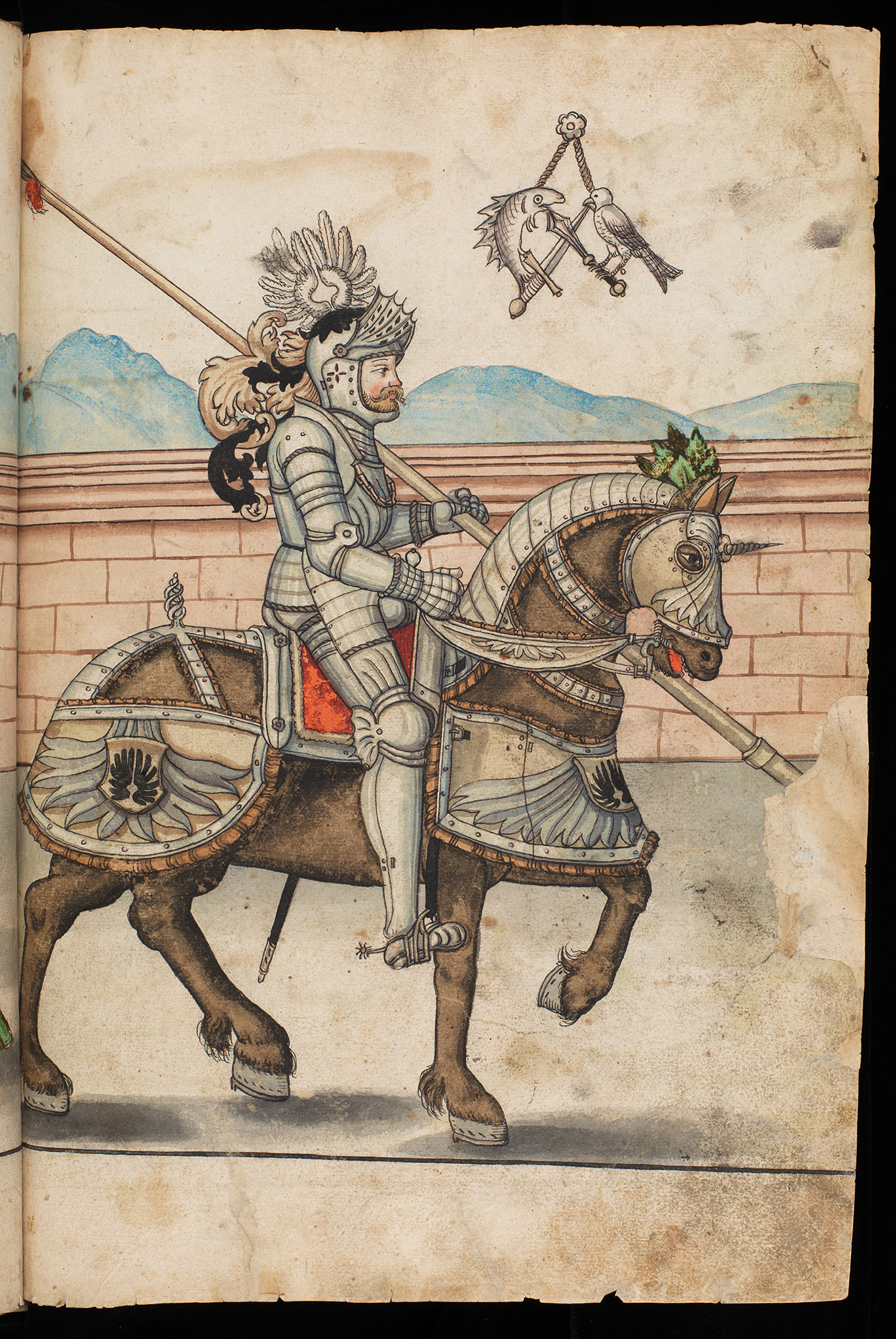
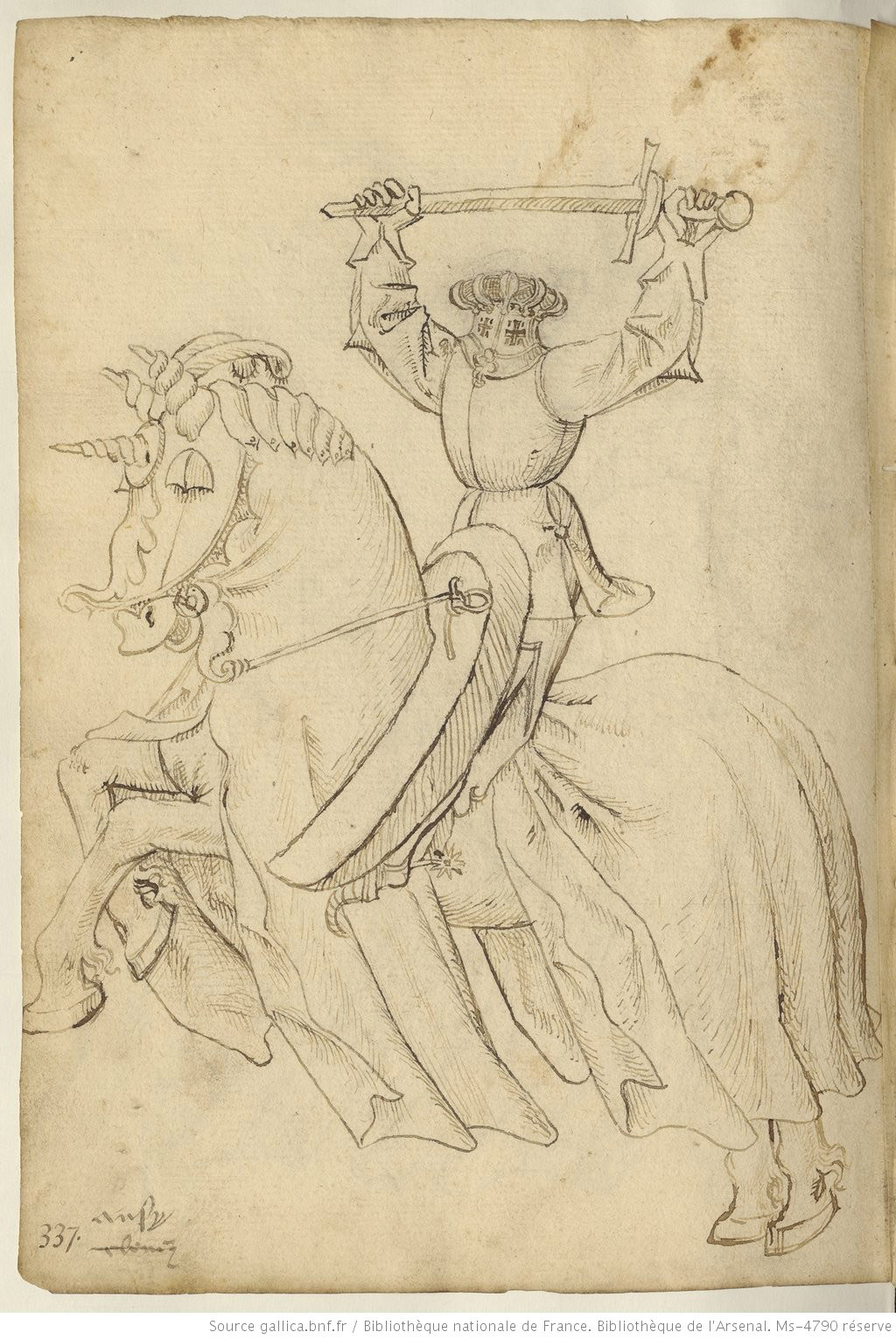
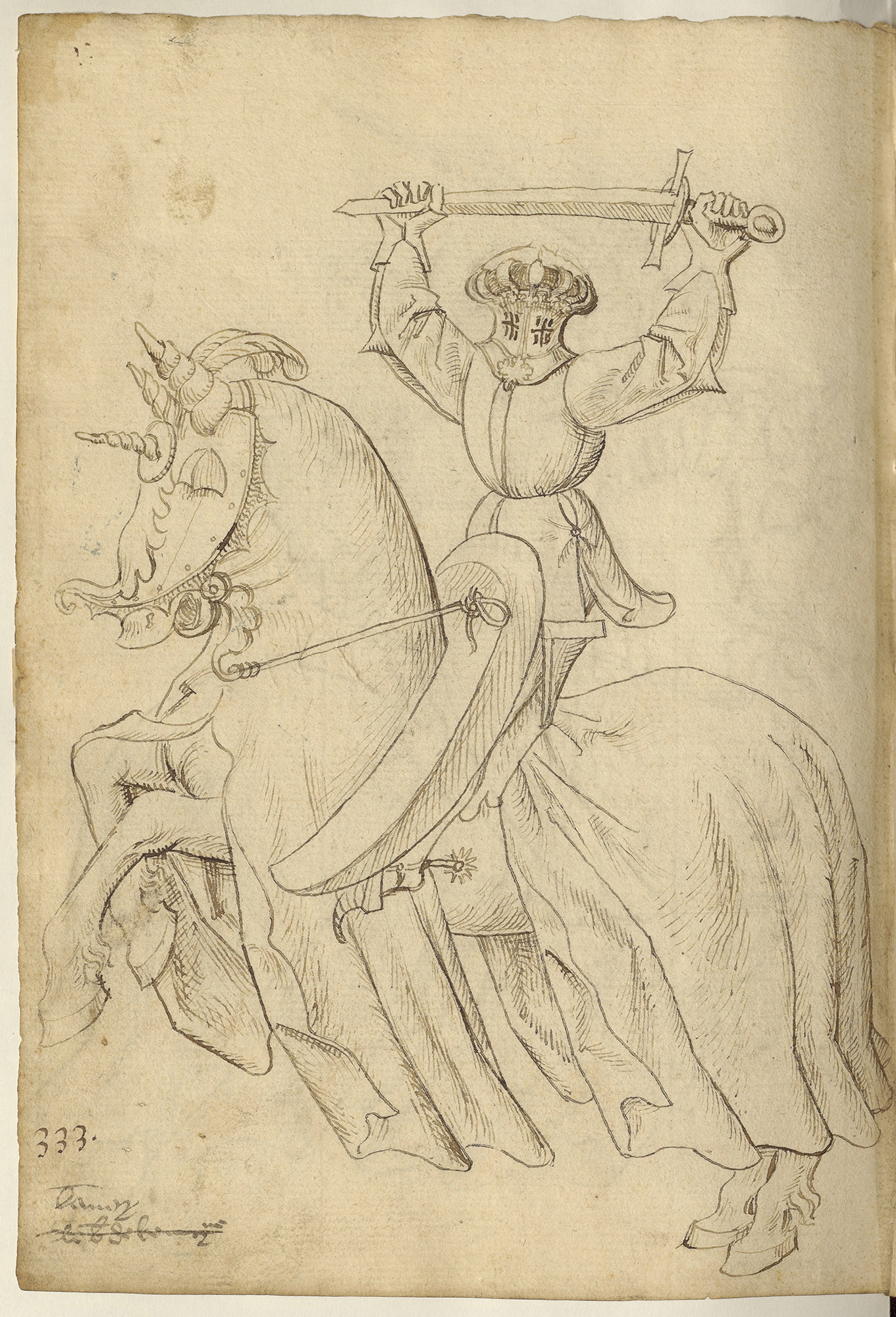
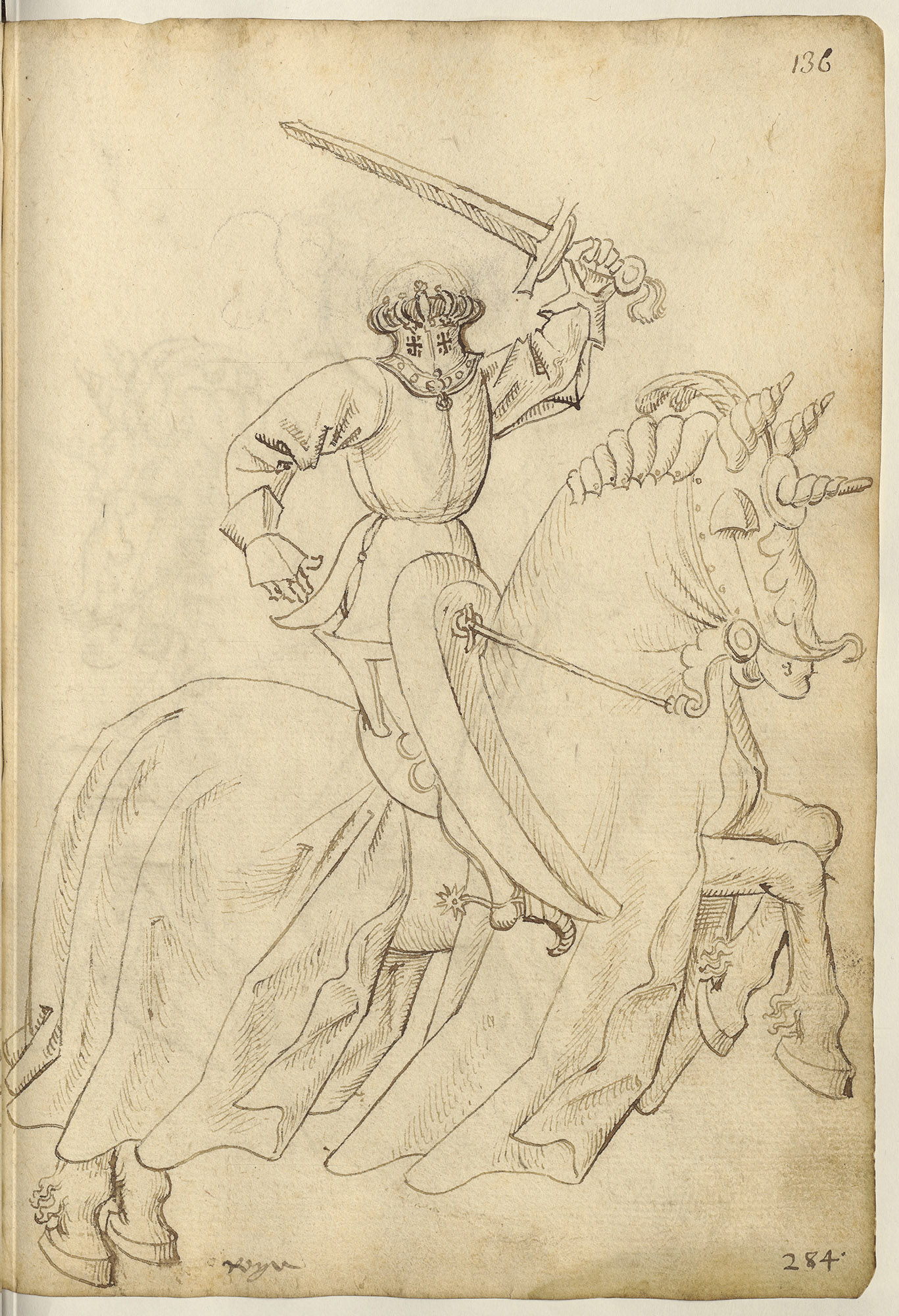
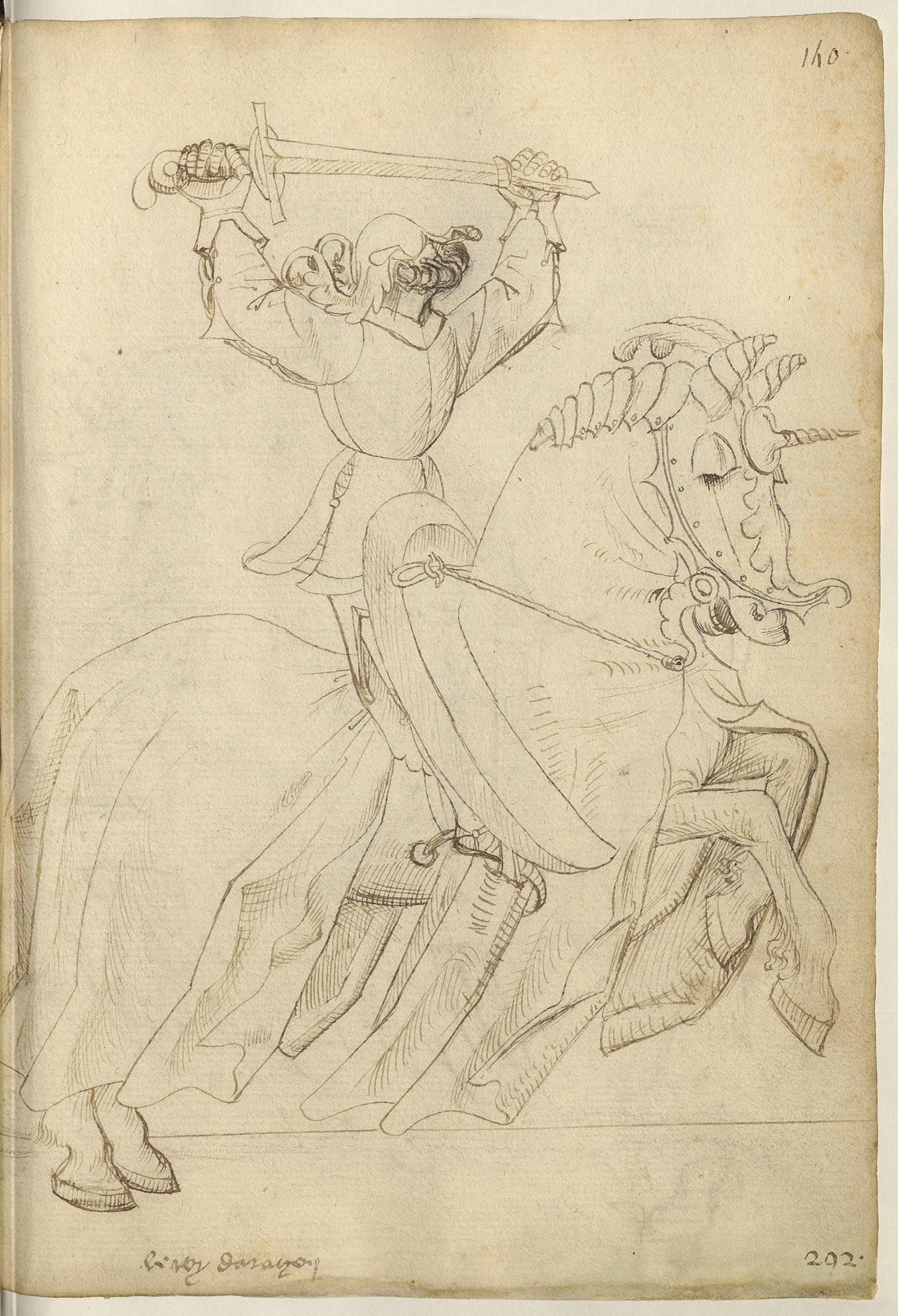
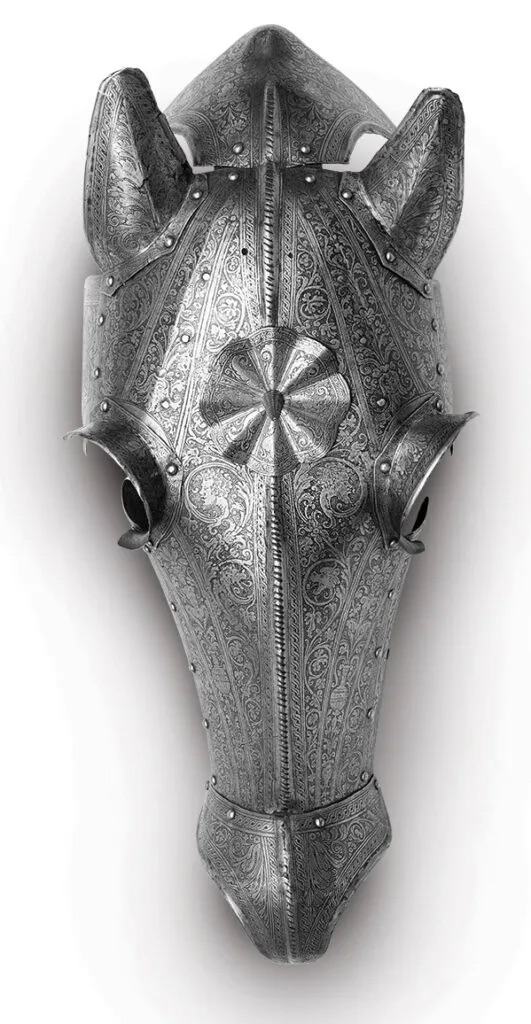
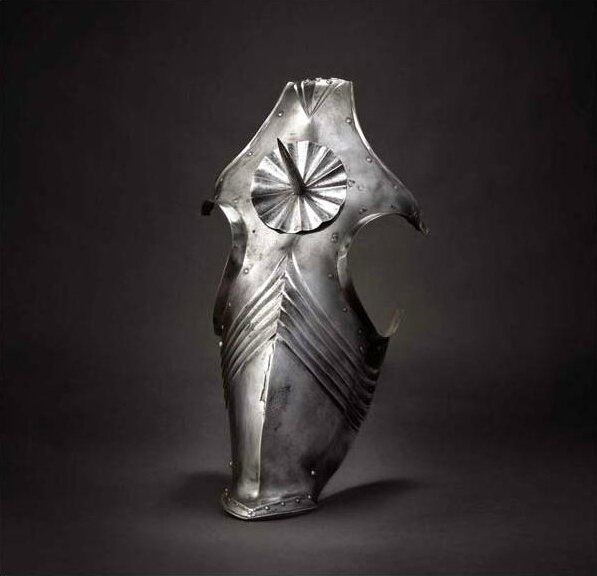
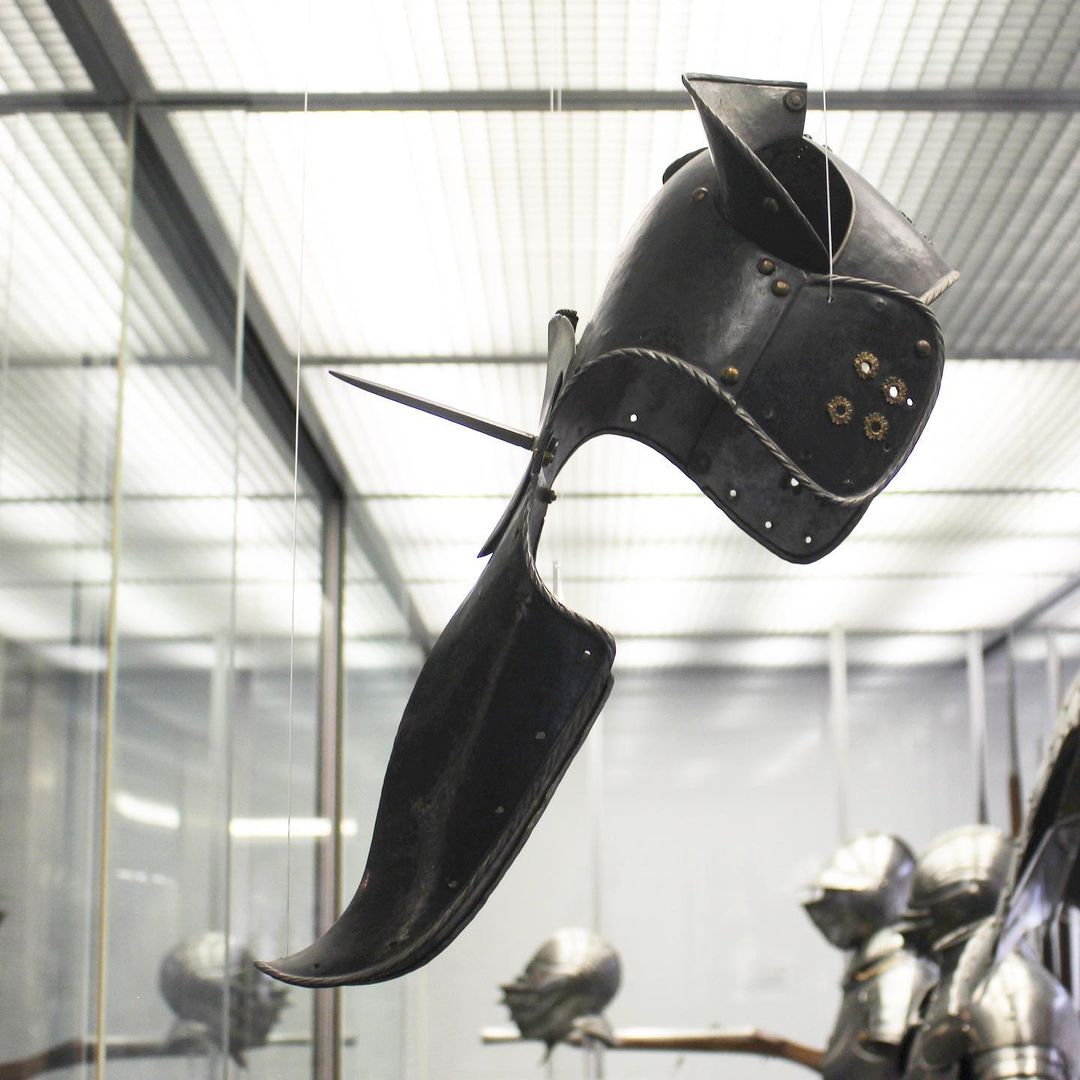
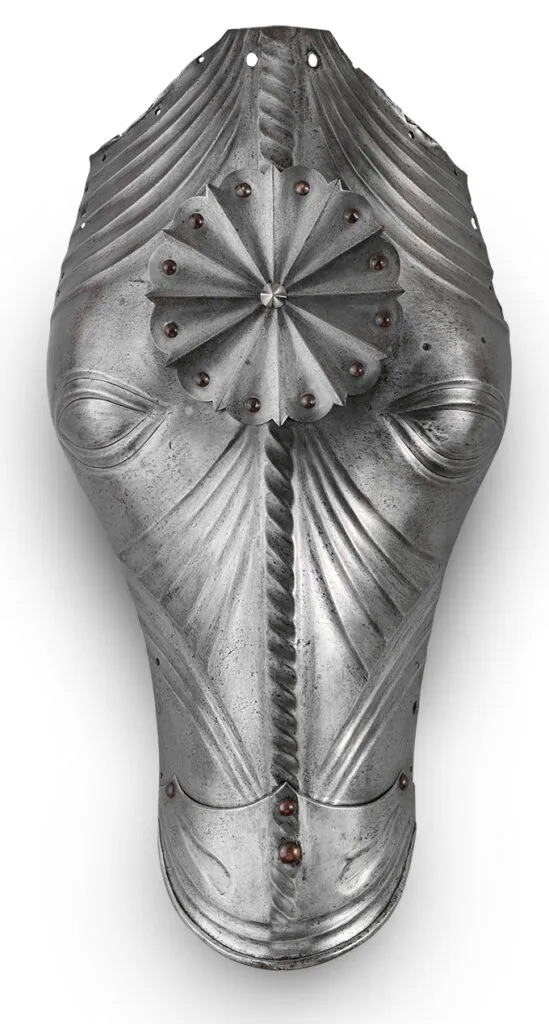
📖 Licornes de guerre et de tournoi

De Potsdam à Paris en licorne

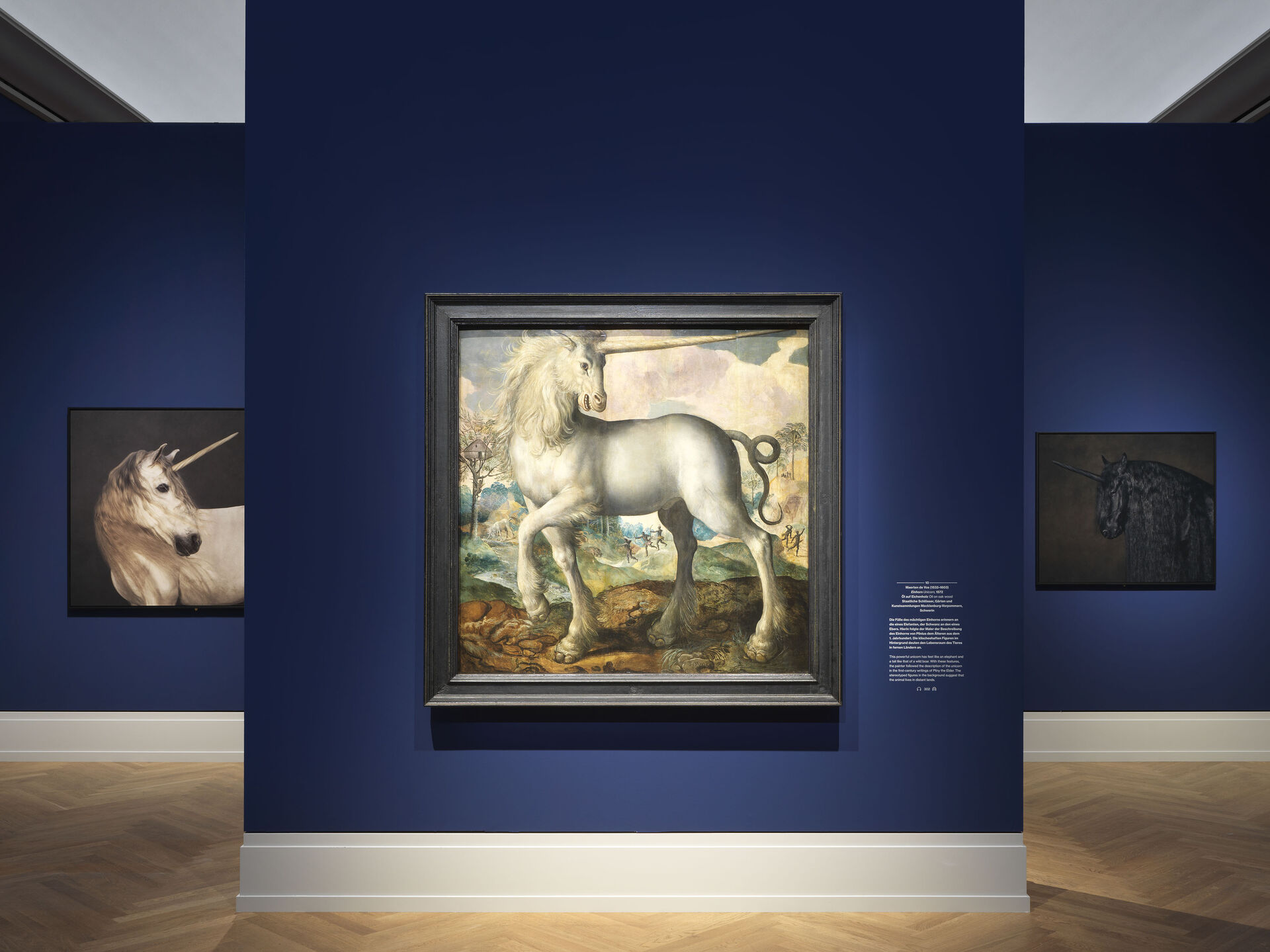
Une très riche exposition sur la lciorne, avec plusieurs pièces que je n’avais jamais vues, est actuellement à Potsdam, au musée Barberini. Vous pouvez en découvrir une partie en ligne, et même commander comme moi le beau catalogue, sur le site du musée Barberini.
Au mois de mars 2026, l’exposition déménagera vers le musée de Cluny, où il me sera quand même plus simple d’aller la voir….

On va sans doute s’arrêter là…

Cela fait quelques mois que je n’ai pas ajouté de nouveaux chapitres à ce blog. J’ai encore entre mille et deux-mille belles images que je pourrai ajouter ici et là, mais peu d’entre elles permettent vraiment d’enrichir mon propos, et j’ai un peu décroché des recherches en ligne pour me replonger dans la création de jeux. Bref, je ne vais sans doute plus enrichir ce site de nouveaux chapitres, ou très épisodiquement, même si je pourrai encore ajouter une image dans une galerie ici ou là lorsque l’envie m’en prendra.
En attendant, mon livre est toujours en vente dans toutes les librairies en ligne (ici par exemple, sur Amazon), et dans quelques-unes en dur.

➕ Lord Dunsany, Jorkens remembers Africa, 1934

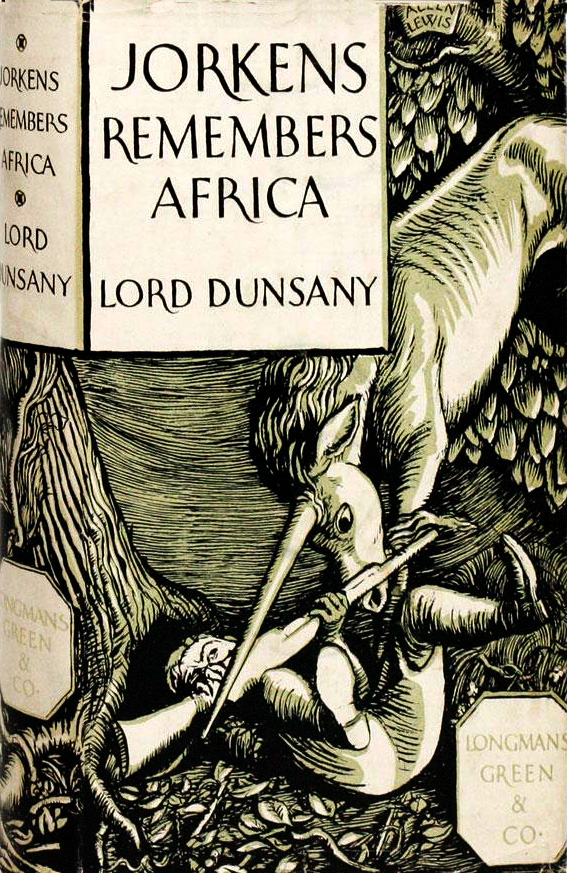
Les aventures de Jorkens furent écrites durant les années trente par Lord Dunsany, également auteur de La fille du roi des elfes dont il sera question plus loin.

Membre d’un club anglais, le héros, Jorkens,  est toujours celui qui raconte les histoires les plus extraordinaires, à défaut d’être les plus crédibles. Il a bien sûr chassé la licorne en Afrique du Sud, l’une des deux régions, l’autre étant le Tibet, où l’on pensait à la fin du XIXe siècle qu’il pouvait y avoir des licornes.. Malheureusement, ce texte n’a pas, à ma connaissance, été traduit, et je vous le livre donc en anglais.

To say that amongst all those that have read any of the tales of Mr. Jorkens’ travels that I have recorded, none have felt any doubts of any of them would be absurd: such doubts have been felt and even expressed. But what has impressed me very considerably is the fair-minded attitude taken up by the general public, an attitude that may be summarized as a firm determination not to disbelieve a man’s story merely because it is unusual, but to await the final verdict of science, when science shall have arrived at the point at which it is able to pronounce on such matters with certainty. Then, should the verdict be against Jorkens, and not till then, will a sporting public turn upon him that scornful disbelief that they are far too fair-minded to show without good and sufficient proofs. I myself meanwhile am careful to record nothing he tells me, against which anyone in the Billiards Club or elsewhere has been able to bring any proof that would definitely rule it out in a court of law. And it would be interesting to see for how long in such a court arguments that may be lightly advanced now, against the exact truth of any one of his tales, would stand up against the ridicule of counsel. But the sporting attitude that the public have adopted towards him is more to Jorkens than a verdict in any court of law. Curiously enough it is in the Billiards Club itself, the source of all these stories, that the most unsporting attitude is often shown to Jorkens. For instance only the other day one of our members was unnecessarily rude to him, though with only a single word. I need hardly say it was Terbut. The word was not in itself a rude one, but was somehow all the more insidious for that. Also it was really a single word, and not a short sentence, as is often the case when a writer says to you “I will tell it to you in one word.” But I will tell the story.

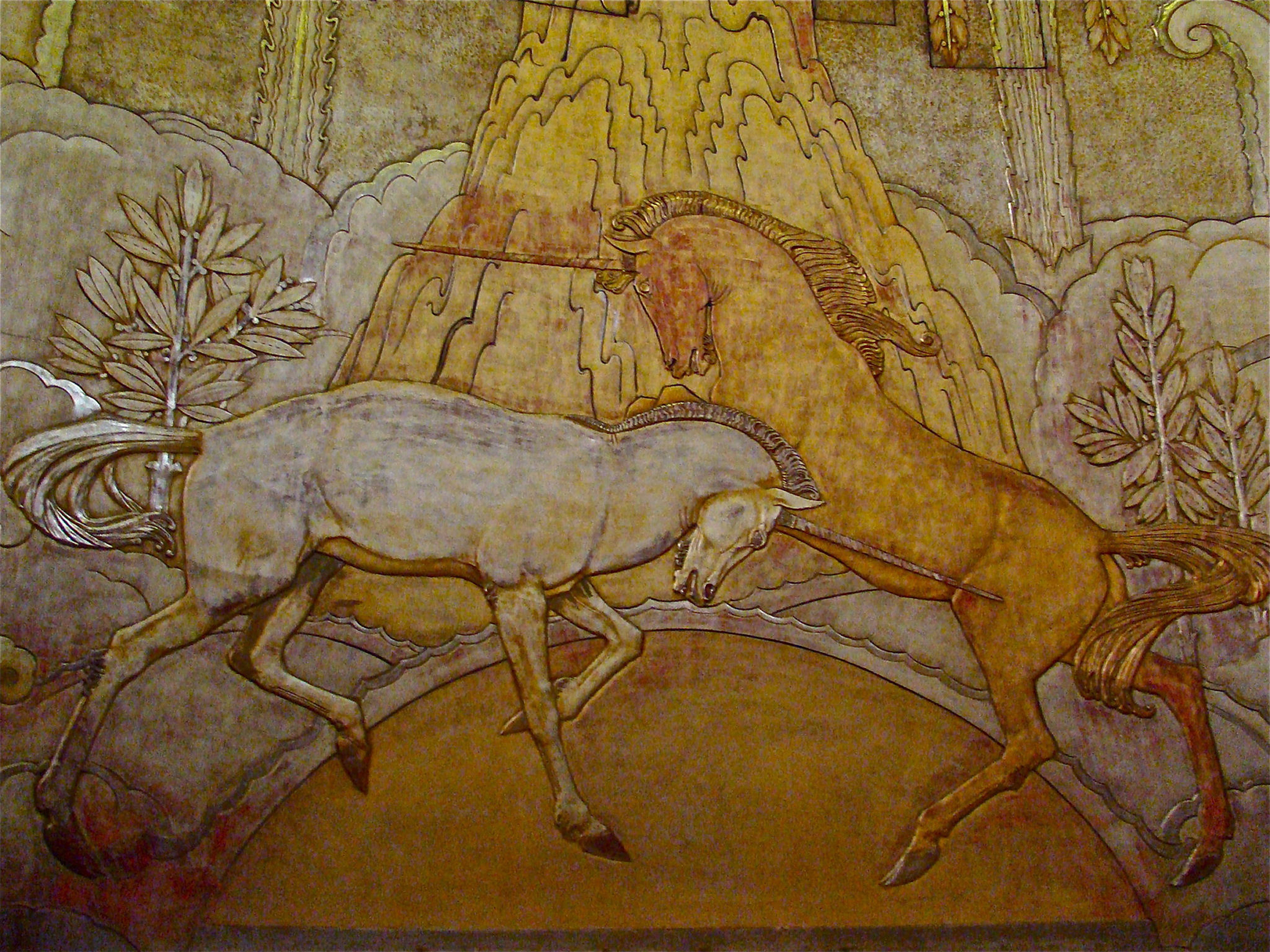
Combat de licornes sauvages dans le Salon de première classe du Queen Mary,Gilbert Bayes & Alfred Oakley, 1936.
Photo Andrea James, Wikimedia Commons

We were discussing billiards, which is not a thing we often do in the Billiards Club. There is, I suppose, some sort of feeling that, if anyone talks of billiards there, his imagination or his experience can provide him with nothing better; billiards being, as it were, bed-rock in the Billiards Club. In just the same way at the Athenæum, although the bird is inseparable from the Club’s presiding goddess, one seldom if ever orders an owl for one’s lunch. But we were discussing billiards to-day, and debating whether bonzoline balls or the old ivory kind were the better. I will not record the discussion, for it has nothing to do with Jorkens, but it may interest my readers to hear that it was held at the Billiards Club that the bonzoline ball was unique among modern substitutes, in being better than the old genuine article. It was as we had decided that, that some young member who ought to have known better, seeing Jorkens near him as he looked up, suddenly blurted out: “Have you ever seen a unicorn, Jorkens?” Of course it was not the way to speak to an elder man. Of course the implication was obvious. And Jorkens saw in a moment that the young fellow did not believe in the existence of unicorns at all. In any case he had not yet passed that time of life in which one believes nothing that the ages have handed down to us until we have been able to test it for ourselves. “I deprecate that hard and fast line between fabulous animals and those that you all chance to have seen,” said Jorkens. “What does it amount to, practically, but a line drawn round Regent’s Park? That’s all it is really. Everything inside that line is an animal you readily believe in. Everything outside it is fabulous. It means you believe in an animal if you have seen it in the Zoo, otherwise not. However full history is of accounts of the unicorn, and the most detailed descriptions, still you go off to Regent’s Park on a Sunday, and if there is not one there waiting for your bun you disbelieve in the unicorn. Oh well, I was like that myself till I saw one.”
“You saw one?” said the young fellow who had started the topic. “I’ll tell you,” said Jorkens. “I was camped once by the Northern Guaso Nyero, or rather I was camped two hundred and fifty yards from it, a distance that just makes all the difference, for two hundred yards is all that the mosquito flies from his home. Of course he has a good many homes, that’s the trouble; but, as he prefers a river frontage, it’s a very good thing to camp that far from a river. Not that it amounts to much, for Africa can always get you some other way. But there it was. Well, I was collecting heads for a museum, and had been at it for some time, with a white hunter and eighty natives, trekking through Africa; and I was beginning to get pretty tired of it. I was sitting by one of our campfires after supper, with the white hunter beside me, and I was gazing into the glow of the smouldering logs and watching the fireflies gliding backwards and forwards, and thinking all the while of the lights of London. And the more the fireflies slowly grew into multitudes, and the more the fire glowed, the more I longed for London. In that mood I asked the hunter what we should do next day; and, whatever he suggested going after, I pointed out I had shot it already. Which was perfectly true. “And winds came out of the forest, or over the plains, and softly played with the smoke going up from our logs of cedar, and the visions changed and changed in the glow of the fire, and every now and then the hunter past, that’s what it is now; and not to take account of that is an error as great as supposing a rhino can’t smell. The moment the unicorn sees the line of beaters, with the flanks coming quietly in on him, he knows what’s up; he knows he’s being driven. By a glance at the line (and his sight is very acute) he knows to what direction. He immediately slips through the forest in exactly the opposite; straight through the line of beaters; and in these forests he usually gets through without even being seen by a native. Not that they haven’t seen them.’ “‘Then the place for a gun to stand,’ I said. “‘Exactly,’ he interrupted. ‘Stand in front of the unicorn, wherever he is, and we’ll try to drive him away from you. He’s sure to come straight back.’ “Now this seemed to me perfectly sound. Unicorns do avoid men, there can be no doubt of that. They must have some method in doing it. Granting a considerable intelligence, without which no method is any good, what better than hiding in a dense forest, and, when driven, always going in the opposite direction to that which is obviously intended? And history is too full of the unicorn for us to suppose that they are merely not there. “‘Well,’ said Rhino, for Rhino Parks was his name there, whatever it may have been in England once, ‘those Wakamba trackers have found him. What about trying to-morrow?’ “‘I’m not sure that I can hold a rifle just yet,’ I said. “‘No use giving in to malaria here,’ he answered, ‘or no one would ever do anything.’ “Which is true, though the place is a good deal written up as a health-resort. “‘All right. To-morrow,’ I said. “And to-morrow came, which was one thing to the good. You never know what’s coming, with malaria. “Well I was up and ready by five, but Rhino wouldn’t start till I’d had a good breakfast. So I sat down to it. It had to be liquid, because I could have no more eaten bacon and eggs, as I was just then, than I could have eaten a live squirrel. But we made a breakfast of sorts on two bottles of vermouth that we had; and by about seven we started. “And now comes the incredible part of my story: we crossed the river and pushed into the forest, and I took up my place where the Wakambas told me in whispers, and the beaters moved off away from me, and all the while I had forgotten to load my rifle. You may not believe me; and, if you don’t, I don’t wonder; but there it was, I did it. Malaria, I suppose. As a matter of fact it is just one of those things that people do do once in their lives, and very often of course it happens to be the last thing they ever do. Well, I stood there with my rifle empty, waiting for the unicorn, a .360 magazine: the magazine holds five cartridges and there should be another one in the barrel: and the steps of the beaters sounded further and further away from me. And then there came a broken furtive sound, as of something heavy but sly coming down through the forest. And there I was, with my empty rifle ready. And all of a sudden I saw a great shoulder so graceful, so silken and gleaming white, nearby in that denseness of greenery, that I knew that it must be the unicorn. Of course I’d seen hundreds of pictures of them, and the thing that I marvelled at most was that the beast, or all I could see of him, was so surprisingly like to the pictures. I put up my rifle and took a good enough aim, and then Click, and I knew it was empty. “Of course I hadn’t forgotten to bring any cartridges at all, I wasn’t so crazy as that, whatever my temperature was: my pocket was full of them. I put my hand to my pocket and slipped in a cartridge at once, and there I was loaded, with the unicorn still only twenty-five yards away. But he had heard the click, and, whether or not he knew what it was, he at any rate knew it for man, even if he hadn’t yet seen me; and he changed at once his slow slinking glide for a sharp trot through the forest. Again in a gap I saw a flash of his whiteness, and I fired and am sure I hit him, and then he came for me. Where I hit him I never knew, my one good chance of a shot behind the shoulder was gone, and I had had to take whatever shot I could get; and now I was again unloaded, for there had been no time to put anything into the magazine, and the unicorn was practically on top of me. Even as I took another cartridge out of my pocket he made a lunge at me with his flashing horn, a deadly weapon of ivory. I parried it with my rifle, and only barely parried, for the strength of its neck was enormous. It wasn’t a thing that you could waft aside as you can with the thrust of a sword, if only you are in time; it was so gigantic a thrust that it took all one’s strength to turn it. And you had to be just as quick as when trying to parry a rapier; even quicker. At once he lunged again, and again I parried: no question of thinking of trying to load my rifle; there was only just time for the parry. And as I barely parried, and the horn slipped by under my left arm, through the brown shirt I was wearing, clean as a bullet, I knew that I should parry few more, if any, like that; and that with the next thrust, or the one after, all would be over; for the power I felt in that horn was clearly more than my match. So I stepped back to gain an instant; which I barely did, so swiftly the huge beast stepped forward; and then I swung my rifle over my back and, before he thrust again, I brought it down as hard as I could at his head. I knew it for my last chance, and put into it all the strength that malaria had left me. Now it was his turn to parry. He saw it coming and flicked at it with his horn, and the horn caught it and the two blows came together. Either of them was a good blow. And together they amounted to pretty much of a smash. Well, neither ivory nor steel is unbreakable; and as for the stock of my rifle I don’t know where it went; the branches all round were full of flying splinters. And then I saw that long thin murderous horn, lying white on the ground beside me. The unicorn saw it too: it put its forefeet out, and lowered its nose and sniffed at it. As the beast was doing nothing at the moment, I picked the horn up. And when it saw the horn in my hand it looked irresolutely at me. For a moment we stood like that. It might easily have overcome me by sheer weight, and trampled me under with its pointed hooves; and yet it stood there motionless, seeming to have an awe for its own horn, which it now saw turned against it. Then I moved the horn into the hand that was holding the rifle, with the intention of seeing if it was possible to get a cartridge into what was left of the breech; and at the movement of the horn in my hand the unicorn shied like a horse, then turned round and kicked out with his heels and sprang away, and was almost immediately lost to sight in the forest. And that was the last I ever saw of a unicorn.”
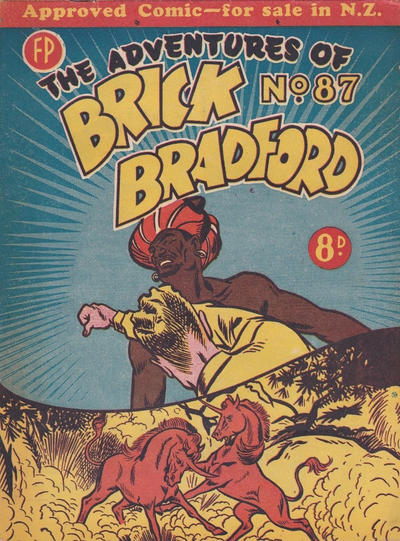
La chasse au lion, Gravure de Jean-Baptiste Scotin, circa 1750.
Le paysage aurait plutôt l’air africain, mais les visages et les costumes font indien. En tout cas, c’est exotique.

“But the horn,” said the young fellow who had asked at first about unicorns. “Why didn’t you keep the horn?” “Waiter,” said Jorkens without a word to his critic, “bring me that toasting fork that I gave to the Club.” We most of us present something to the Club, and sure enough Jorkens had once given an ivory-handled toasting fork, that lay in a drawer in the pantry; for whoever wants to use a toasting fork in a Club? And now the waiter brought it, a fork with silver prongs, or electro-plate, and a long ivory handle, too narrow for the tusk of an elephant and too long for a tooth. “And bring me,” he said, “a small whiskey and soda.” The whiskey was brought, and as he drank it the strange fork was handed round. Not all of us had seen it before; none of us had eyed it attentively. “Well, what do you make of it?” said Jorkens when he had finished his whiskey. It was then that Terbut leaned over to me and whispered, but only too audibly, the one word “Bonzoline.” The ungenerous comment cast over the tale something like, well, a miasma. And that’s the kind of thing that Jorkens has to put up with.

Lord Dunsany, Jorkens remembers Africa, 1934

Heroes of the Dark Continent, 1890. Contrairement à ce que le titre de la gravure peut laisser croire, ce ne sont pas les légendes africaines qui sont illustrées ici mais les légendes antiques et médiévales au sujet de l’Afrique.

Exposition “Animaux Fantastiques” au Louvre-Lens

J’étais hier soir au Louvre-Lens pour le vernissage de la très belle exposition “Animaux fantastiques”, à laquelle j’ai un tout petit peu contribué. On peut y croiser une bonne vingtaine de licornes. La blanche bête y est en effet, après le dragon et plus ou moins à égalité avec le griffon, l’animal le plus représenté. L’exposition est riche, claire, bien structurée, et j’en recommande vivement la visite à tous ceux qui s’intéressent aux licornes ou à d’autres bestioles de la ménagerie fantastique.
Vous trouverez bien sûr tous les détails sur le site du musée.

📖 Dragons unicornes

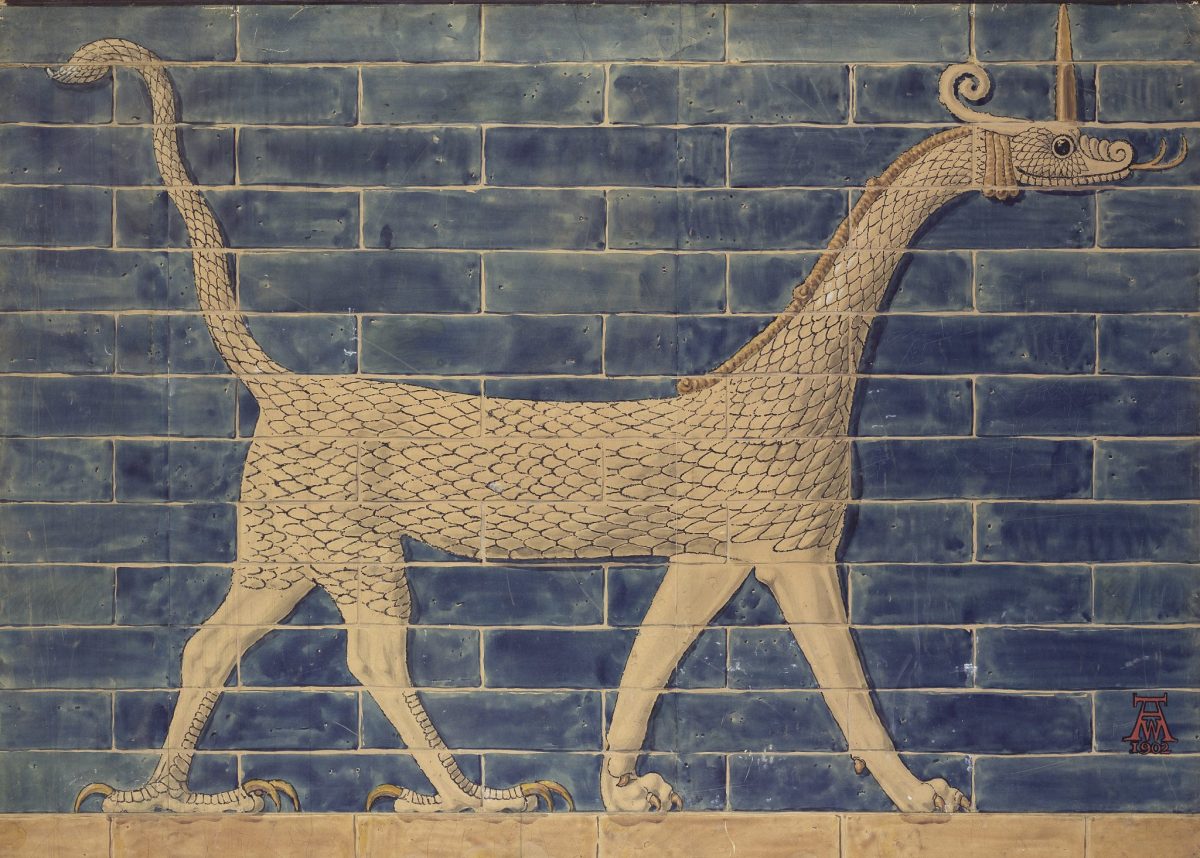
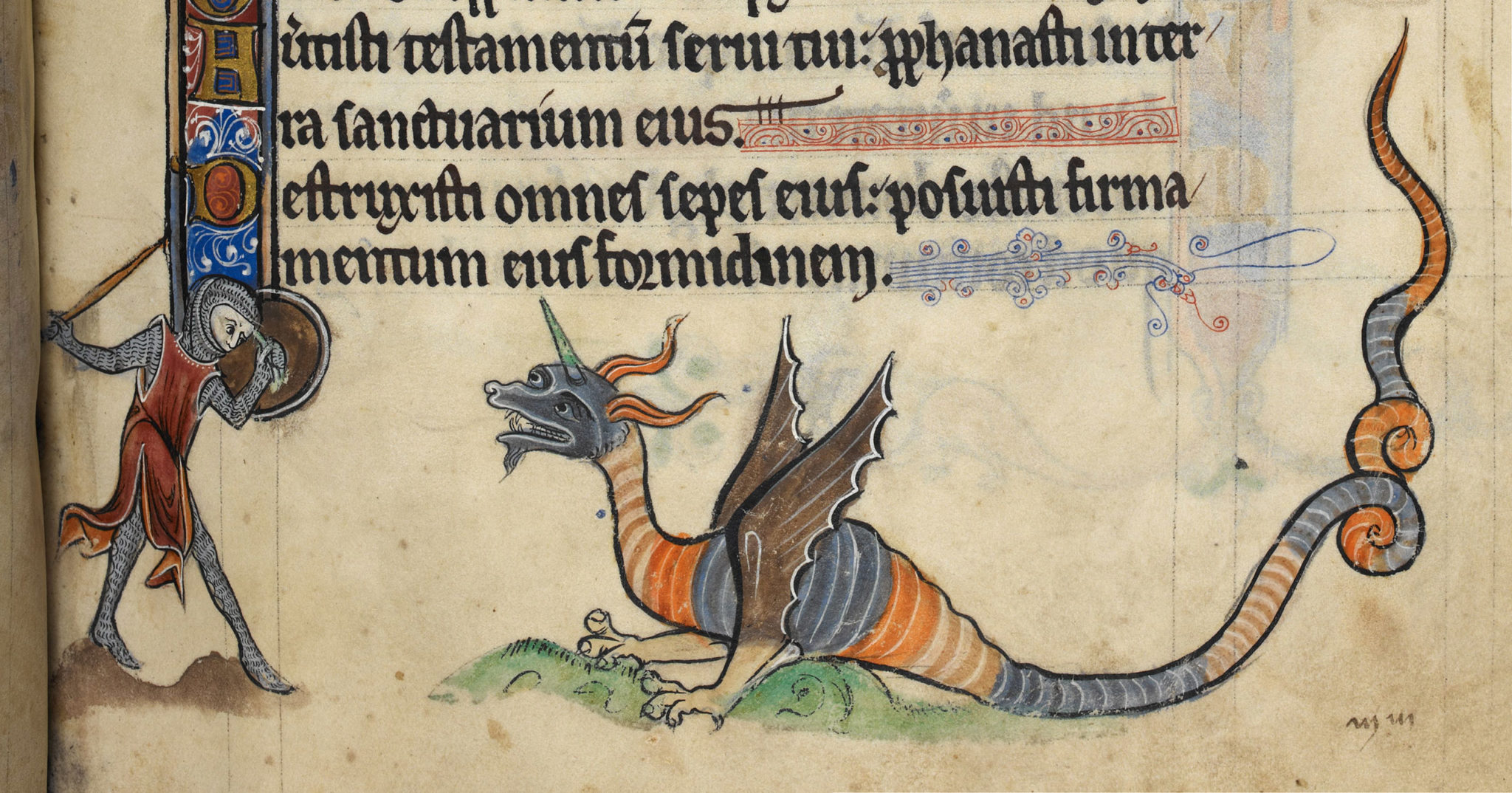
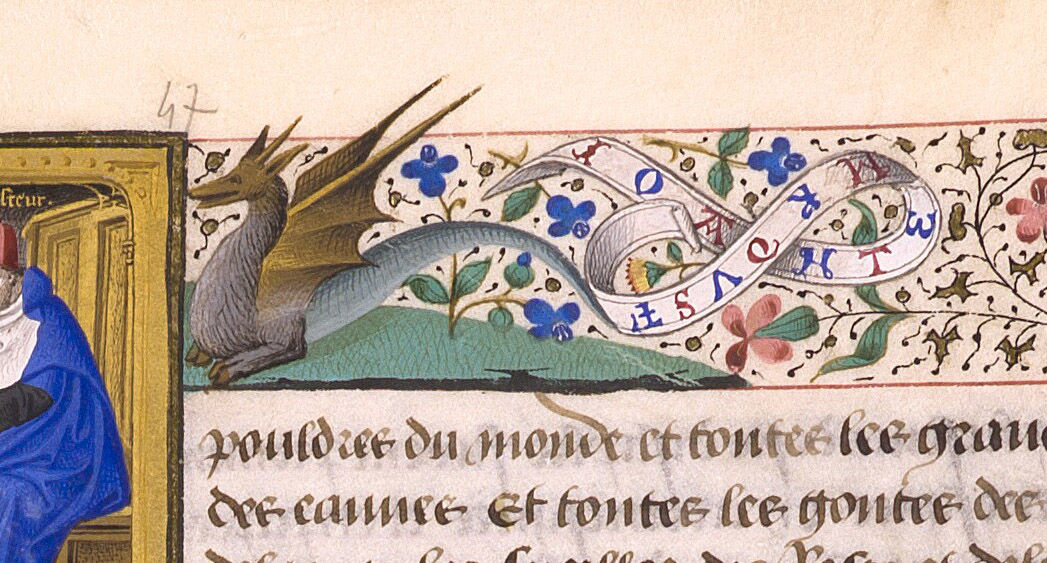
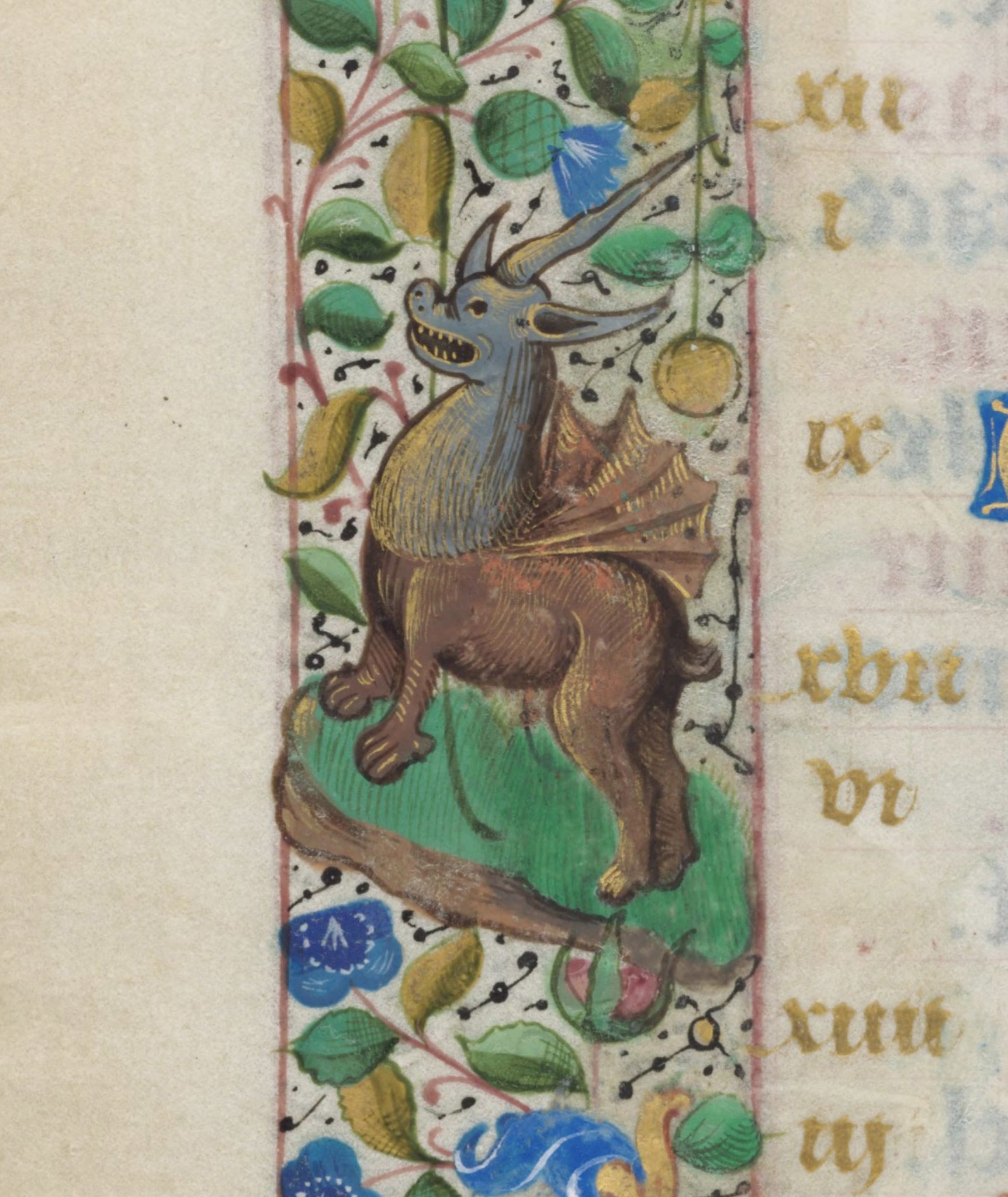
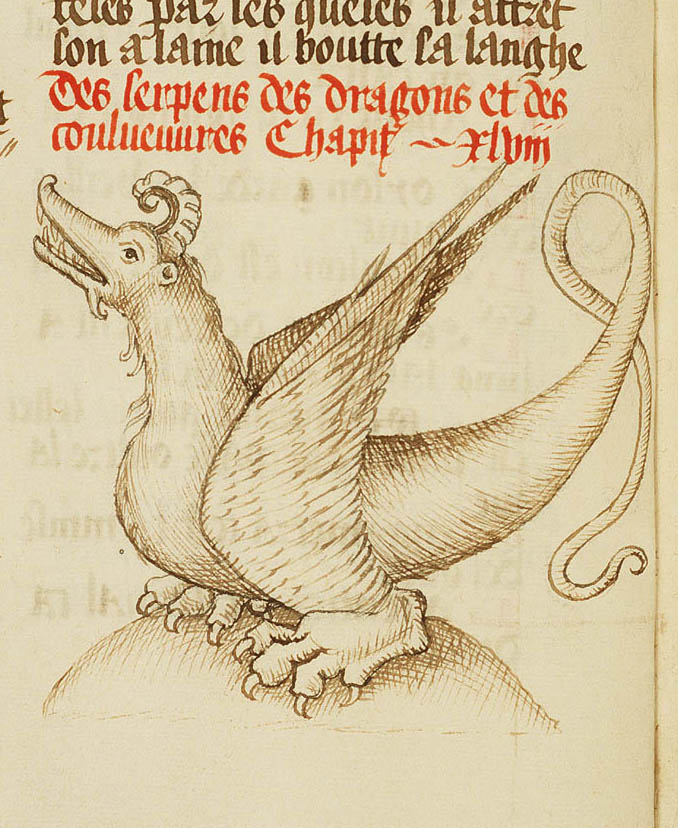
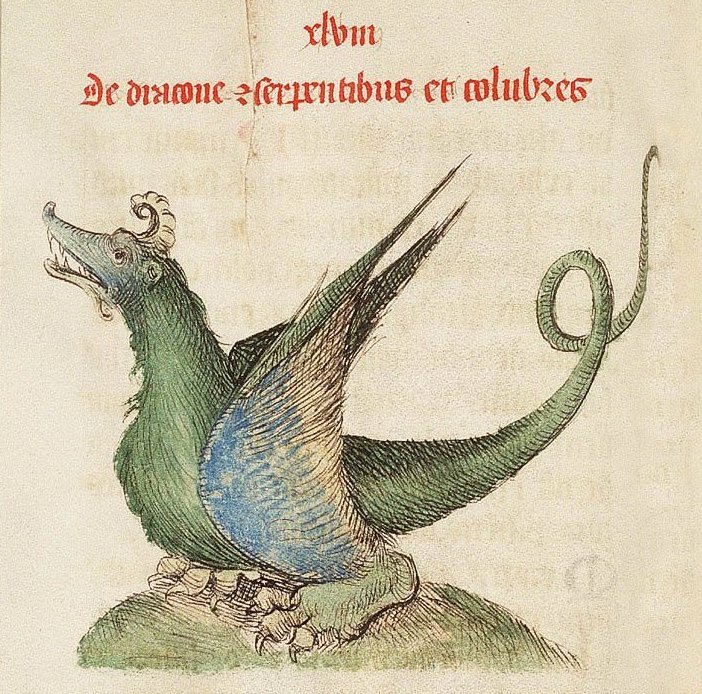
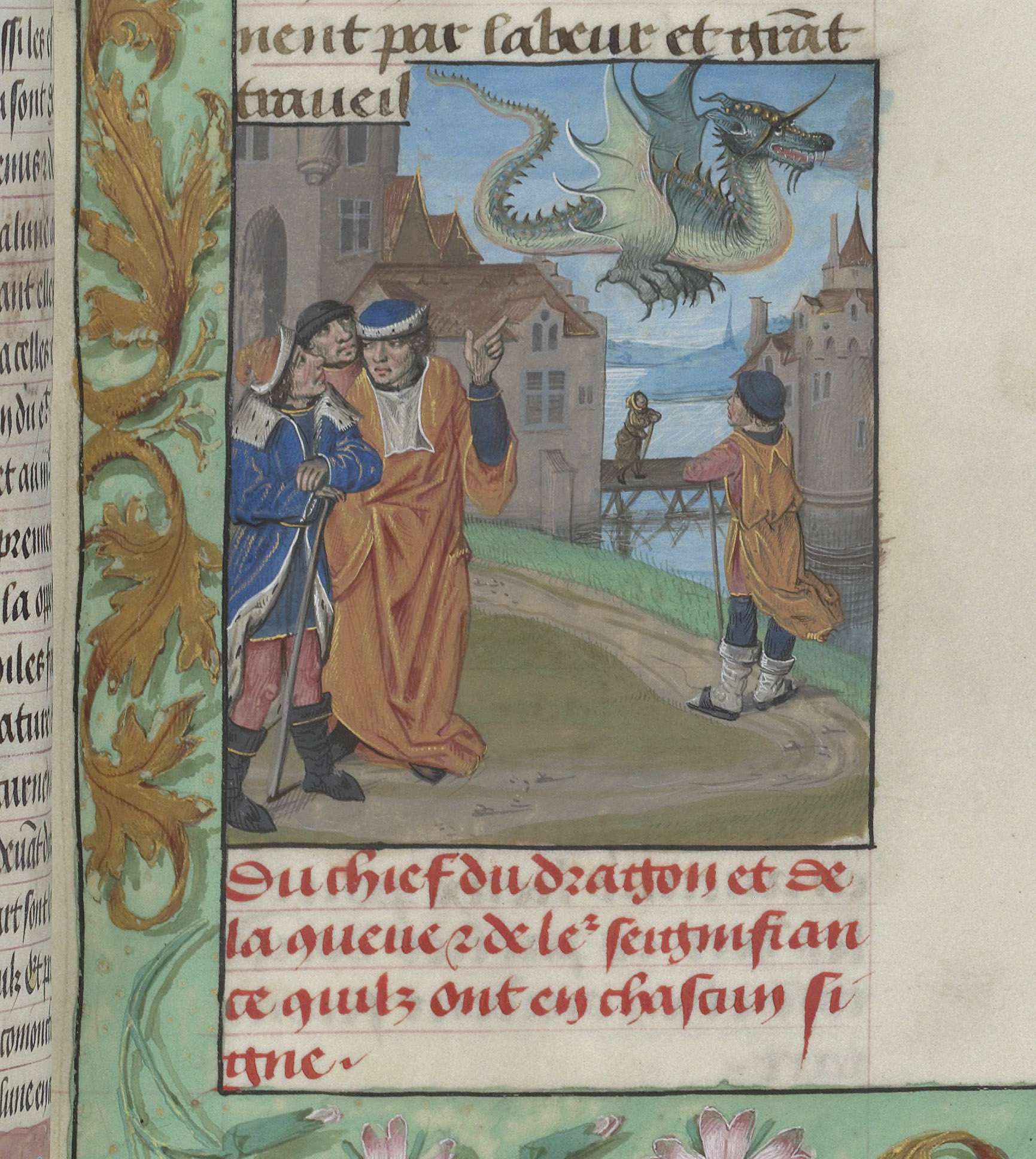
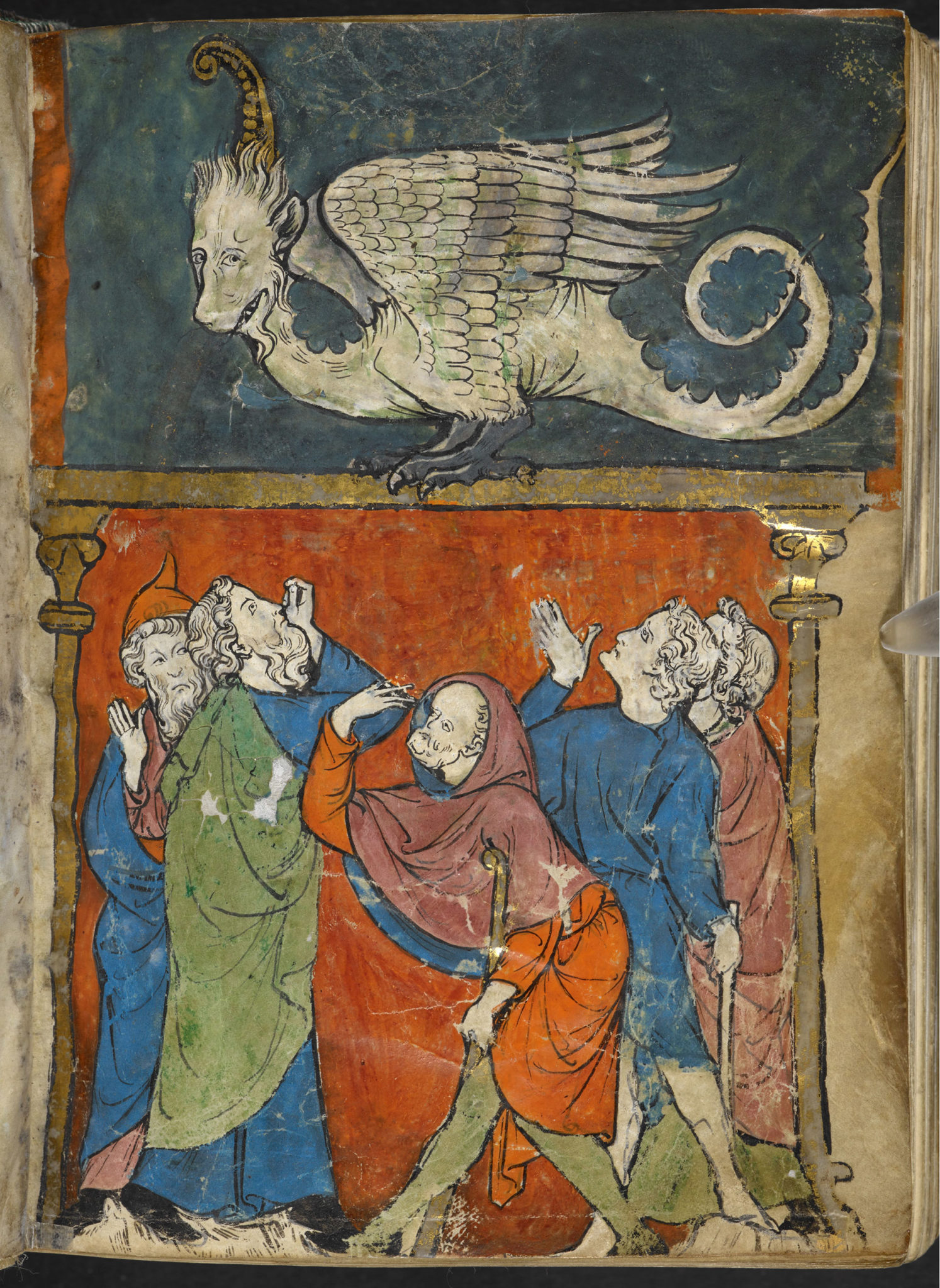
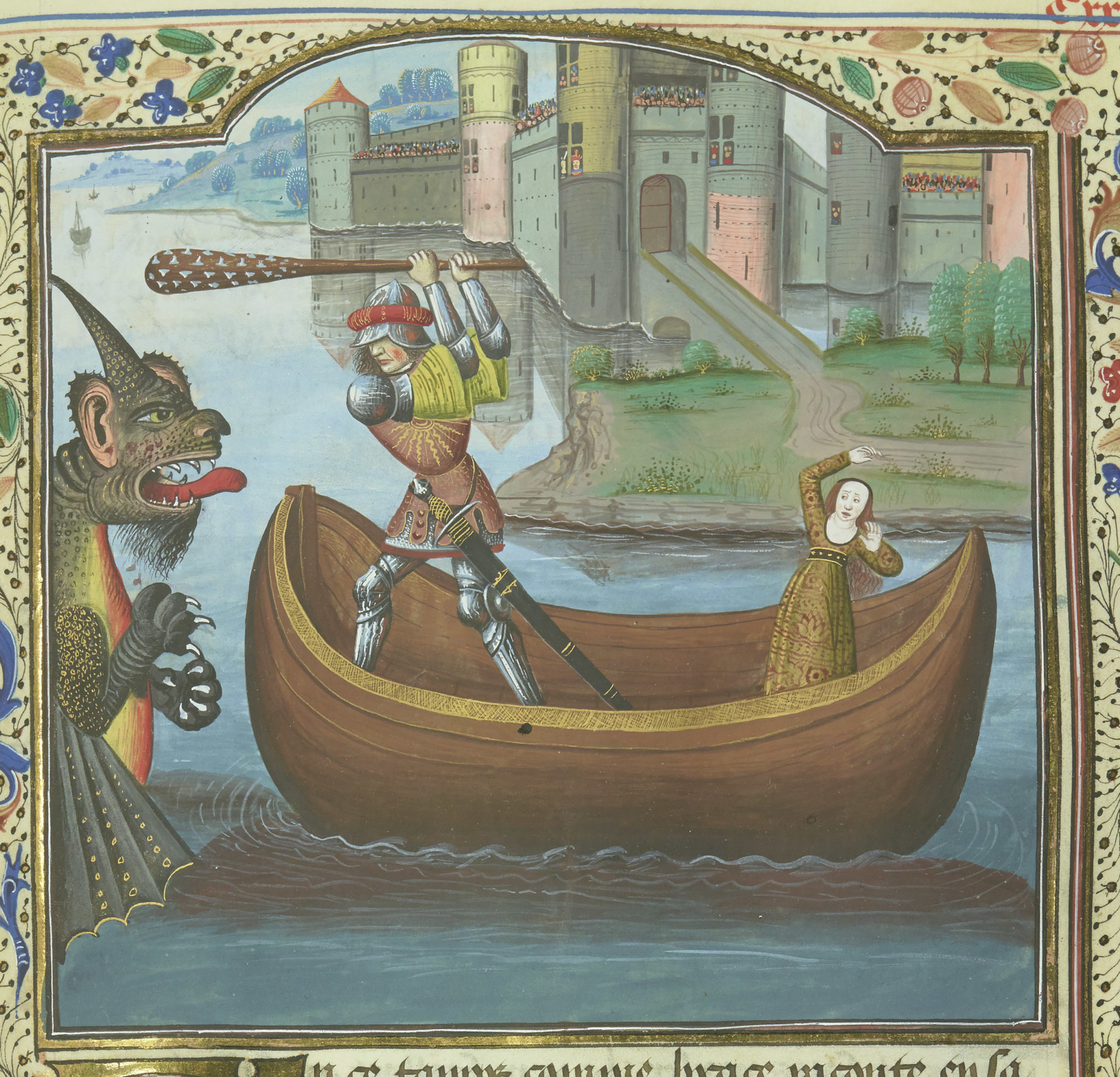
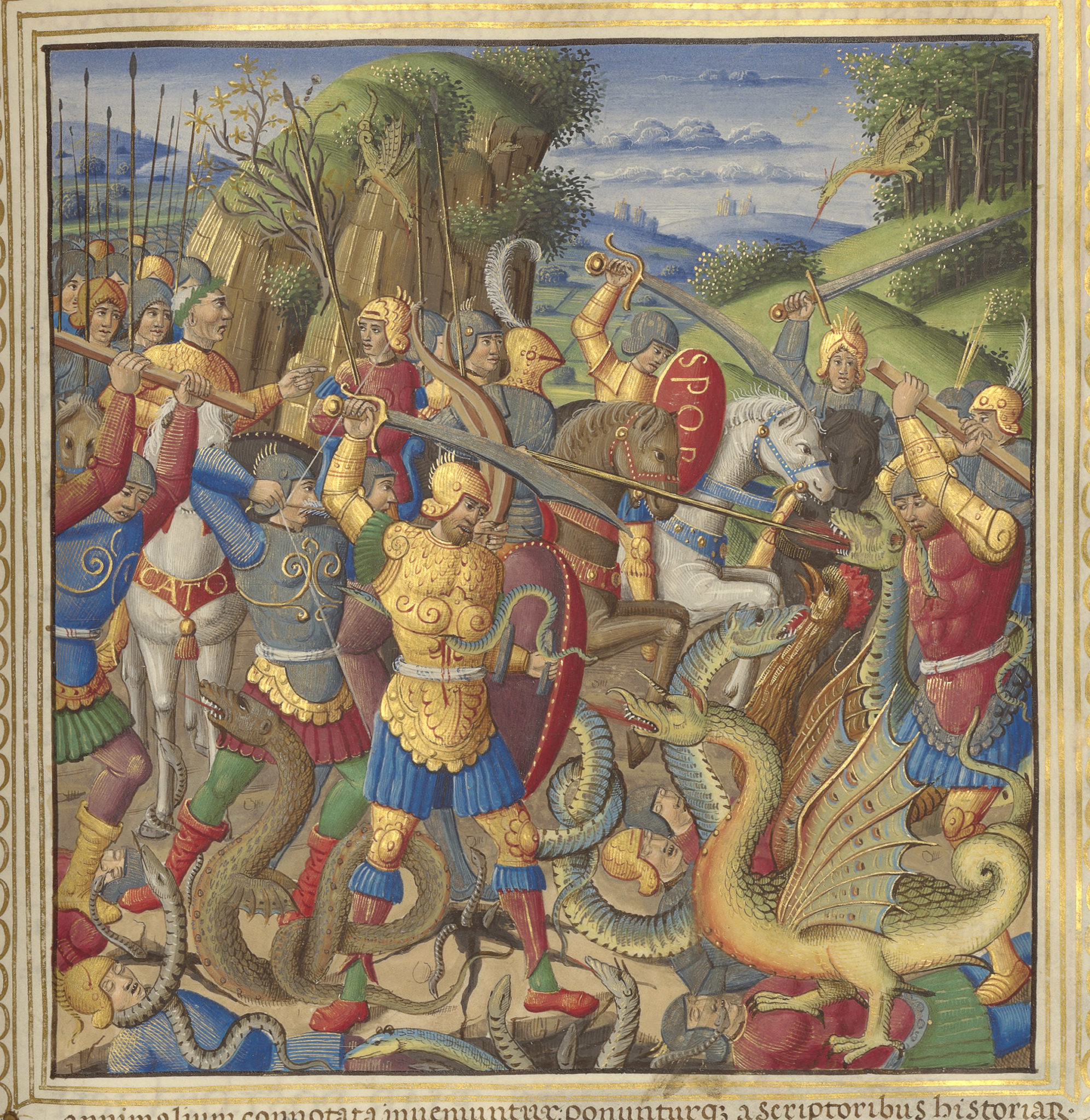
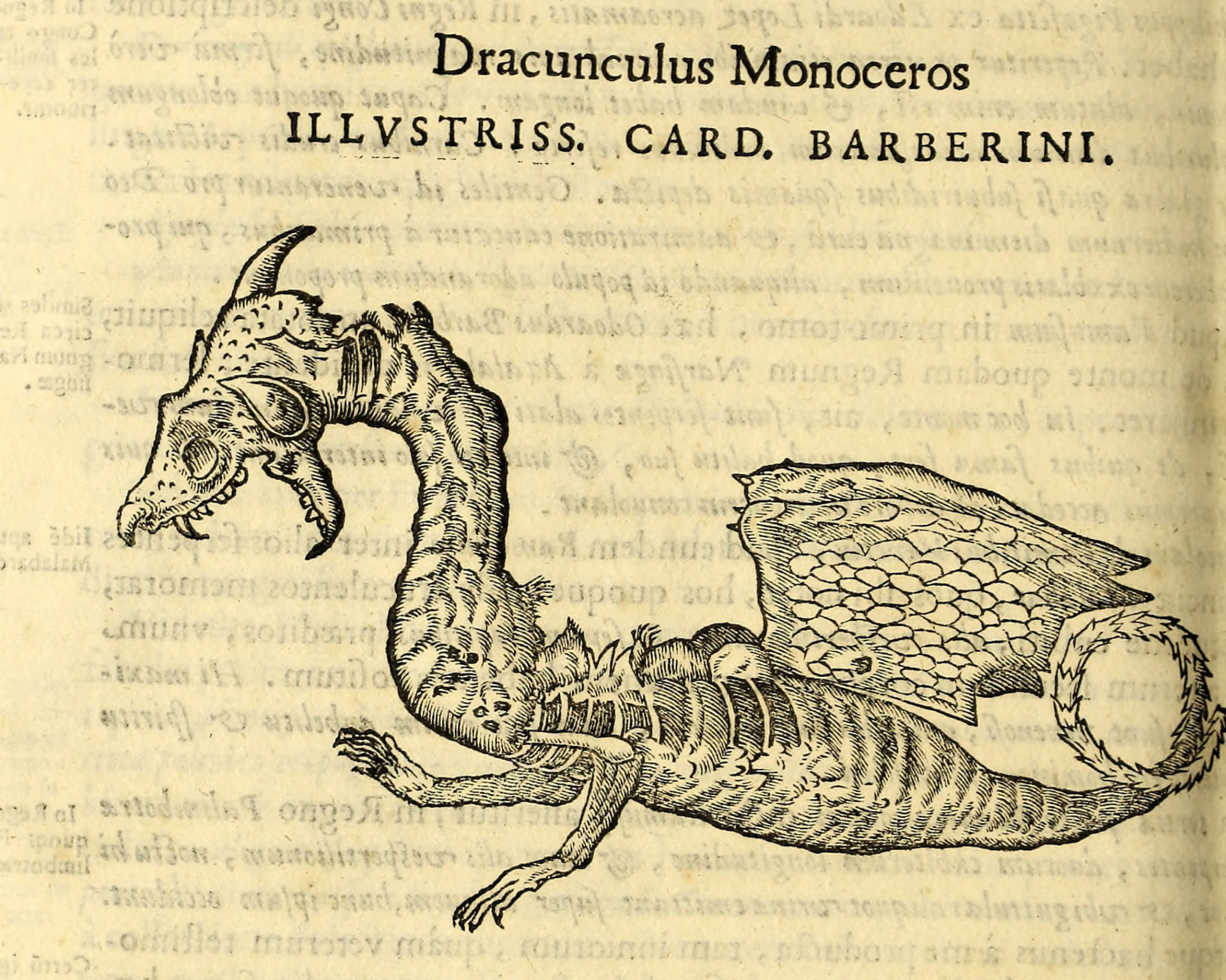
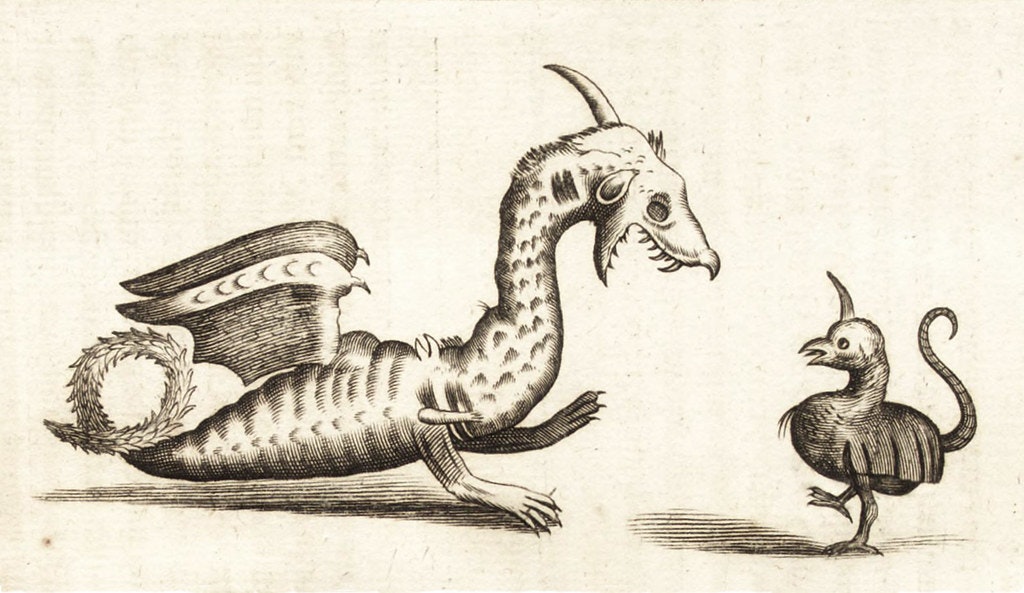
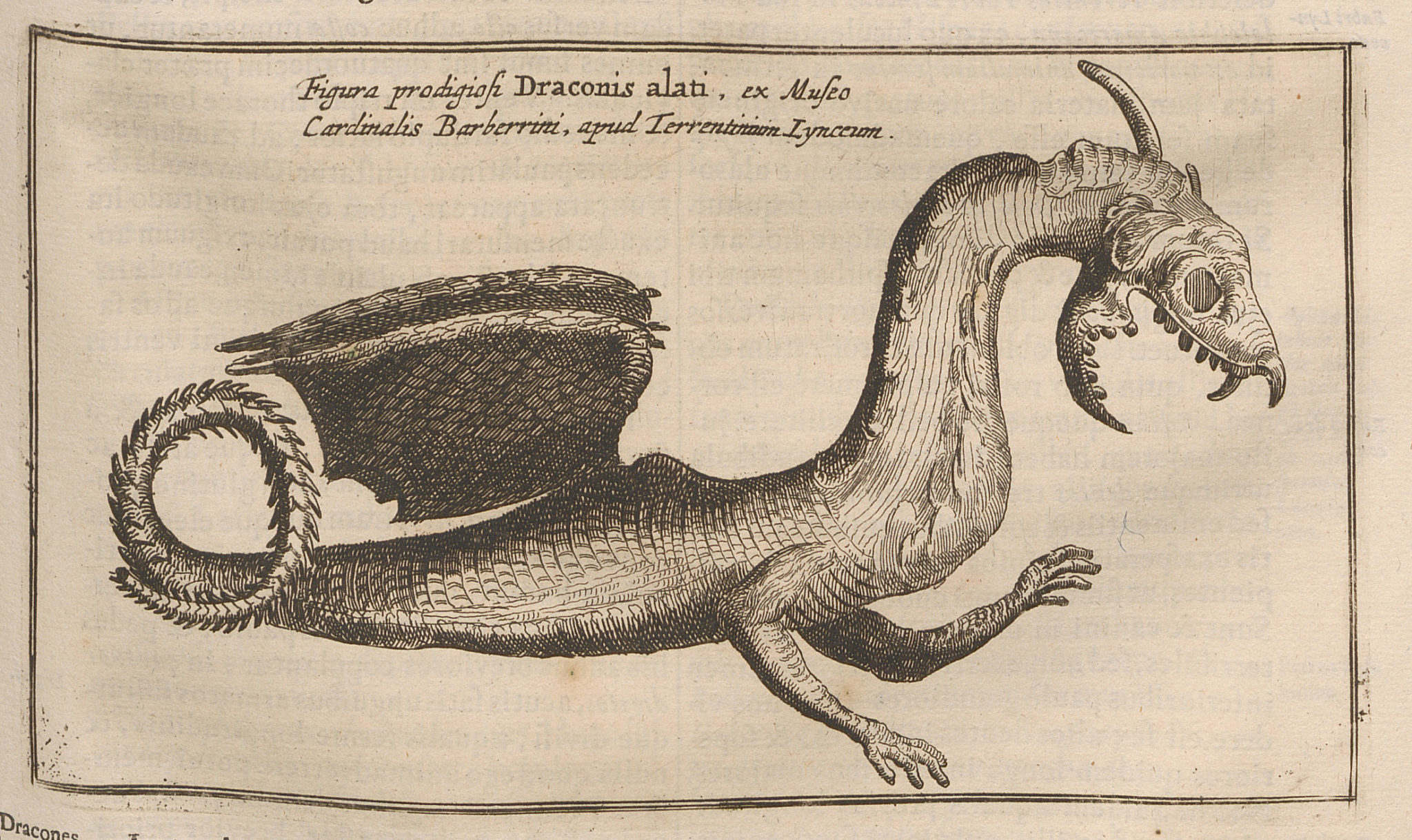
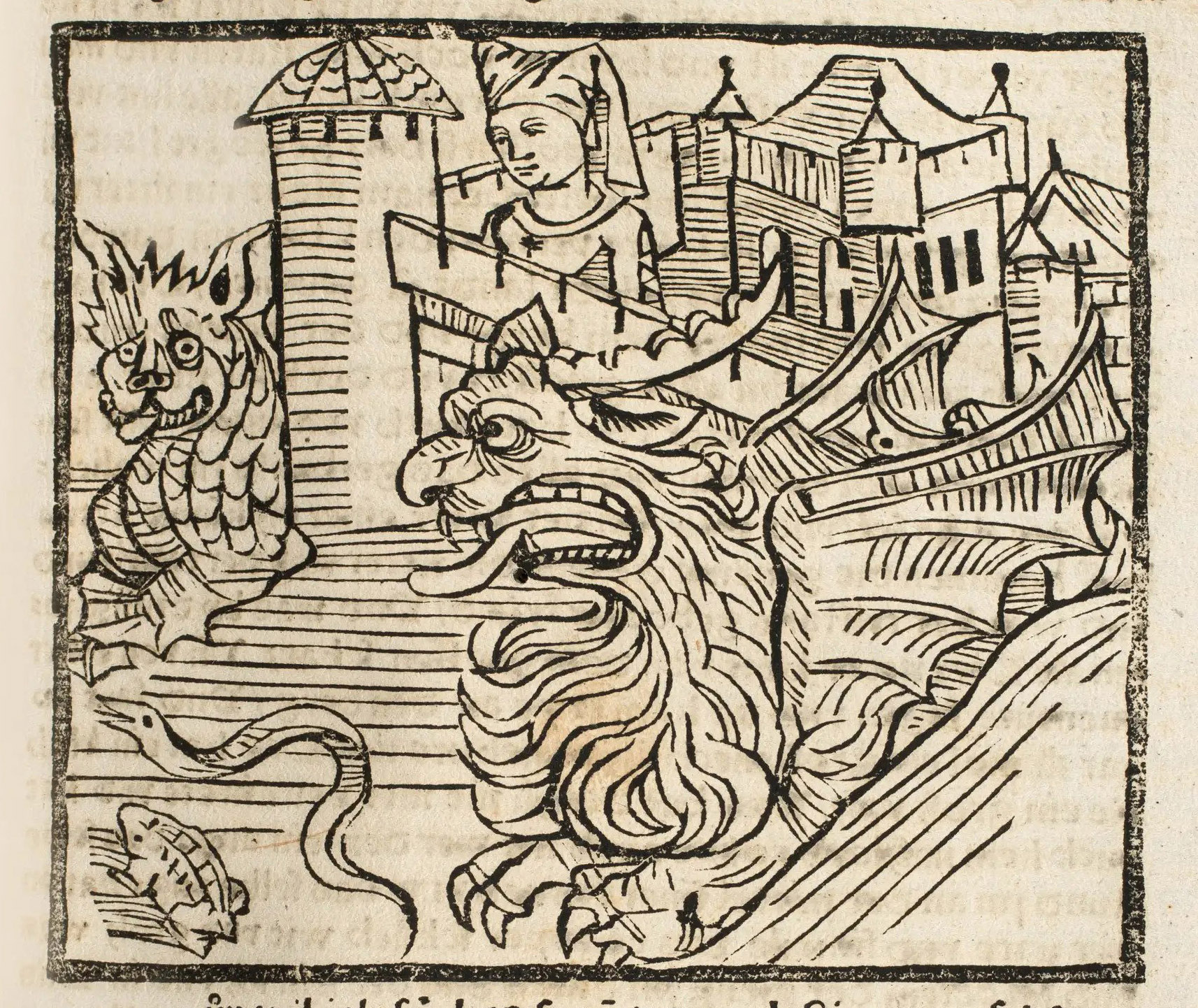
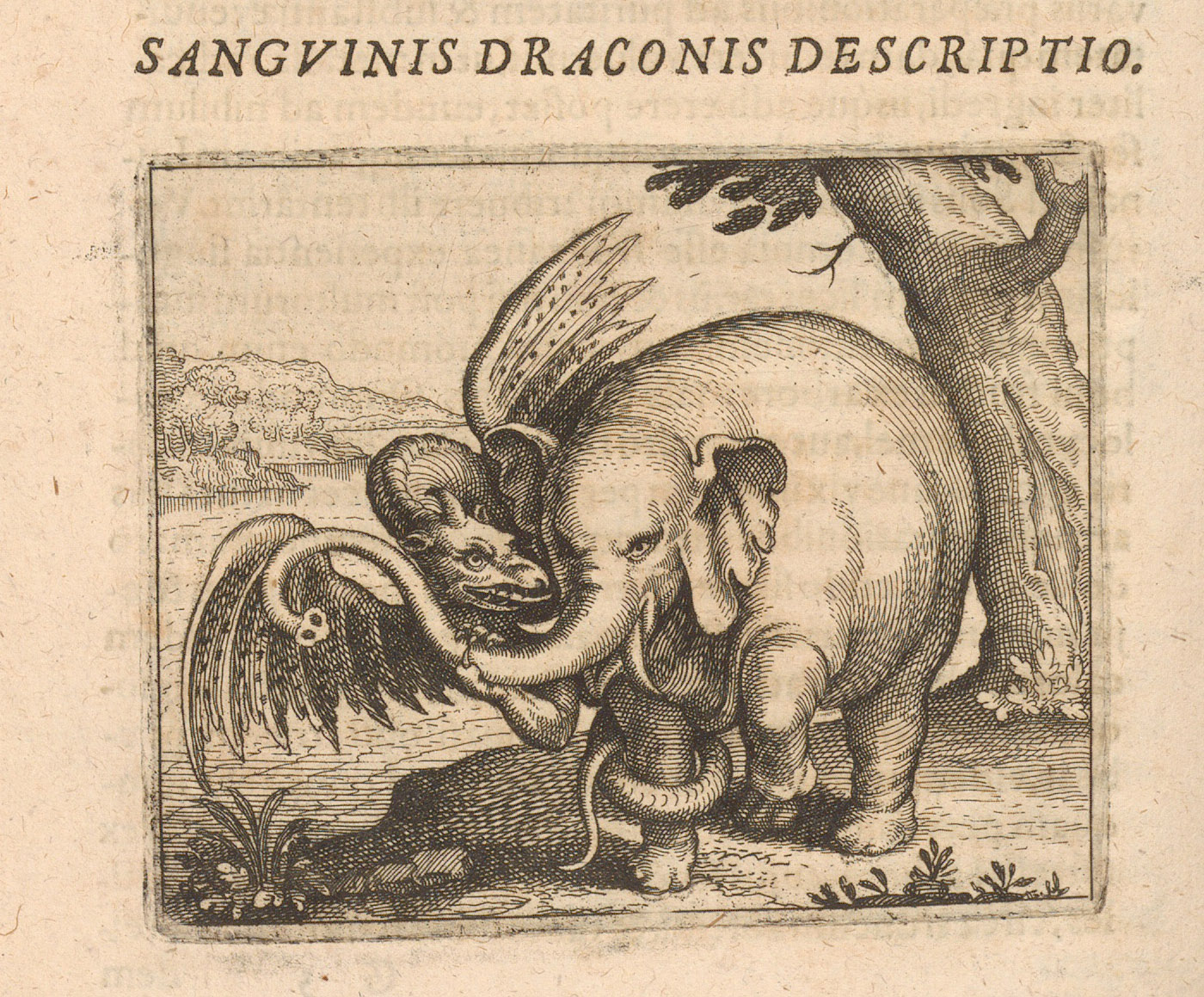
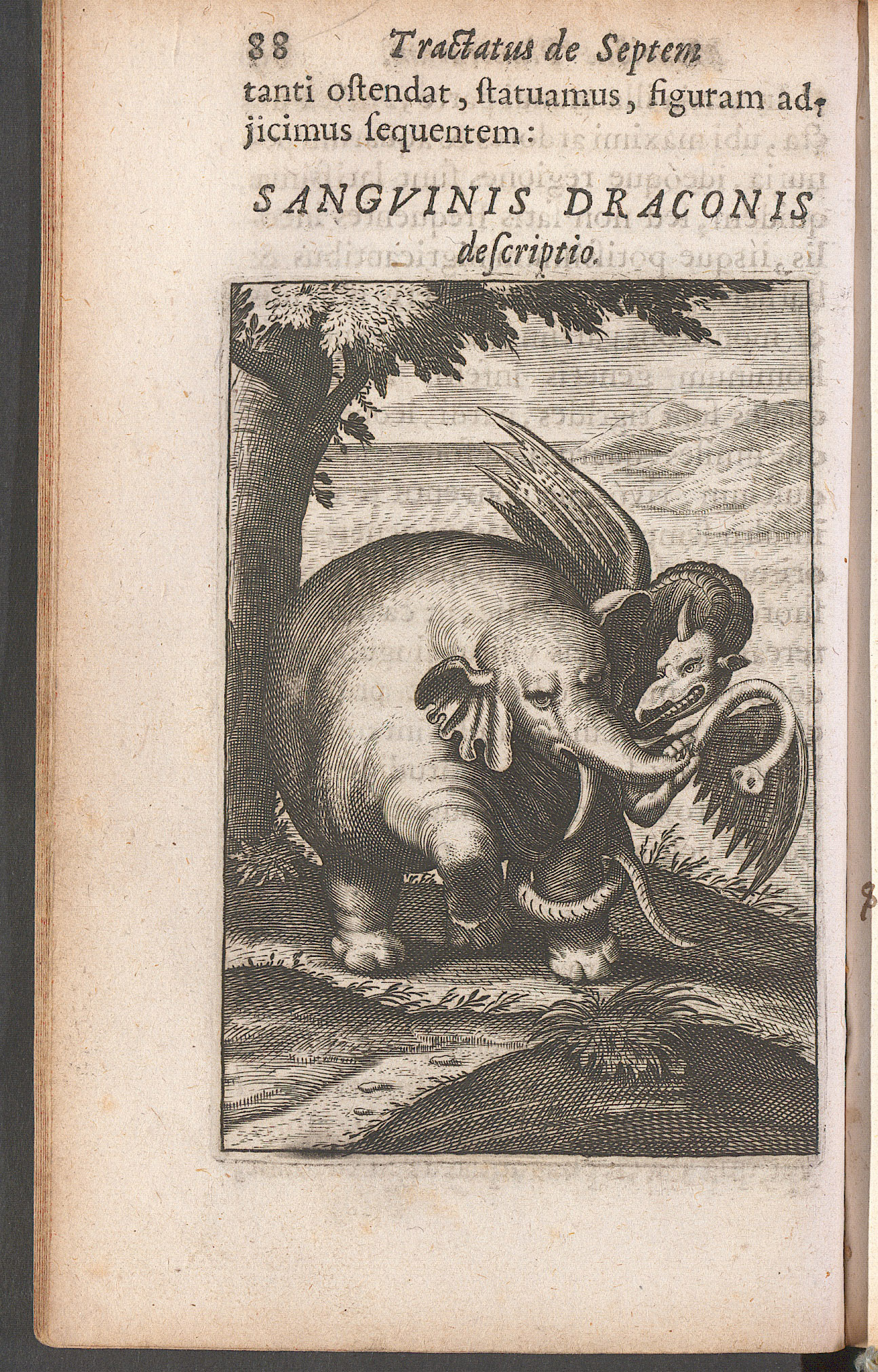
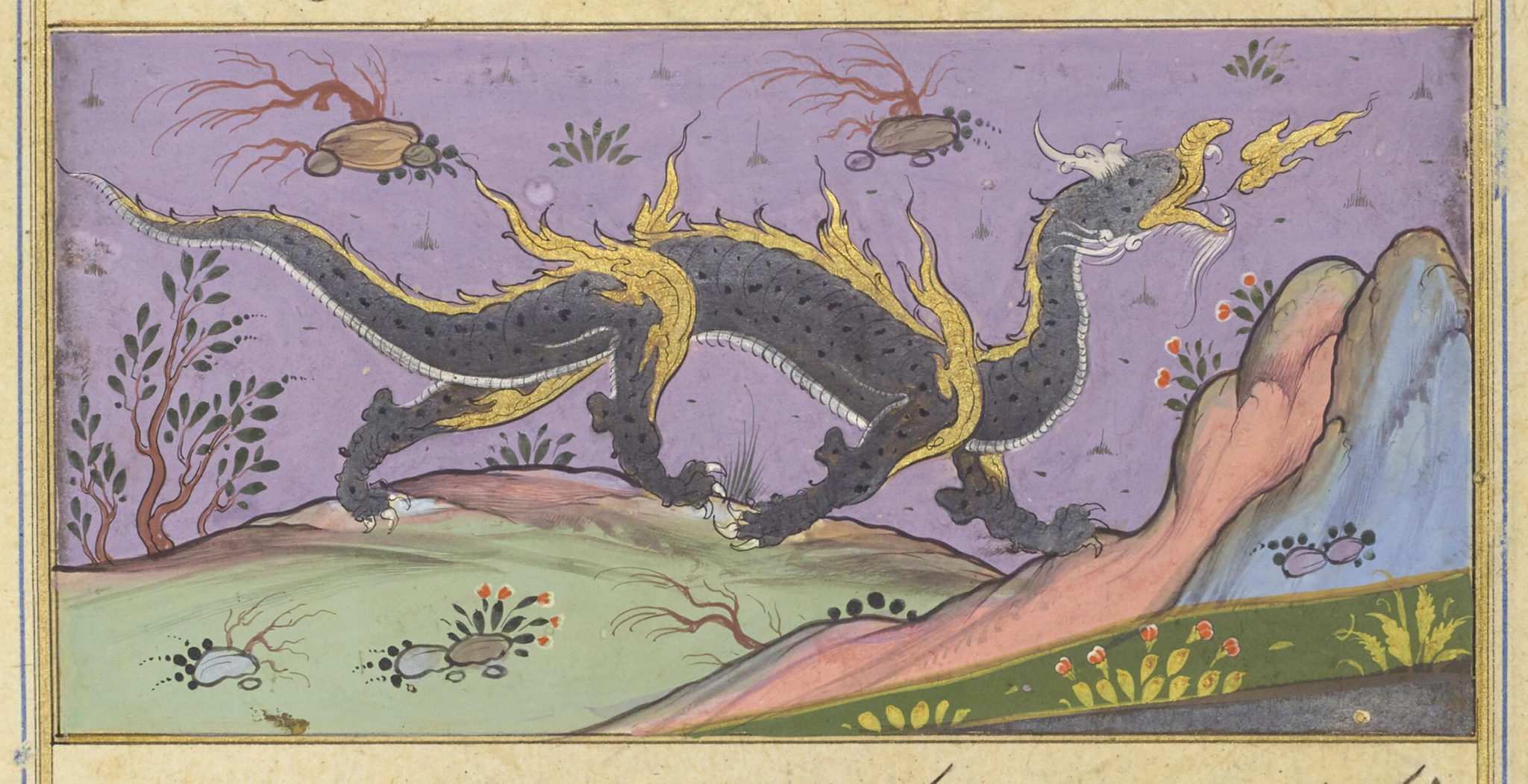
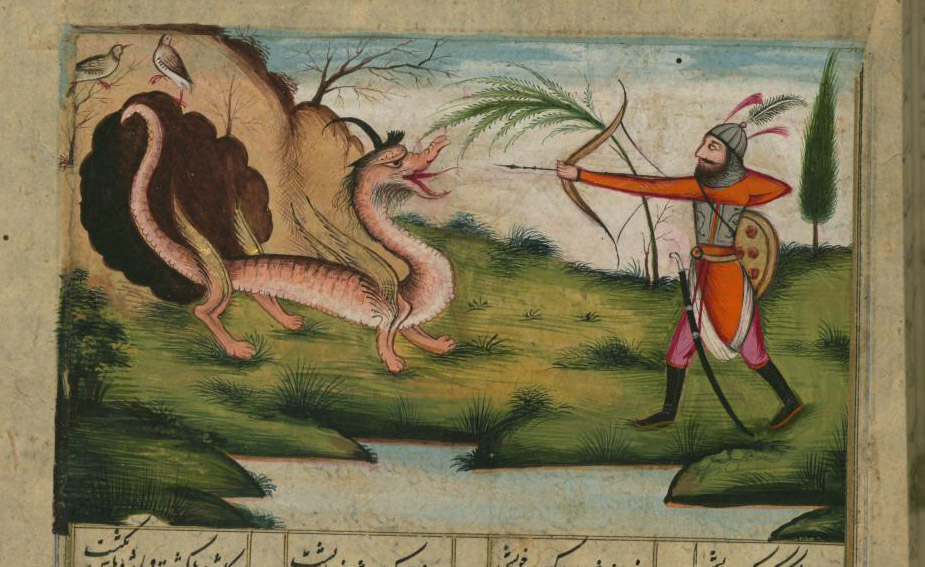
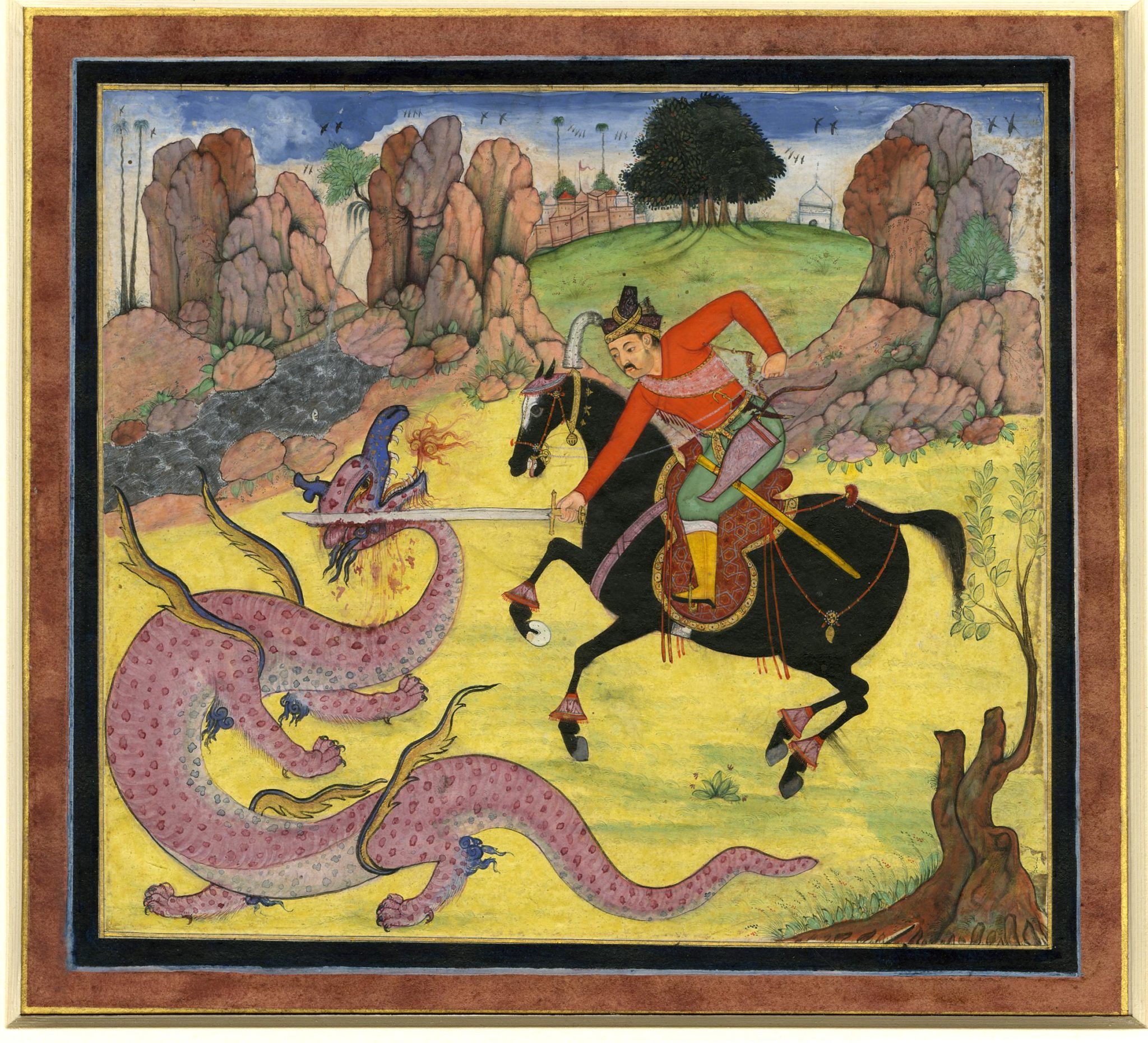
La fréquence des dragons unicornes dans l’iconographie du Moyen Âge et de la Renaissance s’explique peut-être par le modèle iconographique de la bête de l’Apocalypse, avec ses sept têtes et ses dix cornes, dont je ne parle pas dans mon livre mais à laquelle j’ai consacré un post de ce blog. Leurs cornes, comme celles des démons unicornes, est pourtant souvent spiralée à la manière de celles des licornes.

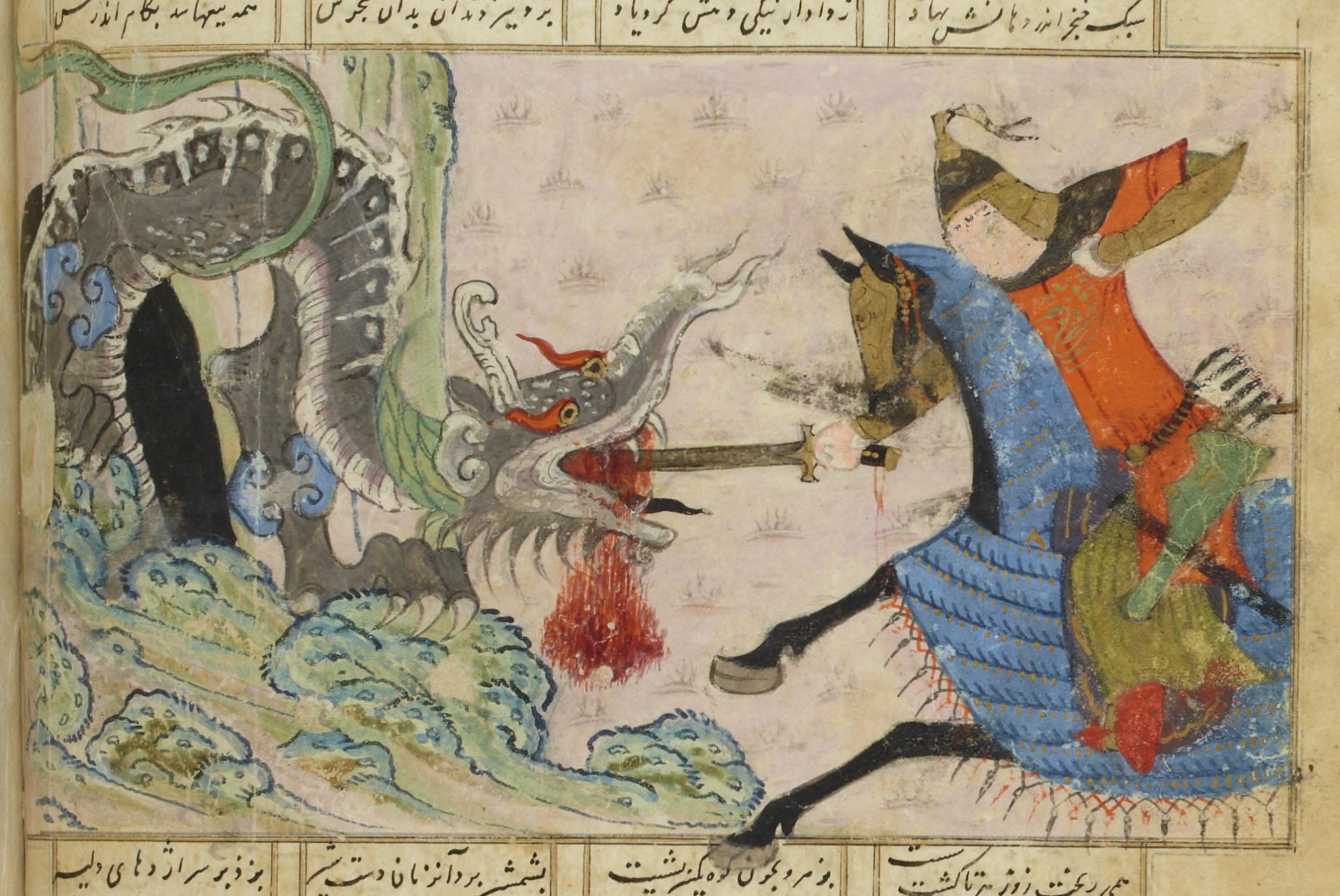
Les dragons des manuscrits persans sont un peu le chainon manquant entre les reptiles diaboliques des légendes européennes et les dragons impériaux de la tradition chinoises. Avec leur fine silhouette et et parfois leur corne de chair, ils ressemblent aux merveilleux reptiles d’extrème orient, mais les récits les mettant en scène, plus ou moins apparentés au roman d’Alexandre, s’apparentent plus aux contes d’Europe.

📖 La licorne complice

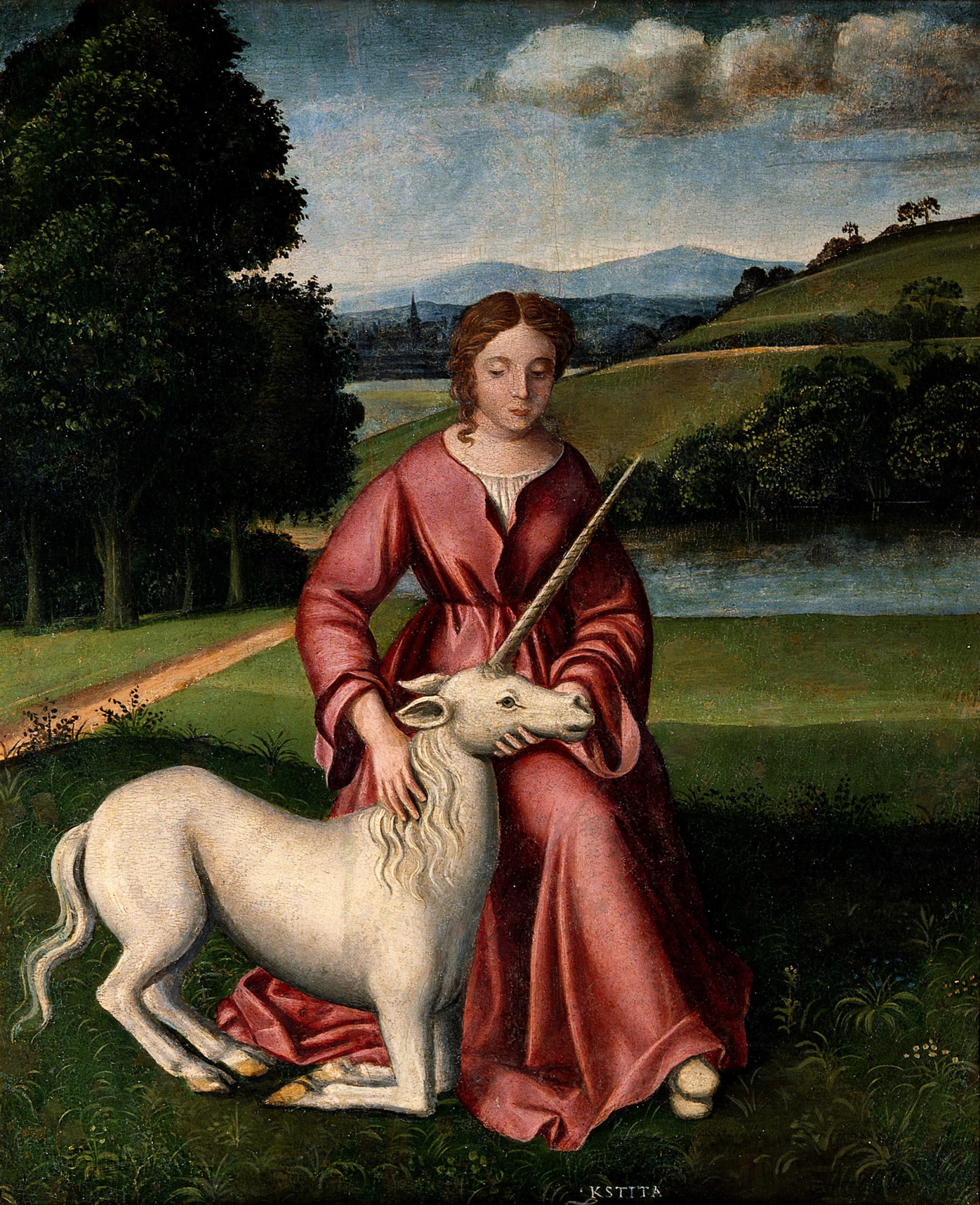
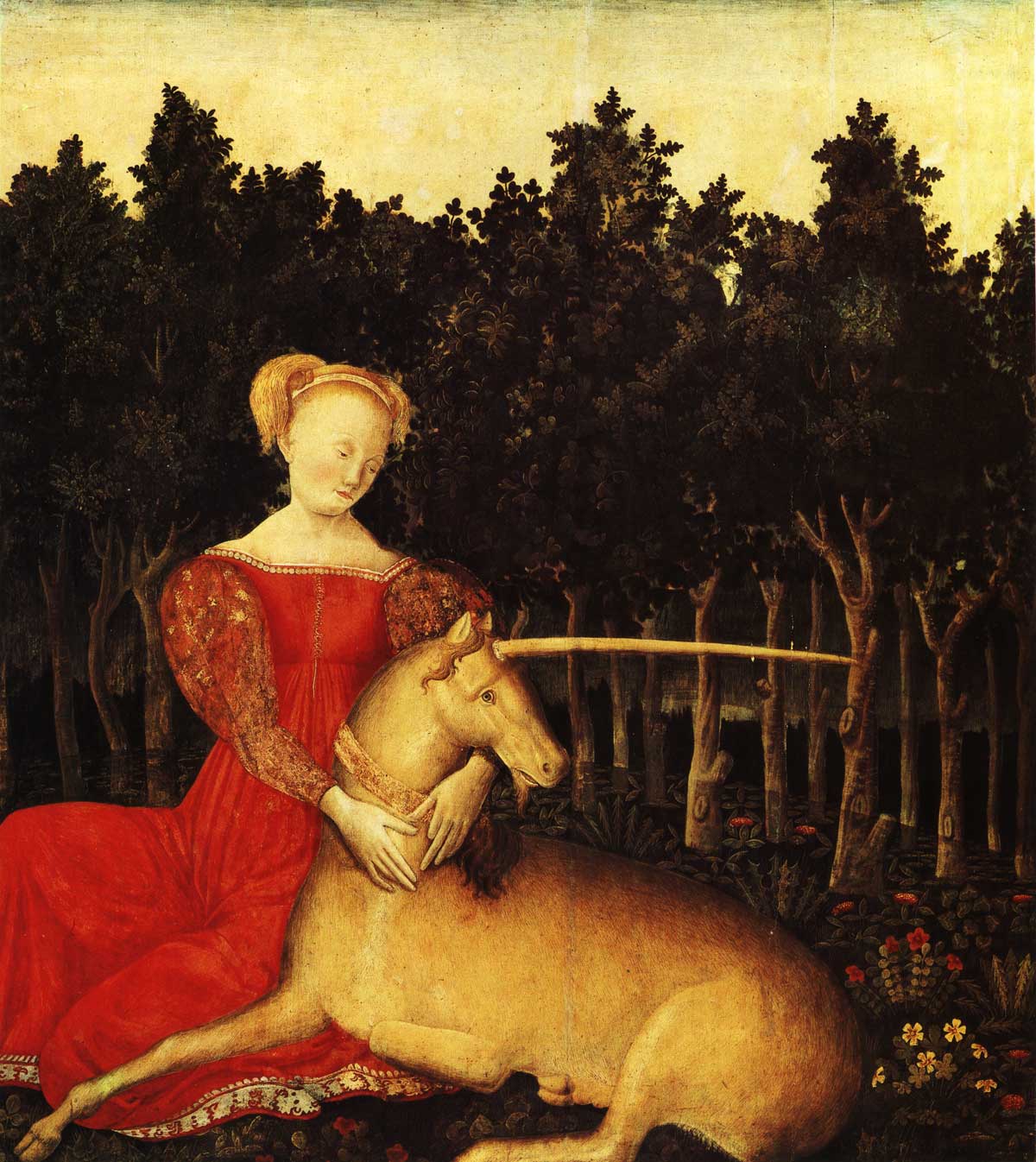
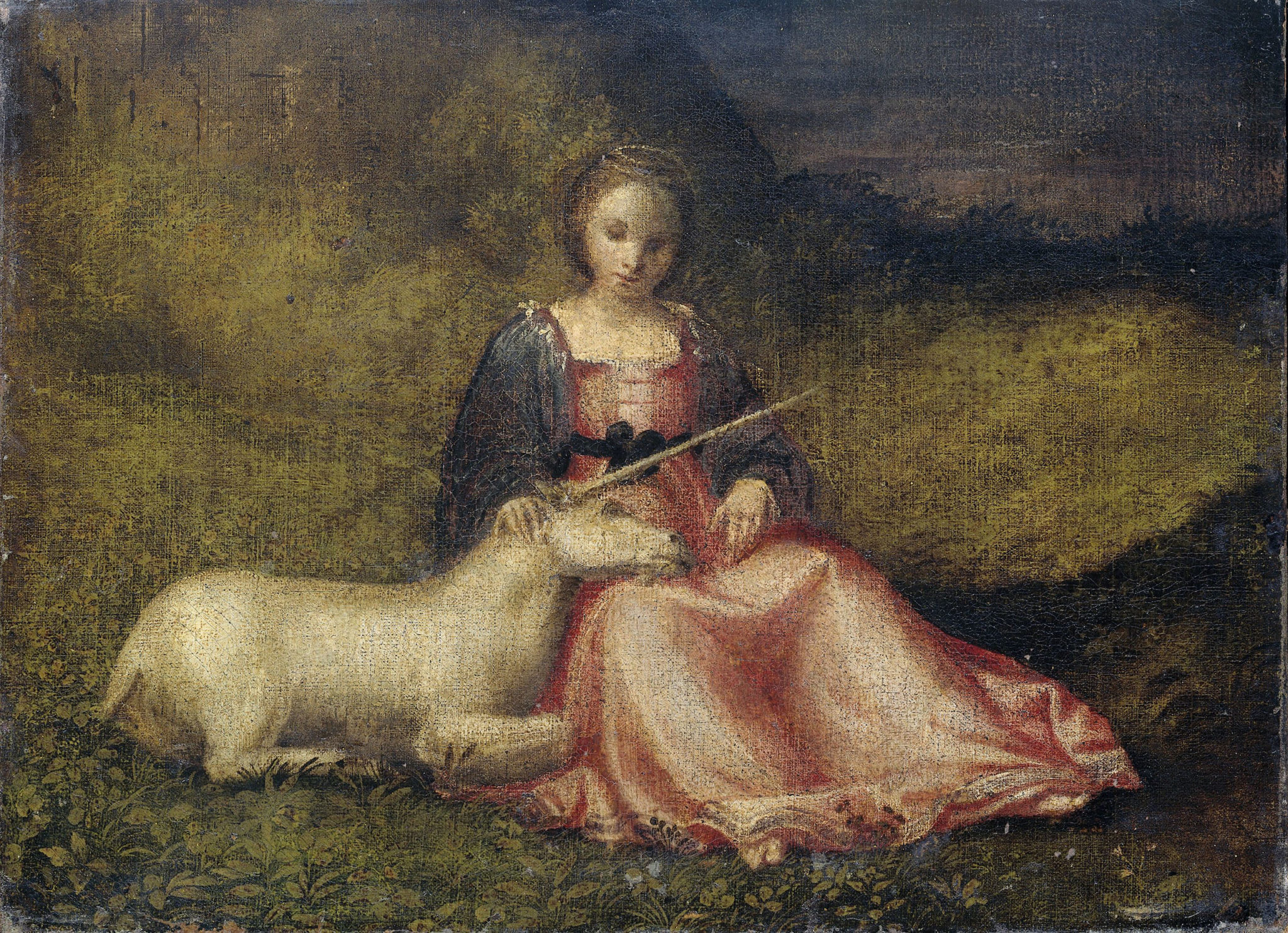
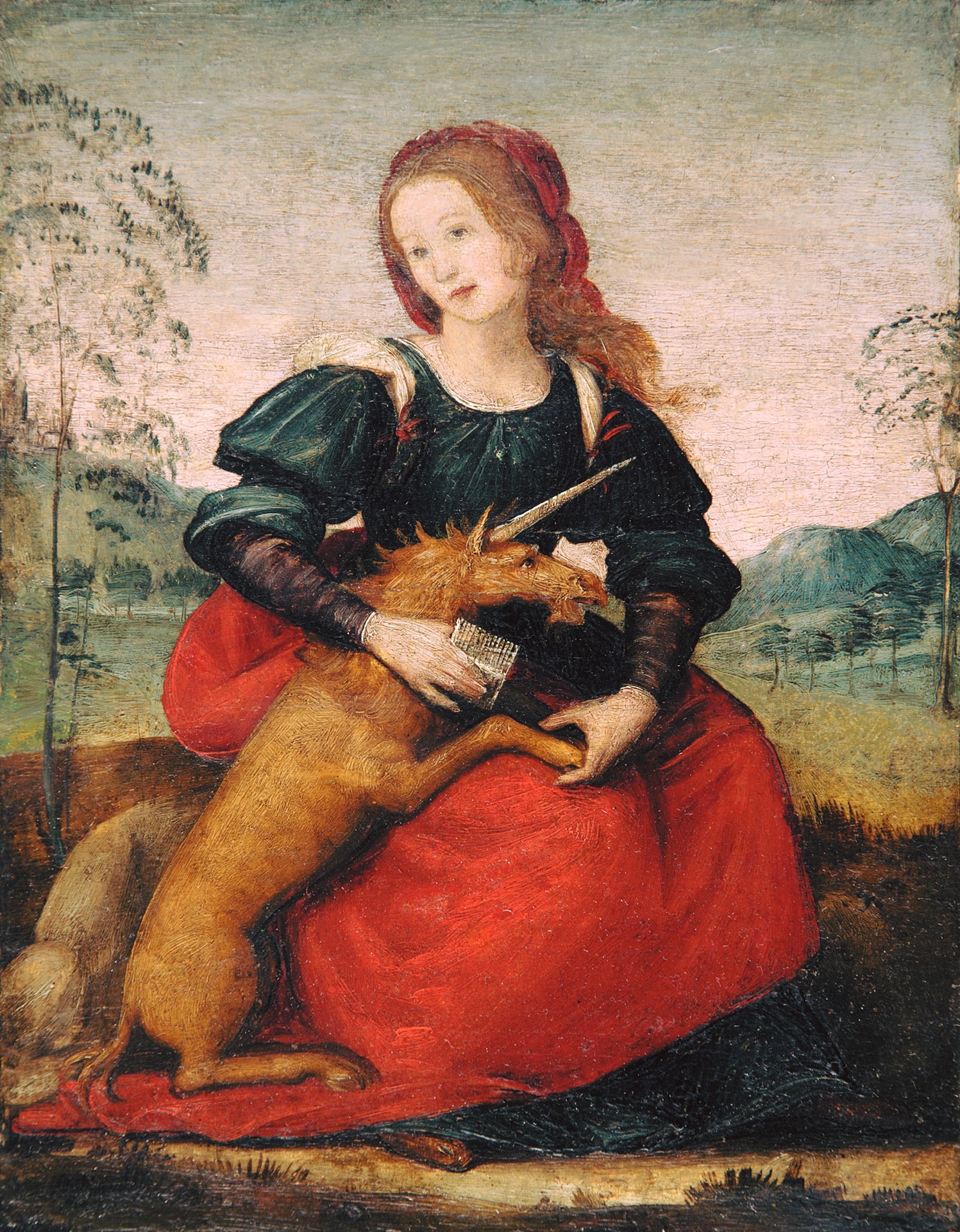
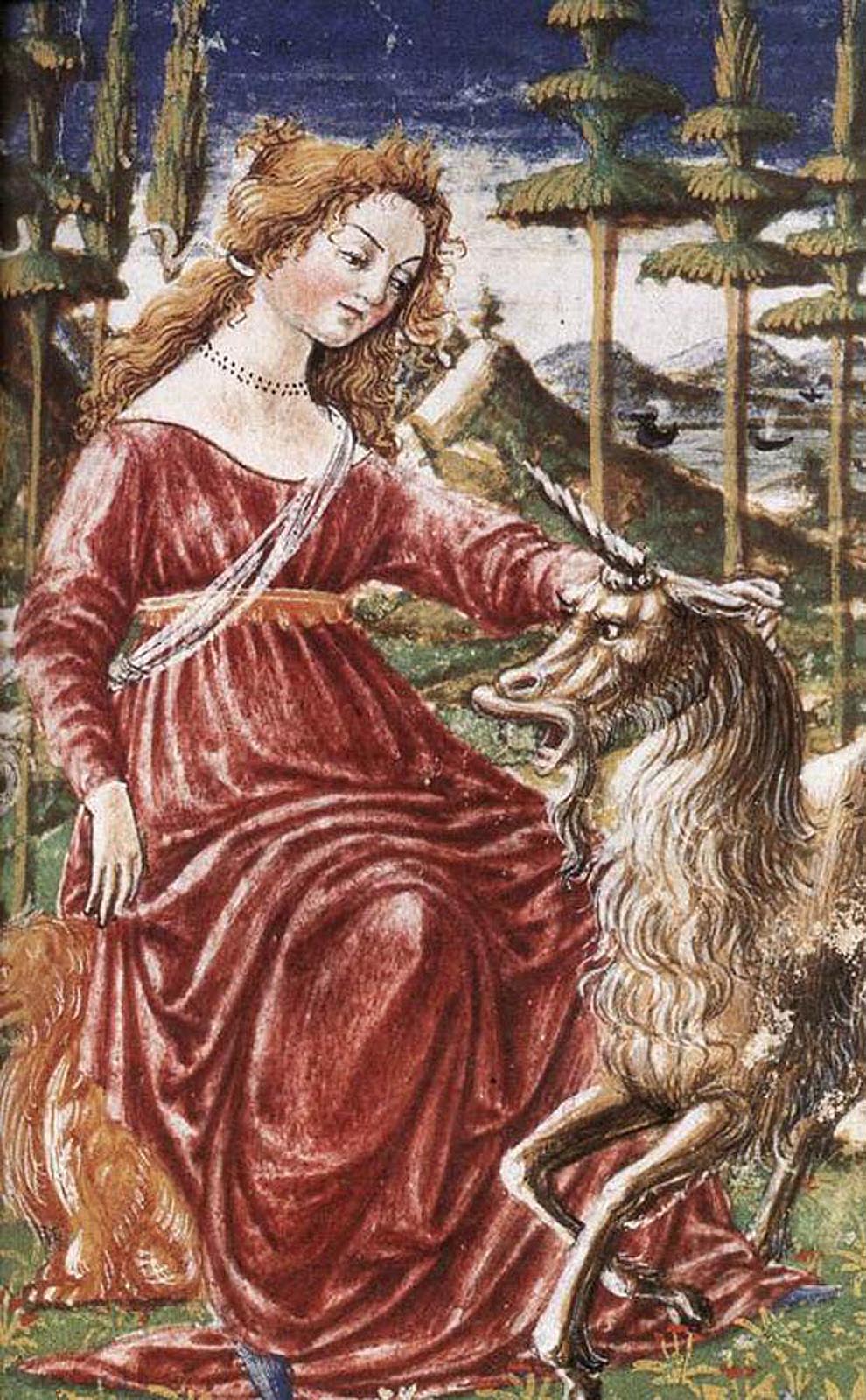
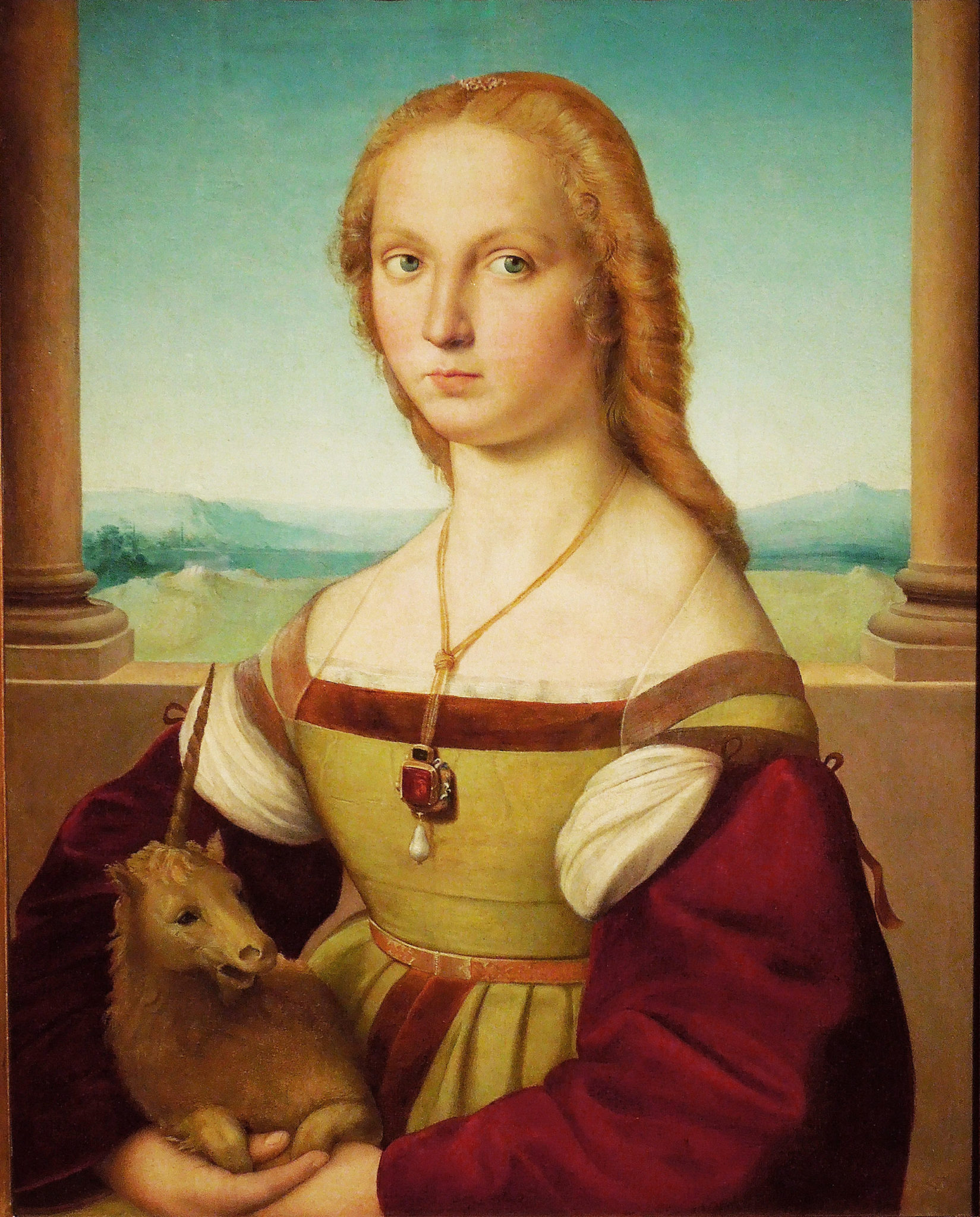
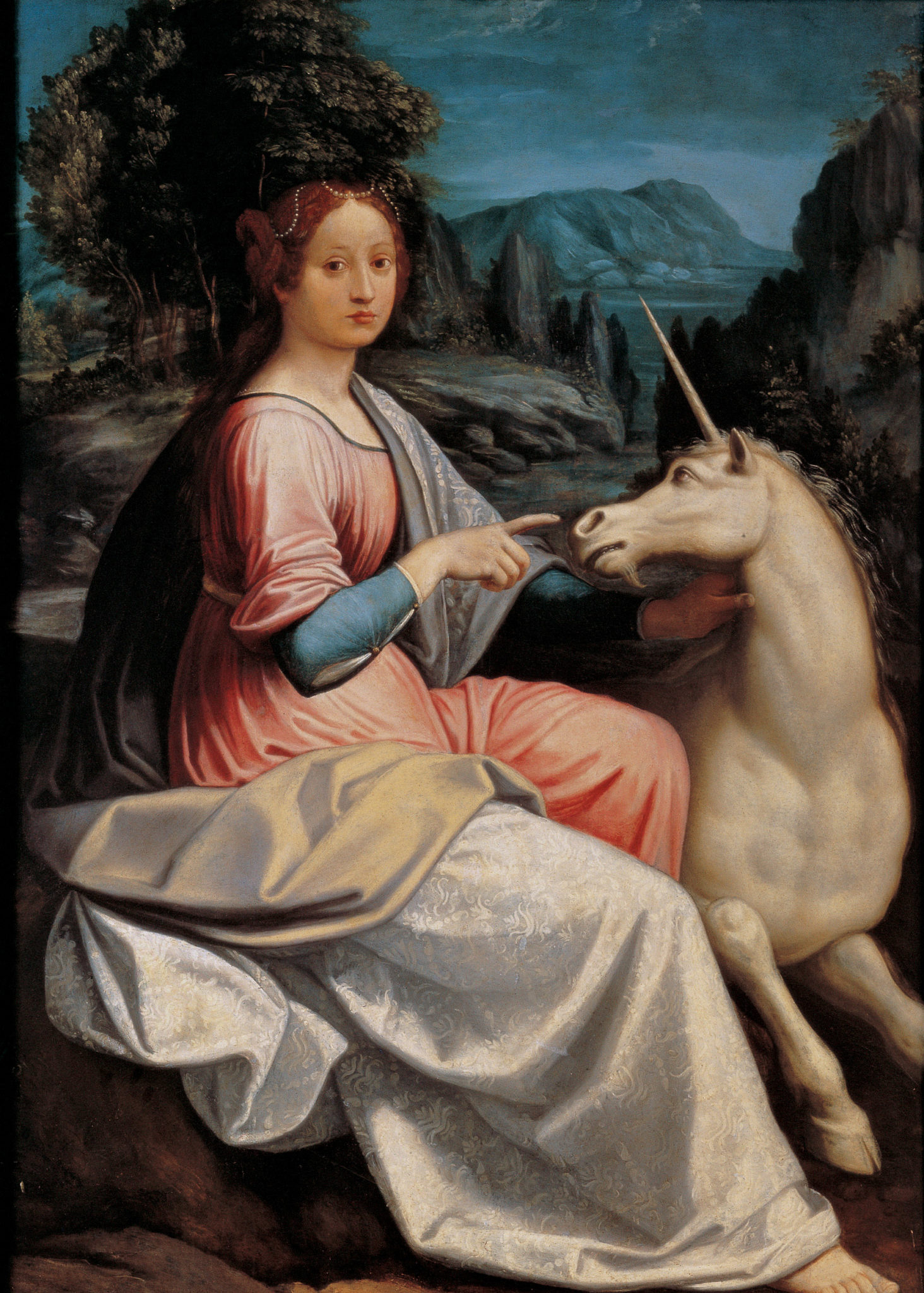
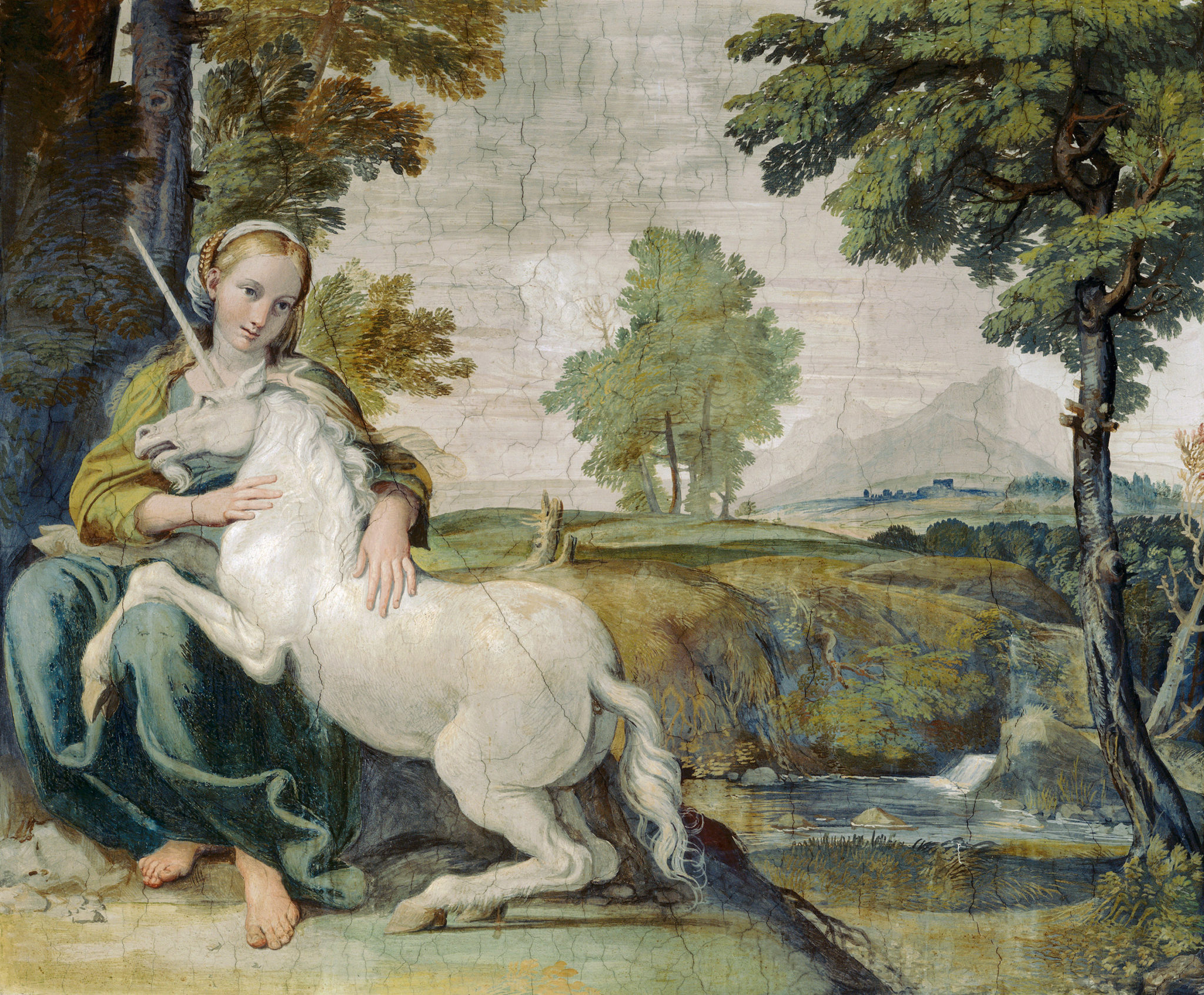
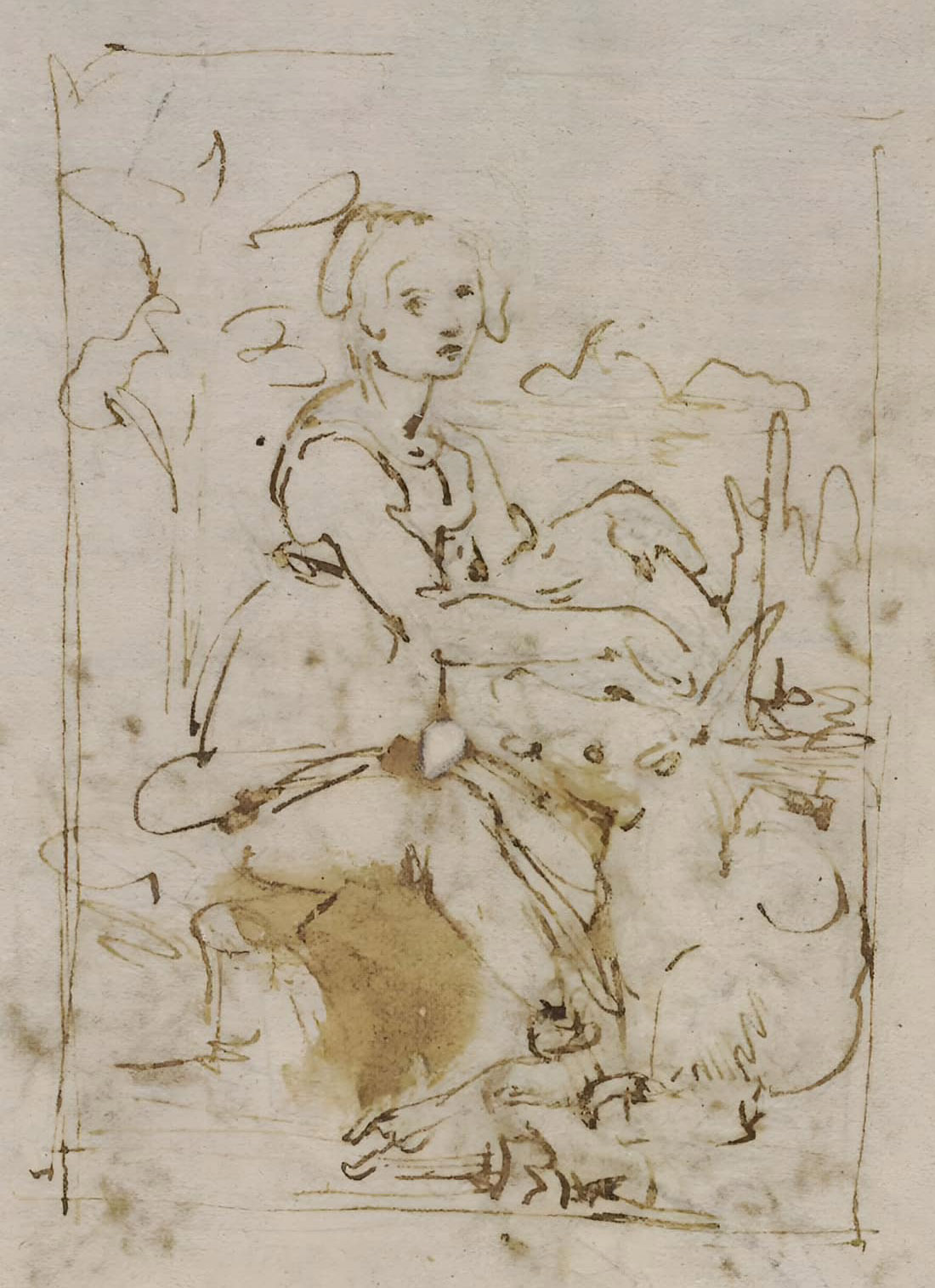
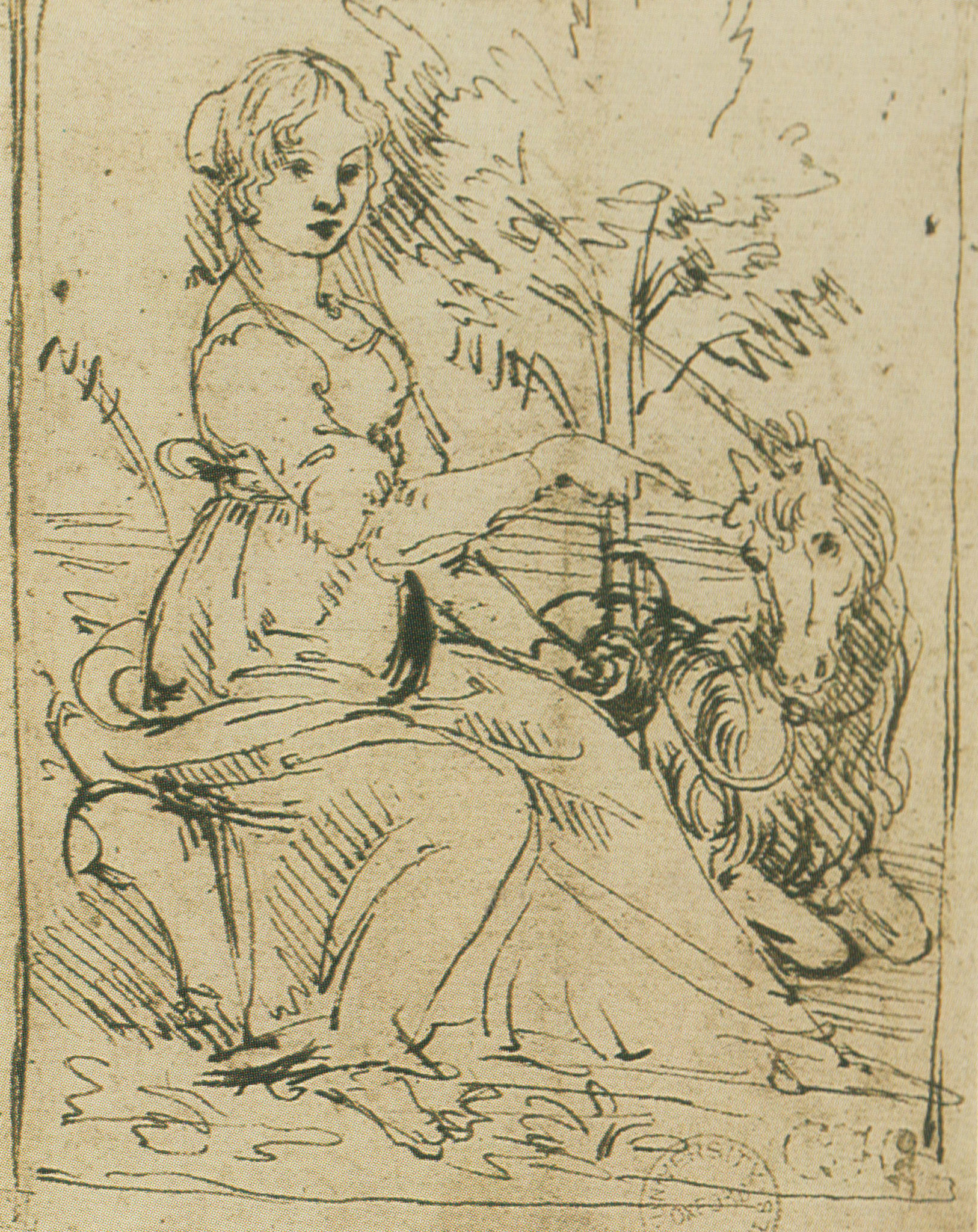
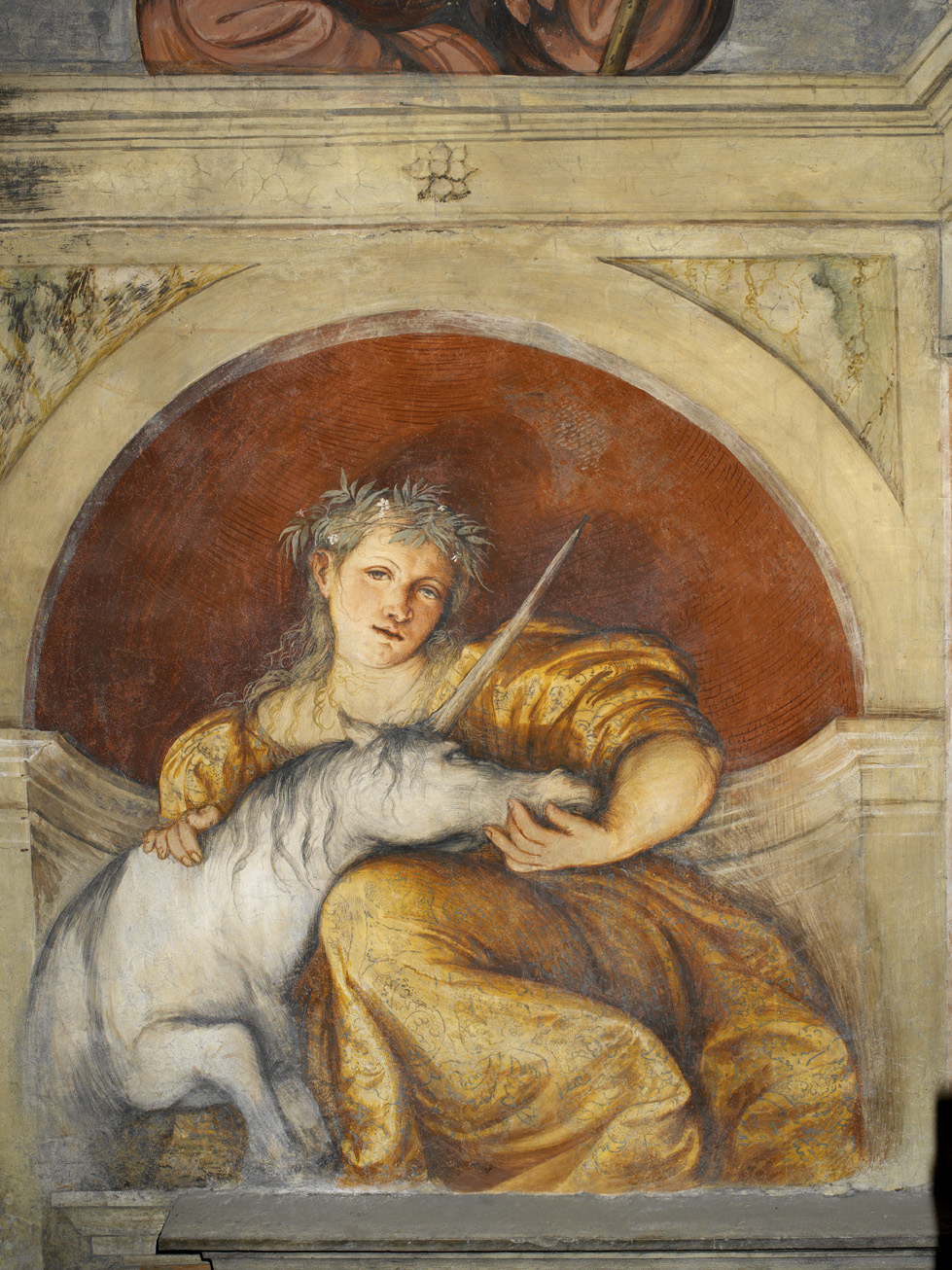
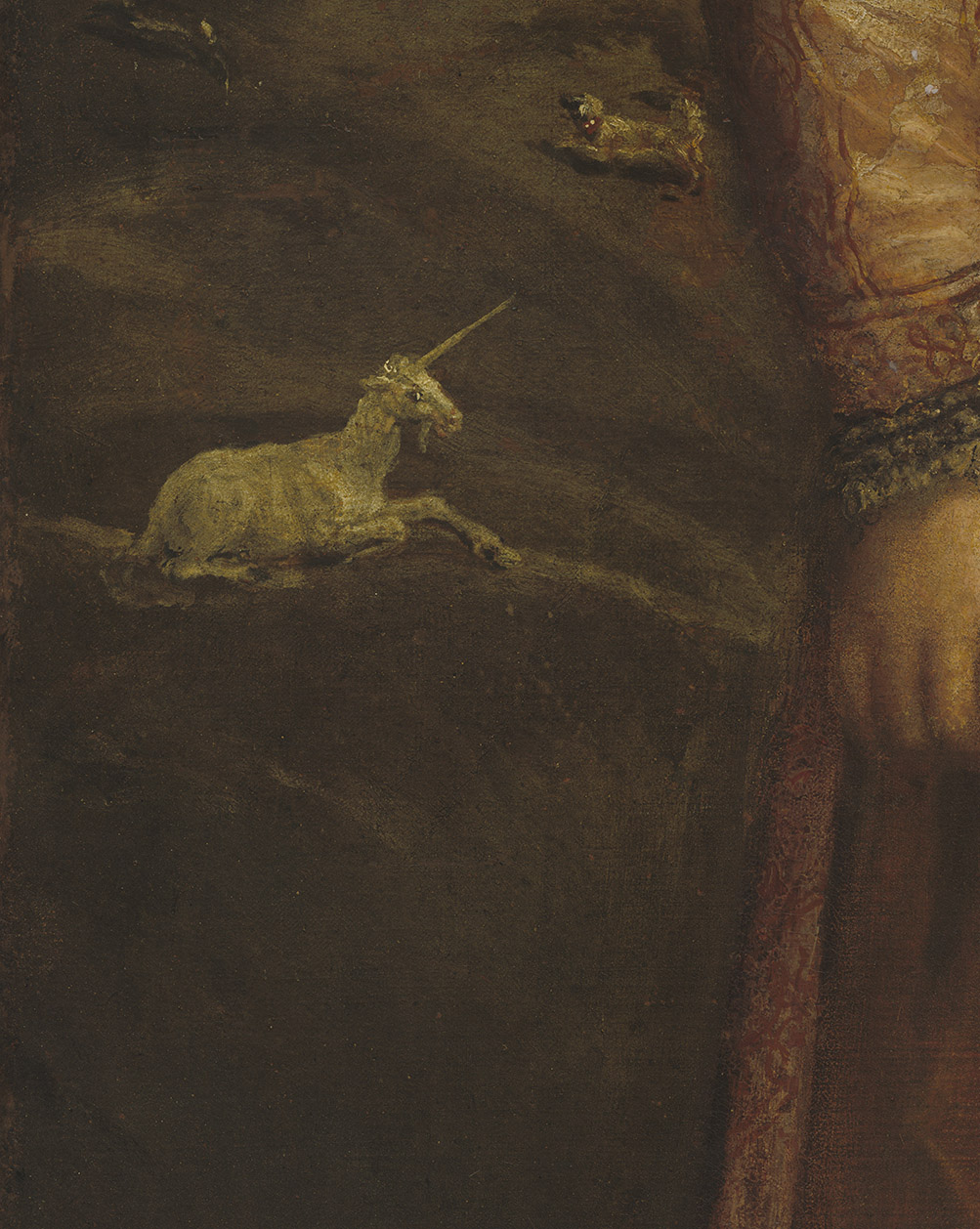
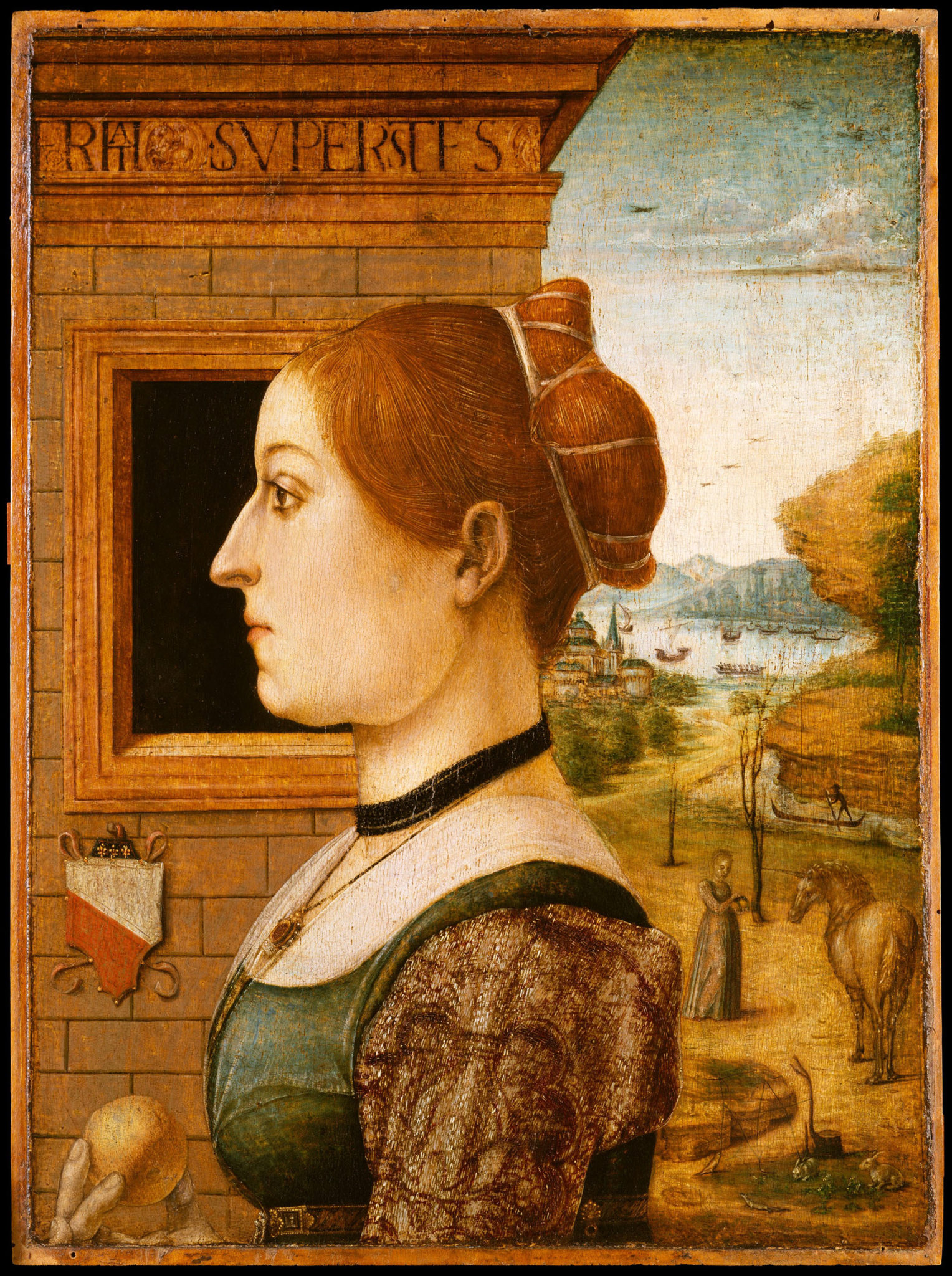
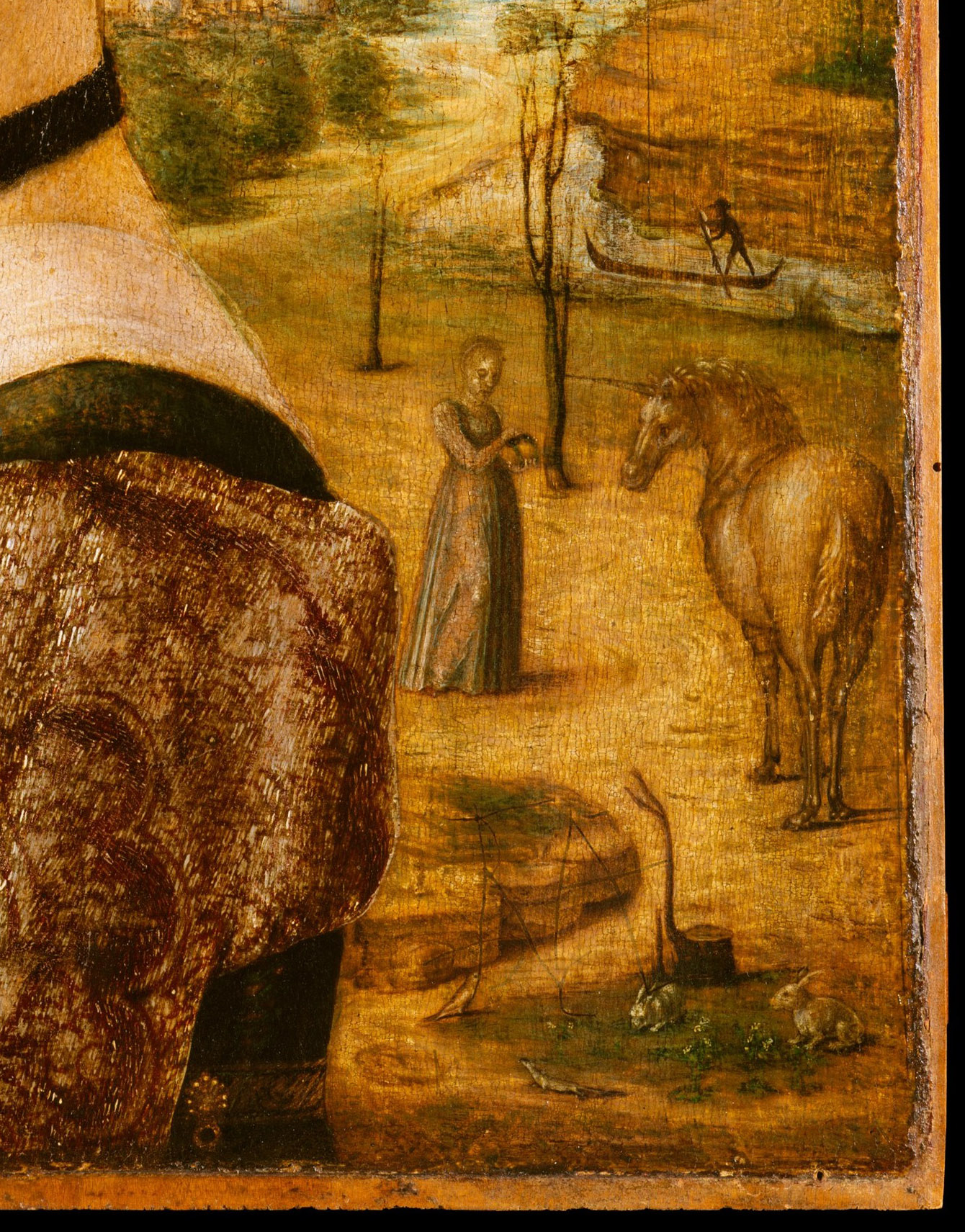
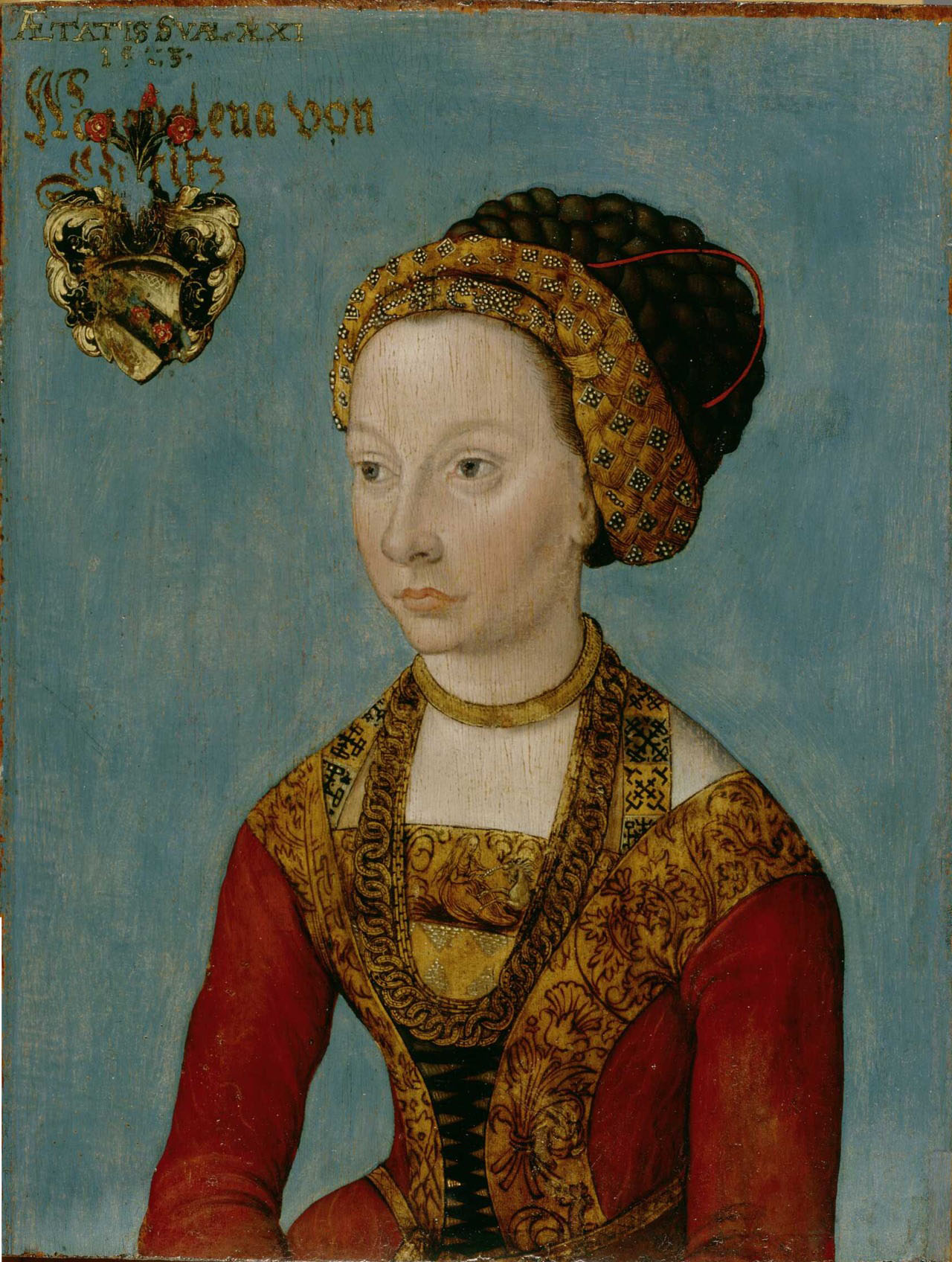
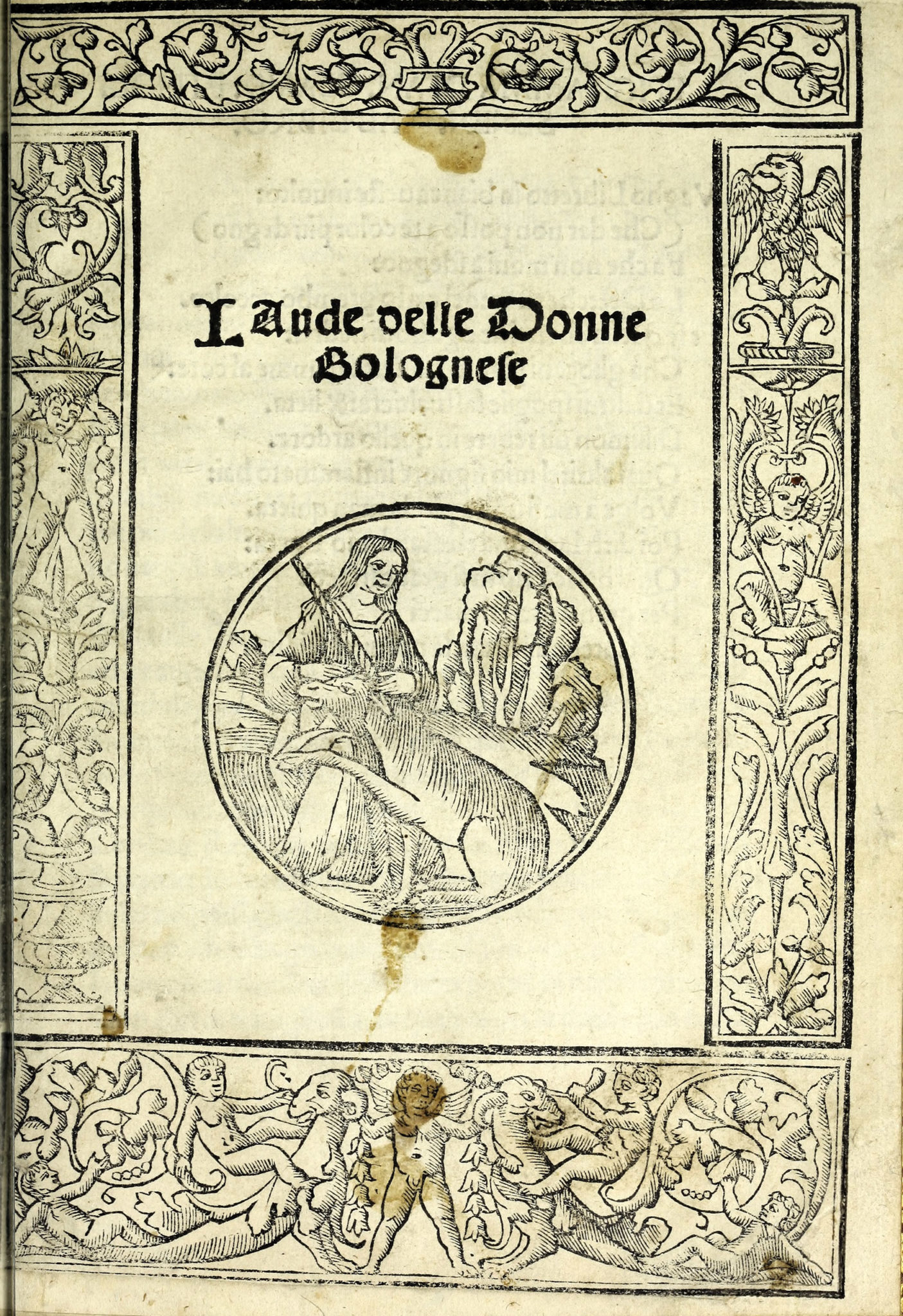
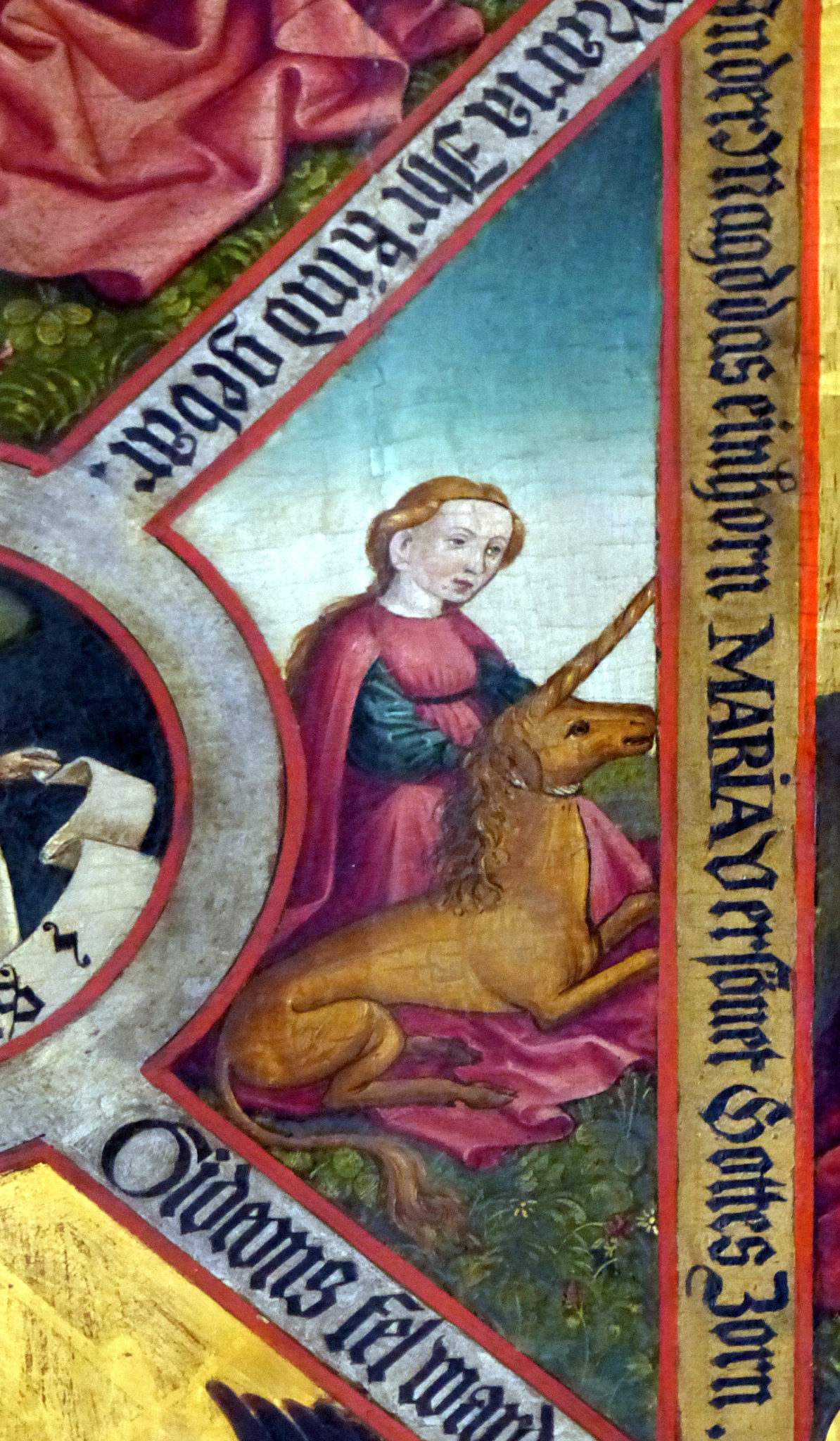
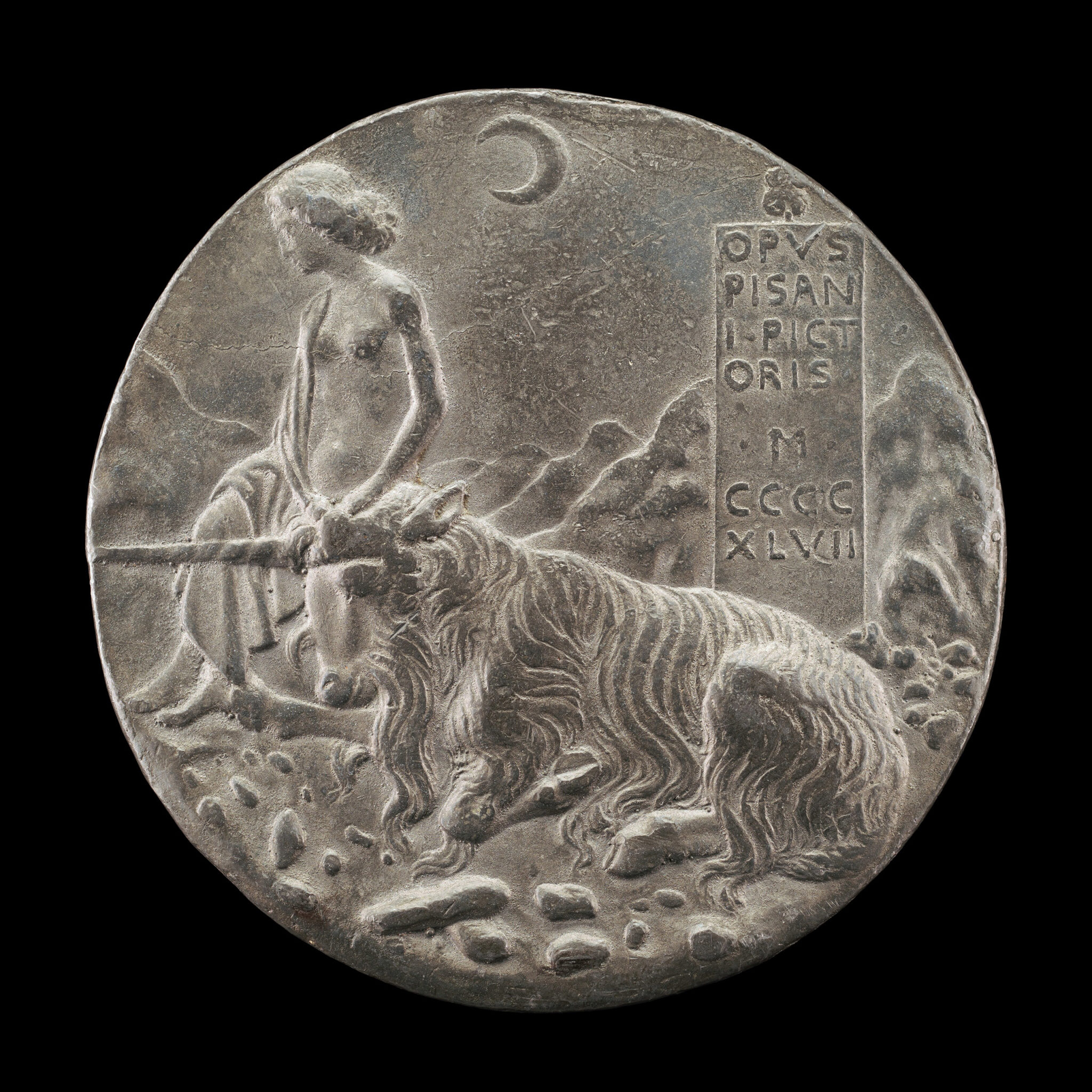
Au XVIe siècle, d’abord en Italie puis dans le reste de l’Europe, les représentations de Chasse à la licorne se font plus rares. La blanche bête est toujours représentée aux côtés d’une jeune et belle dame, mais leur relation est désormais confiante et apaisée. La licorne perd sa signification allégorique pour n’être plus qu’un attribut de la chasteté, de la pureté.

La plupart de ces peintures sont des portraits de dames. La licorne qui les accompagne figure leur vertu, avec peut-être parfois une pointe d’ironie, puisque les trois derniers tableaux représentent sans doute Giulia Farnese, qui n’était pas réputée pour sa chasteté.

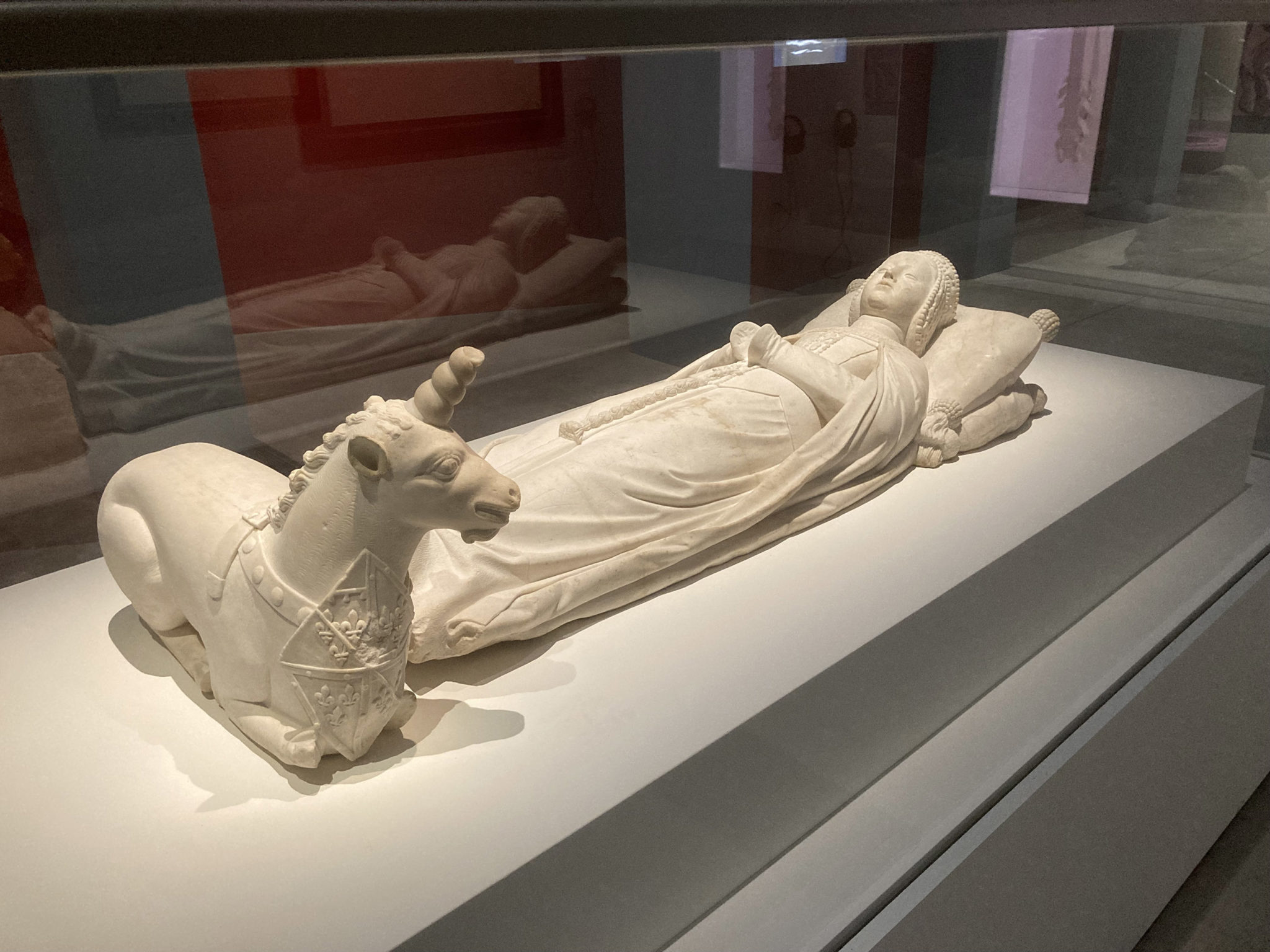
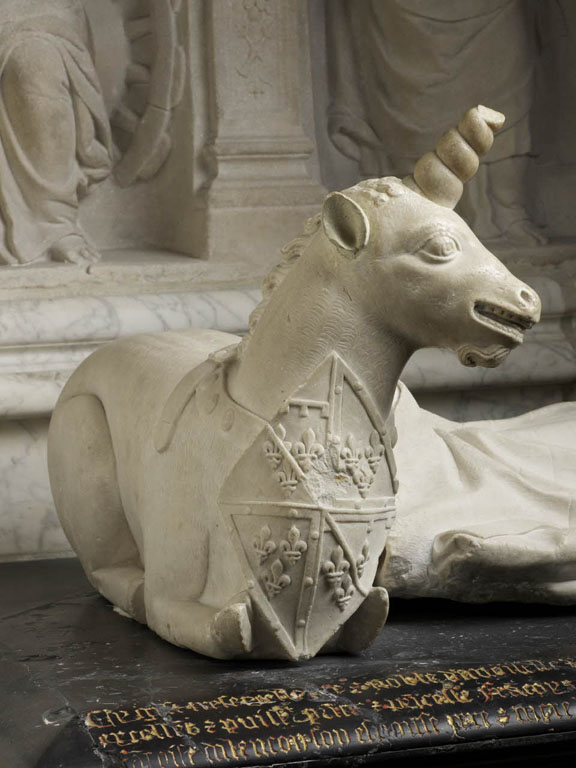
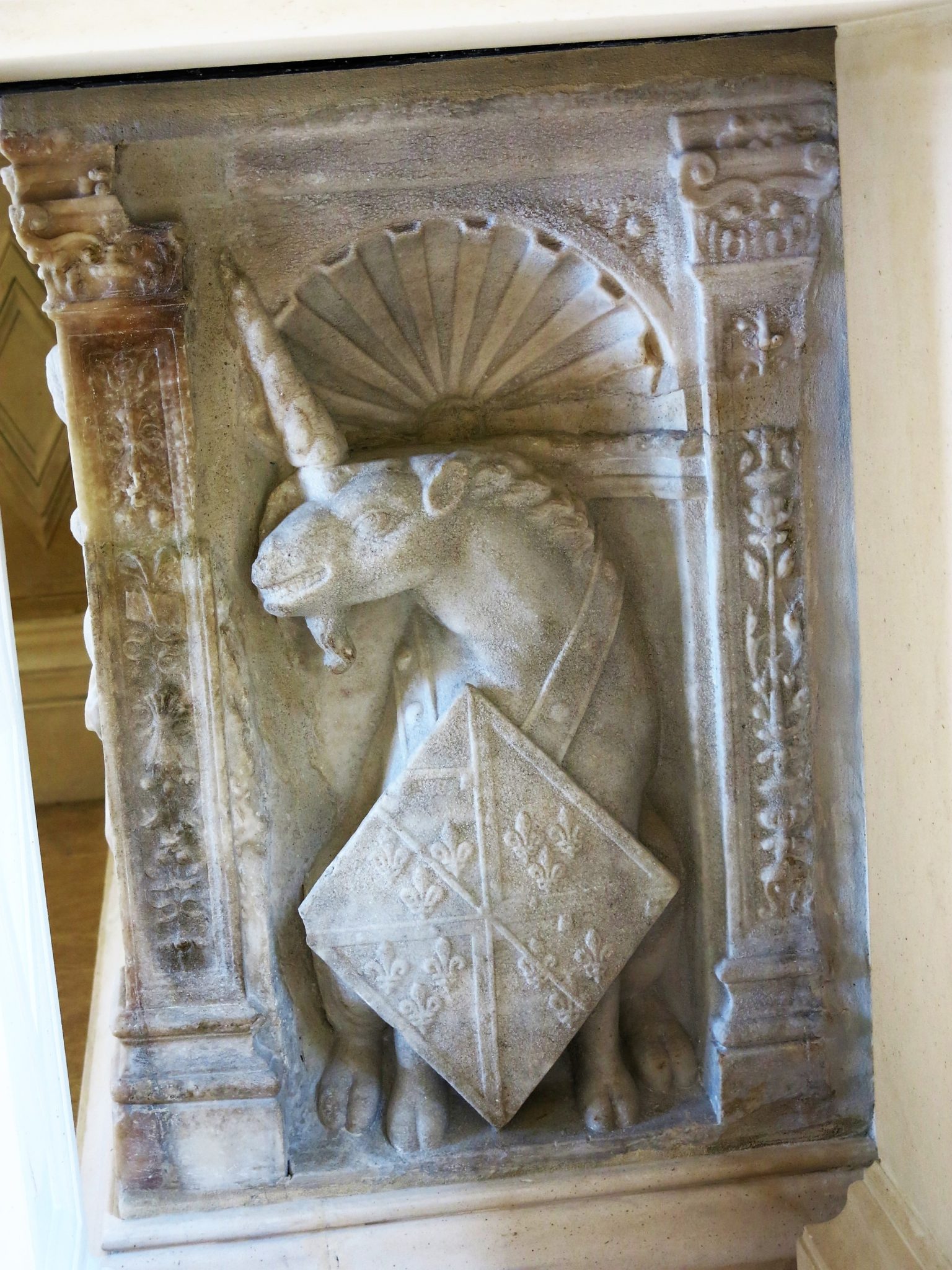
Sur les tableaux, la licorne symbole de virginité, ou du moins de pureté, peut aussi se faire plus discrète. Quand on la voit sur un tombeau alors qu’elle ne supporte habituellement pas les armes familiales, c’est souvent pour figurer la pureté d’une fille morte trop jeune.

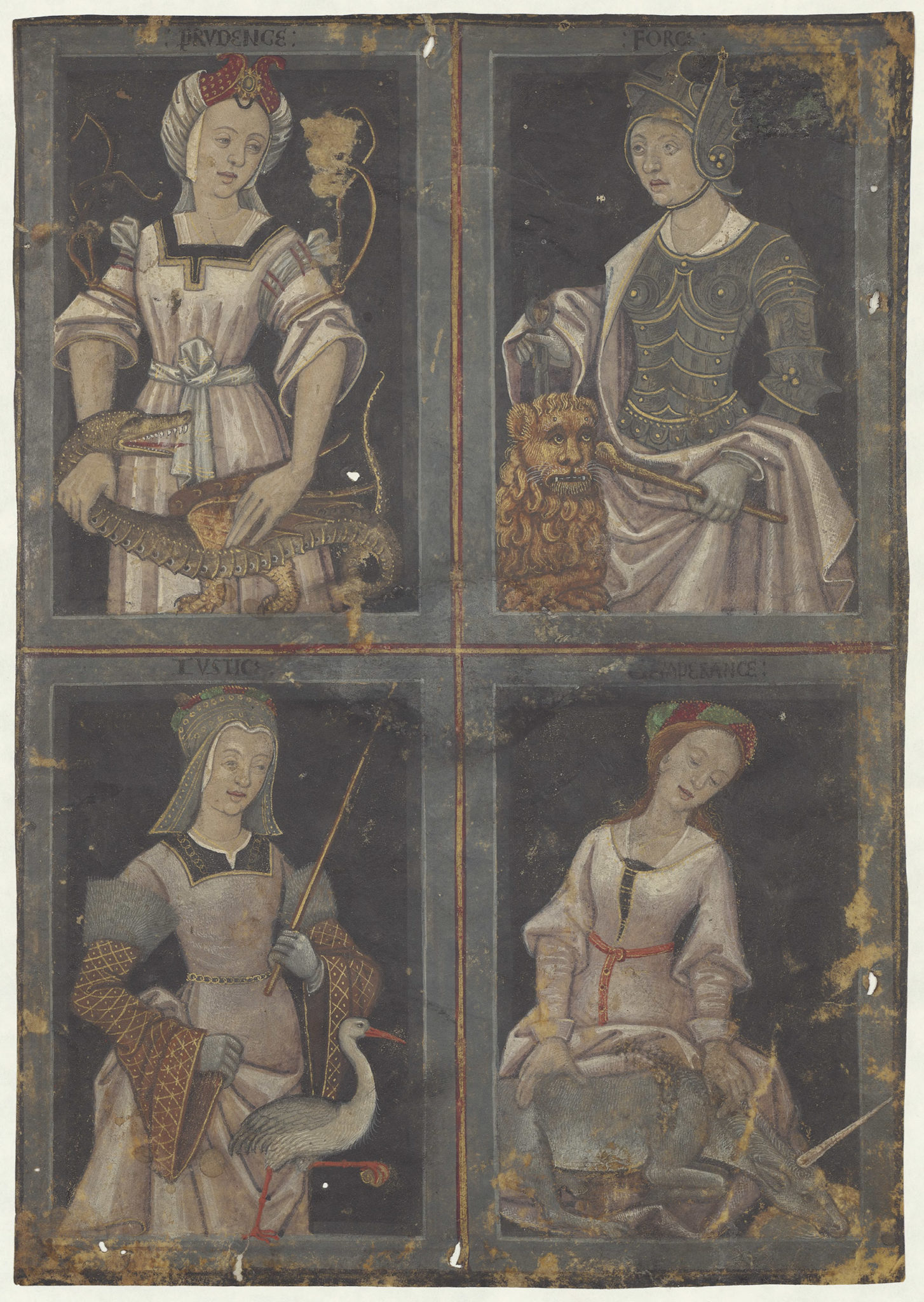
La licorne symbolise encore la chasteté dans un contexte chrétien, comme dans les nombreuses représentations des vertus, mais se retrouve aussi associée à des vierges qui n’ont rien de chrétien, comme Diane ou les vestales.

L’âne blanc

Il y avait des serpents à l’endroit où se trouvaient les vieilles pierres, mais l’herbe y poussait si verte et si drue, que chaque jour Sita y ramenait les chèvres. Nana lui dit : « Les chèvres ont l’air bien grasses. Sita, où les emmènes-tu paître ? » Et quand Sita répondit : « Dans la forêt, là où se trouvent les vieilles pierres », Nana dit : « C’est bien loin, pour les y emmener », et l’oncle Hira ajouta : « Fais attention aux serpents à cet endroit-là » ; mais en prononçant cela, ils pensaient aux chèvres, et non à elle ; c’est pourquoi, finalement, elle ne leur posa aucune question au sujet de l’âne blanc. Elle avait vu l’âne pour la première fois un jour où elle déposait des fleurs sur la pierre rouge située sous le figuier sacré, en bordure de la forêt. Elle aimait cette pierre. C’était la Déesse, déjà bien vieille, toute en rondeurs, qui était là, assise confortablement parmi les racines de l’arbre. Chacun de ceux qui passaient par là laissait quelques fleurs à la Déesse, ou lui versait de l’eau, et à chaque printemps, sa peinture rouge devait être ravivée. Sita offrait une fleur de rhododendron à la Déesse, lorsqu’elle se mit à regarder autour d’elle, pensant qu’une des chèvres s’égarait dans la forêt ; mais ce n’était pas une chèvre. C’était un animal blanc, encore plus blanc qu’un taureau de brahmane, qui avait attiré son regard. Intriguée, Sita le suivit pour le voir de plus près. Quand elle vit sa croupe bien faite et toute ronde, avec une queue semblable à une corde munie d’une petite touffe au bout, elle sut que c’était un âne ; oh, mais un si bel âne ! À qui appartenait-il donc ? Dans le village, il y avait trois ânes, et Chandra Bose en possédait deux ; tous trois étaient gris, osseux, tristes, de vraies bêtes de somme. Alors que celui-ci était grand, avec un pelage soyeux : c’était un âne délicat, un âne merveilleux. Ce n’était pas possible, il ne pouvait appartenir à Chandra Bose, ni à quiconque dans le village, ni même à personne d’autre dans le village voisin. Il ne portait ni licol ni harnais. Il devait être sauvage ; il devait vivre seul dans la forêt. En effet, quand elle siffla l’astucieuse Kala pour rassembler les chèvres et suivre ainsi les traces de l’âne blanc dans la forêt, ils passèrent d’abord par un sentier, pour arriver enfin à l’emplacement des vieilles pierres, là où les blocs taillés sont aussi grands que des maisons, tous à moitié enfouis sous terre et recouverts d’herbes et de plantes grimpantes kerala ; et l’âne blanc se tenait là, dans la pénombre des arbres, et la regardait. Elle pensa alors que l’âne était une divinité, parce qu’il avait un troisième œil au milieu du front, comme Shiva. Mais quand il se retourna, elle vit que ce n’était pas un œil, mais une corne – non pas courbe comme celle d’une vache ou d’une chèvre mais aussi droite et effilée que la ramure d’un daim – une corne unique, entre les yeux, comme l’œil de Shiva. Peut-être était-ce une sorte d’âne divin ; c’est pourquoi elle cueillit une fleur jaune dans les plantes grimpantes kerala, et, tendant sa paume ouverte, elle la lui offrit.
Pendant un instant, l’âne blanc, immobile, les observa, elle, les chèvres, et la fleur ; puis, se glissant lentement entre les grandes pierres, il se rapprocha d’elle. Il avait les sabots fendus comme les chèvres et se déplaçait avec encore plus d’agilité qu’elles. Il accepta la fleur. Son museau était blanc rosé, et Sita en sentit la grande douceur quand il flaira sa main. Elle cueillit rapidement une autre fleur, et à nouveau l’âne l’accepta. Mais quand elle voulut lui caresser la tête, à proximité de la corne blanche, courte, torsadée, et près des oreilles blanches et nerveuses, il s’éloigna, tout en la regardant de biais, avec ses yeux sombres et allongés. Sita avait un peu peur de lui, et elle pensa que, peut-être, il avait aussi un peu peur d’elle ; c’est pourquoi elle s’assit sur l’une des pierres à moitié enfouies, et fit mine de regarder les chèvres, toutes occupées à paître la meilleure herbe qu’elles aient eue depuis des mois. Aussitôt l’âne s’approcha de nouveau, et, se tenant près de Sita, posa son menton avec sa petite barbiche bouclée sur ses genoux. Le souffle de ses naseaux agitait les fins bracelets de verre qu’elle portait aux poignets. Lentement et avec beaucoup de douceur, elle lui caressa la tête en plusieurs endroits : là où prennent naissance les oreilles blanches et nerveuses ; à la base de la corne, là où se dressent les beaux poils durs ; puis sur le museau soyeux ; et l’âne blanc se tenait près d’elle, avec sa respiration au souffle long et chaud. Depuis lors, elle amenait chaque jour les chèvres à cet endroit, marchant avec précaution à cause des serpents ; les chèvres devenaient grasses ; et l’âne son ami sortait chaque jour de la forêt, et acceptait son offrande, et lui tenait compagnie. « Un taurillon et cent roupies comptant, dit l’oncle Hira, tu es folle si tu crois qu’on va pouvoir la marier pour moins que ça ! – Moti Lal est un homme paresseux, répondit Nana. Sale et paresseux. – Justement ! Il veut une femme qui travaille pour lui et fasse son ménage ! Et pour l’avoir, il se contentera d’un taurillon et de cent roupies comptant ! – Peut-être qu’une fois marié, il se stabilisera », dit Nana. Et c’est ainsi que Sita fut fiancée à Moti Lal, de l’autre village, qui l’avait regardée, chaque soir, ramener les chèvres à la maison. Elle avait bien vu qu’il l’observait de l’autre côté de la route, mais quant à elle, elle ne l’avait jamais regardé. Elle ne voulait pas le regarder. « C’est le dernier jour », dit-elle à l’âne blanc, pendant que les chèvres broutaient l’herbe au milieu des grandes pierres sculptées qui jonchaient le sol, et qu’autour d’eux la forêt les enveloppait dans le chant du silence. « Demain, je viendrais avec le petit frère de Uma, afin de lui montrer le chemin qui mène jusqu’ici. C’est lui qui sera maintenant le gardien des chèvres du village. Après-demain, ce sera mon mariage. » L’âne blanc demeurait immobile, sa barbiche soyeuse et bouclée reposant dans le creux de sa main. « Nana va me donner son bracelet d’or, dit Sita à l’âne. Je porterai un sari rouge, et j’aurai du henné sur les pieds et les mains. » L’âne demeurait toujours immobile, et écoutait.
« Au mariage, il y aura du riz sucré à manger », dit Sita ; puis elle se mit à pleurer. « Adieu, bel âne blanc », dit-elle. L’âne blanc la regarda furtivement, puis lentement, sans jeter un regard en arrière, il s’éloigna d’elle, et s’enfonça dans la pénombre des arbres.

Ursula Le Guin, L’âne blanc, 1982